Subject
How the structures around you actually hold themselves up. Concrete, steel, bridges, earthquake design — the engineering hiding in plain sight in every city.
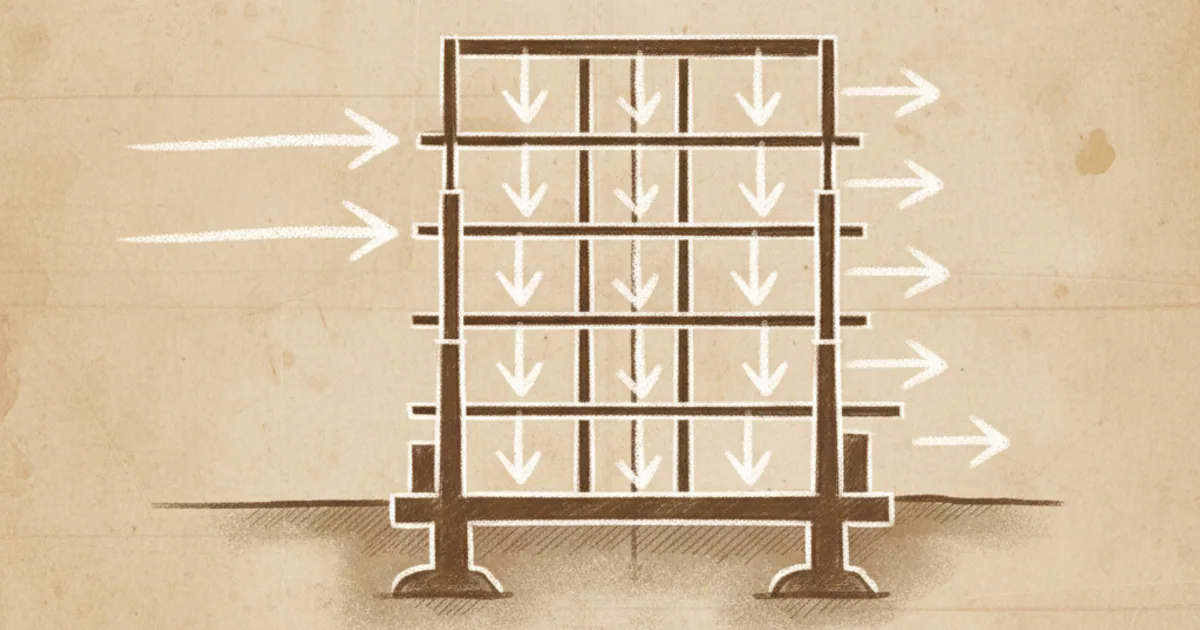
Walk into any building and look up. There's a ceiling, a floor above it (or a roof), maybe a wall in the way. All of these are heavy. Concrete is roughly 2,400 kg/m³. Steel is about 7,850. A typical floor in a residential building weighs around 200-300 kg/m² before you add people and furniture.
So why doesn't all this come down on your head?
Because every gram of weight is connected to the ground through a chain of structural members that can carry it. Floors rest on beams. Beams rest on columns. Columns transfer load down to lower columns, eventually reaching the foundation, which spreads the load over enough soil that the building doesn't sink.
Structural engineering is the discipline of designing that chain — making sure every load has a clean path to the ground, through materials and shapes that can handle the specific kind of force each part faces.
A building deals with several distinct kinds of force, not just gravity:
Dead load — the permanent weight of the structure itself. Walls, floors, roof, fixed equipment. Largest in most buildings.
Live load — the variable weight of what's inside. People, furniture, books, water in pipes. Building codes specify minimum live loads per floor type (residential floors typically 1.5-2 kN/m², offices 2.5-4 kN/m², libraries 7 kN/m², warehouses much higher).
Snow load — important in cold climates. Wet heavy snow on a flat roof can add hundreds of kg/m². Some collapsed roofs in the 2018 Carolinas snowfall happened because the snow exceeded design loads.
Wind load — pushes sideways and creates suction on the lee side. Increases with height and exposure. Important for everything taller than a few stories.
Earthquake load — sudden ground motion. Different mechanism from wind: it shakes the building's base, and the building's mass resists due to inertia, creating dynamic forces. See how buildings survive earthquakes.
Thermal expansion — buildings expand and contract with temperature changes. Long structures need expansion joints or they'll crack.
Settlement — soil shifting under load. Foundations are designed to limit and accommodate this.
A structural engineer designs for all of these acting in realistic combinations, with safety factors that ensure the building handles loads well beyond the worst plausible case.
Materials respond differently depending on how they're being loaded. The two fundamental cases:
Compression: forces pushing inward, squeezing the material together.
Tension: forces pulling outward, stretching the material apart.
Different materials handle compression and tension very differently:
Reinforced concrete is a clever composite: concrete for compression, steel rebar embedded inside for the tension parts. Together they handle the full range of forces in beams, slabs, and walls.
Most floors and roofs span between supports using beams. A simply-supported beam (resting on two supports with a load in the middle) bends slightly. The top of the beam compresses (gets shorter); the bottom stretches (extends). The middle is in neither.
This is why I-beam shapes are so common in steel construction: the top and bottom flanges (the horizontal bars) carry the compression and tension where they matter most, while the thin vertical web in the middle just keeps the flanges apart. Almost all the material is doing work; very little is wasted.
For larger spans, beams become trusses: triangulated frameworks where each member is in pure tension or compression rather than bending. Railway bridges, roof spans, and tower bases often use trusses for this reason.
The maximum span of a single beam depends on the material and depth:
Columns carry vertical loads down. Each column carries the weight of everything above it — its own weight, the beams resting on it, the columns above it, the floors above, the roof.
A column's main risk is buckling: under enough load, a slender column suddenly bows sideways and fails catastrophically rather than just crushing. The longer and thinner the column, the more vulnerable it is. Steel columns in tall buildings are stocky for this reason; tall slender columns need bracing.
The Roman engineering insight: arches and vaults turn what would be bending forces into pure compression. An arch carries weight by pushing outward against its abutments rather than bending under load. This is why so much Roman infrastructure (aqueducts, the Pantheon's dome) is still standing 2,000 years later — stone in pure compression doesn't fail.
Eventually all loads reach the soil. Foundations spread the building's load over enough area that the soil can support it without excessive settlement.
Foundation types:
Spread footings: square or rectangular concrete pads under each column. Common in small buildings on firm soil.
Strip footings: continuous concrete strips under load-bearing walls. Common in residential foundations.
Mat (raft) foundations: a single large concrete slab under the whole building. Used when soil is weak or loads are very heavy.
Piles: long columns driven or drilled deep into the ground until they reach firm soil or rock. Used when surface soil is poor. Skyscrapers in soft soil cities (much of central Boston, parts of Chicago, central London) sit on piles going 20-50+ m down.
Caissons: very large diameter (1-5+ m) drilled piles. Some major bridges and skyscrapers rest on these.
Soil mechanics is a whole branch of engineering: soils have different compression, drainage, and lateral support properties. A foundation that's perfect on one soil is wrong for another.
For tall buildings, the dominant design challenge is often lateral (sideways) loads — wind, earthquake. The vertical structure handles gravity easily; resisting sideways shaking is the harder problem.
Common solutions:
Moment frames: beams and columns rigidly connected so the whole frame resists sideways loads through bending. Flexible but limited in height.
Braced frames: diagonal members (think X-shapes) between columns. Triangulate the frame so it can't deform sideways. Stiffer than moment frames; visible in many industrial and seismic-resistant buildings.
Shear walls: solid walls (usually concrete) that resist sideways loads through their in-plane stiffness. Often around stairs, elevators, and at the building perimeter.
Cores: stiff central tower (often shear walls) around the elevator and stair shafts. Most modern tall buildings have a central core that does most of the lateral resistance work.
Outrigger systems: in supertall buildings, horizontal trusses ("outriggers") connect the central core to outer columns, dramatically improving the building's resistance to overturning.
Damped systems: in the very tallest buildings, mechanical dampers (huge masses that swing or slide opposite to building motion) reduce sway. The Taipei 101 has a famous 660-ton steel ball pendulum visible from a public viewing platform.
The taller a building, the more the lateral system dominates the design. A 50-story tower spends most of its structural budget resisting wind, not gravity.
A common building failure mode — especially in smaller residential structures — is interrupted load paths from unengineered renovations.
Someone removes a load-bearing wall to open up a kitchen-living-room space. The columns or beams above that wall now have nothing supporting them. If the renovation didn't install a new beam or post to replace the load path, the floor above will sag — slowly at first, then with cracks, then potentially with collapse.
Modern building codes (such as the International Existing Building Code in the US, and equivalents elsewhere) typically require engineered review for alterations that affect load-bearing elements, though specific thresholds and enforcement vary by jurisdiction. Across all failure types, the leading causes documented in failure-investigation databases also include construction or design errors, material deterioration, and extreme loads (earthquake, wind, fire, impact) — but unauthorized load-path changes remain a real and preventable cause of partial collapse.
Other common failures:
The two dominant structural materials of the modern era are reinforced concrete and structural steel, often in combination. Why?
Concrete:
Steel:
Together: reinforced concrete for foundations, floor slabs, and columns; steel for beams, trusses, and lateral systems. Many tall buildings combine the two in hybrid systems optimized for cost and performance.
Wood is making a comeback for mid-rise buildings with engineered timber products (CLT — cross-laminated timber, glulam — glued laminated timber). These can span larger distances than traditional lumber while remaining lightweight and carbon-storing.
Masonry (brick, stone, concrete block) is still common for low-rise construction, though reinforced concrete and steel dominate above 4-5 stories.
If you'd like a guided 5-minute course on how structures actually work, NerdSip can generate one.
Buildings stay up because every load — the building's own weight, occupants, snow, wind, occasional earthquakes — has a continuous path through structural members down to the ground. Materials are chosen for the forces they'll face: stone and concrete in compression, steel and cables in tension, reinforced concrete combining both. Beams handle bending, columns handle vertical loads, foundations spread loads into the soil, and lateral systems resist sideways forces. Modern engineering combines centuries of accumulated wisdom with material science and computation, producing structures designed with explicit safety margins above expected loads — though safety factors are finite and high-profile collapses still happen when extreme combinations of loads, construction errors, or deterioration overwhelm those margins. The cluster articles cover the specific players — concrete, steel, bridges, earthquake design — in more detail.
A short editorial reading list. Pick whichever fits how you like to learn.


Comments 0
No comments yet. Be the first to share your thoughts.