
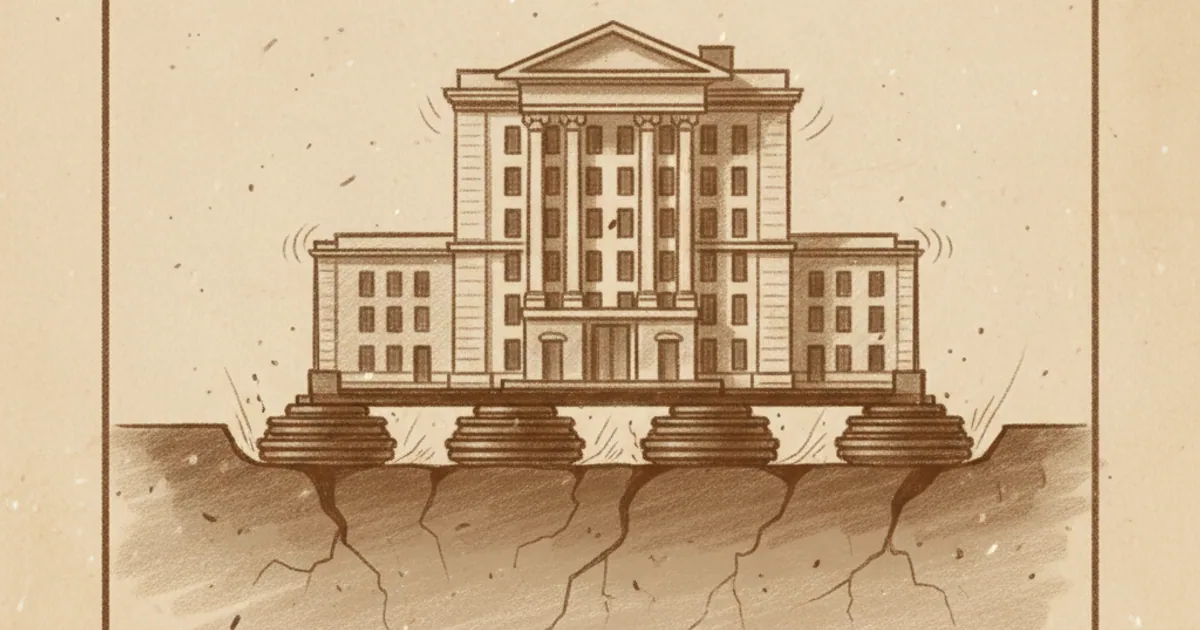
What an earthquake does to a building
An earthquake is the sudden release of energy from rocks deep underground, sending seismic waves through the earth. At the surface, this manifests as ground motion — the ground accelerates, decelerates, reverses direction, repeatedly, over seconds to minutes.
Now imagine a building sitting on the ground when this happens. The foundation moves with the ground. But the upper floors — which weigh a lot — don't want to. Their mass resists changes in motion (Newton's first law). The result: the foundation moves one way while the upper part of the building, briefly, doesn't.
This creates large sideways forces throughout the structure. The taller and heavier the building, the larger the forces. The faster the ground accelerations, the larger the forces. The closer the building's natural frequency to the earthquake's dominant frequency, the worse the resonance.
A building that wasn't designed for earthquakes can't handle these forces. Walls crack, columns crush, connections break, and in worst cases, the building collapses (often "pancaking" — floors falling on top of each other).
A building that was designed for earthquakes turns this same motion into manageable, even survivable, stresses. The structure may be damaged but it doesn't collapse.
The three goals (in priority order)
Modern seismic codes in earthquake-prone regions generally pursue three performance goals, roughly in this priority order:
1. No collapse in the design earthquake. Even in a severe earthquake, the building stays standing. Occupants can evacuate; lives are saved. This is the central life-safety goal in modern seismic codes (ASCE 7/IBC in the US, Eurocode 8 in Europe, NZS 1170.5 in New Zealand, Japan's Building Standard Law). Many countries have only partial or regional seismic provisions, and even where codes are strong, enforcement varies — the 2023 Türkiye-Syria earthquake highlighted what happens when codes exist but aren't applied.
2. Limited damage in moderate earthquakes. In smaller, more frequent earthquakes, damage should be limited so the building can be repaired economically. Modern codes increasingly target "rapid recovery" rather than just survival.
3. Continued functionality for critical buildings. Hospitals, fire stations, emergency operations centers, schools used as shelters need to remain functional even after major earthquakes. These get higher design requirements (importance factors or specific "immediate occupancy" or "operational" performance objectives).
The exact requirements depend on the seismic hazard at the building site and the building's importance. Ordinary buildings under most national codes are designed primarily for life safety; functionality after a design earthquake is targeted only for critical facilities.
The seismic design strategies
Engineers have several tools for handling earthquake loads:
1. Lateral load-resisting systems
The structural skeleton needs to be stiff enough sideways to handle the forces without excessive deformation. Common systems:
Moment frames: beams and columns rigidly connected so they resist lateral loads through bending. Flexible (which is OK for moderate earthquakes if detailed for ductility). Used widely in mid-rise steel buildings.
Braced frames: diagonal members between columns. Stiff, but tend to be brittle unless special "ductile" bracing is used.
Shear walls: solid concrete walls oriented to resist lateral loads. Very stiff. Common in residential high-rises.
Reinforced concrete cores: stiff concrete towers (around stairs and elevators) doing most of the lateral resistance. Standard in modern high-rises.
Outrigger systems: in supertall buildings, horizontal trusses connecting the central core to outer columns, improving lateral resistance.
Different systems behave differently. The strategy is matched to the building's geometry, occupancy, and seismic hazard.
2. Ductile detailing
When seismic forces exceed what the structure can handle elastically (without permanent deformation), parts of the structure will deform plastically (permanently). The key is that this deformation must be controlled and gradual, not sudden and catastrophic.
Ductile behavior means the material bends and yields under load but doesn't fracture. Brittle behavior means it suddenly snaps. Ductile failure absorbs energy; brittle failure releases it.
Detailing for ductility:
- Closely spaced ties around concrete columns confine the core concrete, allowing it to deform without crushing.
- Capacity-design principle: strong columns connected to weaker beams, so beams yield first (which is repairable; column failure can cause collapse).
- Avoiding "soft stories": floors where columns are much weaker than the floors above and below. Common cause of collapse in older buildings.
- Connection details: bolted, welded, and concrete-embedded connections designed to resist the full ductile strength of connected members.
Buildings designed without these details — especially those built before modern codes — are vulnerable to brittle failure in moderate-to-large earthquakes.
3. Energy dissipation
The earthquake's energy has to go somewhere. If the building stores all of it elastically (like a spring), the deformations get very large. If the building converts some of it to heat or distributes it into intentionally-damaged elements, the deformations stay manageable.
Modern approaches to dissipation:
Viscous dampers: fluid-filled cylinders (like giant car shock absorbers) that resist motion. Convert kinetic energy to heat. Mounted in braces between floors.
Friction dampers: clamped plates that slip past each other under load, dissipating energy through friction.
Yielding dampers: specifically designed elements (sometimes called "structural fuses") that yield in a controlled way during severe shaking, absorbing energy while protecting the main structure.
Tuned mass dampers: huge sliding or swinging masses (often near the top of tall buildings) that move opposite to the building's motion, reducing sway. The 660-ton tuned mass damper in Taipei 101 is famous (and visible from a public viewing platform).
Energy-dissipation devices are added to many modern critical buildings and seismic retrofits. They're effective but add cost and complexity.
4. Base isolation
The most dramatic approach. Instead of trying to make the building survive ground motion, decouple the building from the ground entirely.
Base isolation places flexible bearings between the foundation and the rest of the building. Common types:
Lead-rubber bearings (LRBs): alternating layers of steel and rubber (often with a lead core for energy dissipation). The rubber allows horizontal motion; the steel layers prevent vertical compression of the rubber.
Friction pendulum bearings: a slider sitting in a curved (concave) dish. The building can slide horizontally; the curvature of the dish creates a restoring force that returns the building to center.
Sliding bearings: simpler sliding interfaces, sometimes with friction-modifying coatings.
How it works: during an earthquake, the ground accelerates sharply. The bearings allow the foundation below them to move with the ground while the building above stays relatively still due to inertia. The acceleration the building experiences is much lower than the ground acceleration.
Base isolation can reduce the seismic forces experienced by a building by 70-90%. It's expensive — typically 2-15% of the total building cost — and requires careful detailing of utilities (gas, water, electricity, sewer) crossing the isolation gap. But for critical buildings (hospitals, museums, emergency centers), it's increasingly standard.
Famous base-isolated buildings include:
- Many hospitals in California, Japan, and New Zealand.
- The Foothill Communities Law and Justice Center (the first major US building on base isolation, 1985).
- The Apple Park in California uses base isolation.
- The Tokyo Sky Tree has tuned mass dampers in its core.
- LACMA has retrofitted some pavilions onto base isolators.
- New Zealand's Parliament Buildings ("the Beehive") and the National Library have been base-isolated.
5. Building geometry
The building's overall shape affects how it responds:
Regular and symmetric buildings perform better. Asymmetric buildings tend to twist during earthquakes ("torsion"), concentrating damage at specific points.
Tall thin buildings can sway dramatically; they need stiff lateral systems.
Discontinuities in stiffness or mass cause problems. The classic "soft story" failure mode (where the ground floor is much weaker than upper floors, often because it's open for parking or commercial use) has killed thousands of people in past earthquakes.
Tuning the natural frequency away from likely earthquake frequencies. The dominant period of a typical earthquake is 0.2-2 seconds; tall buildings with natural periods in this range can resonate badly. Some designs deliberately make buildings either much stiffer or much more flexible than this range.
Why some earthquakes are worse for buildings than others
Earthquakes vary in:
Magnitude: total energy released. Each unit increase in magnitude is roughly 32x more energy.
Distance: ground motion attenuates with distance from the rupture. Same magnitude, less damage farther away.
Duration: how long shaking lasts. Longer durations cause more cumulative damage; subduction zone earthquakes (Cascadia, Japan) can shake for minutes.
Frequency content: most damage comes from waves with periods matching the building's natural period.
Site conditions: soft soil amplifies shaking (sometimes 2-5x compared to bedrock). The 1985 Mexico City earthquake was 350 km from its epicenter but caused devastating damage in the city because the ancient lakebed soil amplified specific frequencies that matched mid-rise buildings.
Directionality: certain directions can have larger ground motions than others, depending on the fault rupture geometry.
A magnitude 7 earthquake can be barely felt at a site on bedrock 200 km away, or devastating at a site on soft soil 50 km away. The site matters enormously.
What goes wrong
Common earthquake-induced failures:
Pancake collapse: floors fall on top of each other after columns fail. Common in older concrete frame buildings without ductile detailing. Lethal to occupants.
Soft-story collapse: ground floor with open spans (parking, retail) fails first, dropping upper floors. Happened repeatedly in Christchurch (2011), Mexico City (1985, 2017), San Francisco (1989 Loma Prieta).
Liquefaction: saturated sandy soils lose strength during shaking and behave like liquid. Buildings can tilt, sink, or topple — without the structure itself failing. Famous in the 1964 Niigata earthquake (Japan) and 2011 Christchurch.
Falling exterior elements: cornices, parapets, claddings, chimneys falling onto streets. Major hazard. Modern codes require these to be anchored.
Internal hazards: falling ceilings, light fixtures, unsecured furniture and equipment. Hospitals are required to secure equipment specifically.
Fire after earthquake: gas lines rupture, electrical systems short, fires start. The 1906 San Francisco earthquake's fires destroyed more buildings than the shaking. Modern codes require seismically activated gas shutoffs.
What retrofits look like
Older buildings can be retrofitted to perform better in earthquakes:
Adding shear walls or braces: increasing lateral stiffness.
Connecting roofs to walls: many older buildings have inadequate connections between floor/roof diaphragms and walls.
Strengthening columns: wrapping columns with steel jackets or fiber-reinforced polymers to confine the concrete and prevent crushing.
Base isolation retrofit: cutting the building's columns at the foundation and inserting isolators. Expensive but dramatic in effect.
Removing soft stories: filling in the open ground floor, or adding bracing.
Securing nonstructural elements: cornices, glass, false ceilings, equipment, water heaters.
San Francisco, Los Angeles, Tokyo, Wellington, and Istanbul all have ongoing seismic retrofit programs. Older buildings in seismic regions are routinely identified, assessed, and upgraded.
A few specific notable lessons
A handful of past earthquakes shaped modern seismic engineering:
1906 San Francisco: tested early steel-frame buildings (mostly survived) and showed brick masonry was inadequate (mostly didn't).
1971 San Fernando (California): showed reinforced concrete buildings needed ductile detailing, not just strength.
1985 Mexico City: demonstrated site effects (soft soil amplification) and the deadliness of mid-rise concrete frame buildings without ductile detailing.
1989 Loma Prieta (California): showed soft-story buildings collapsing and led to retrofit requirements.
1994 Northridge (California): exposed problems with steel moment-frame welded connections that hadn't been recognized before.
1995 Kobe (Japan): catastrophic, but provided huge data on building performance. Drove adoption of base isolation, energy dissipation, and improved codes.
2010-2011 Christchurch (New Zealand): caused major liquefaction and collapse of older buildings, leading to extensive retrofit requirements.
2011 Tōhoku (Japan): earthquake damage was less than tsunami damage, but the earthquake exposed nuclear plant vulnerabilities and led to new tsunami-aware building codes.
2023 Turkey-Syria: revealed widespread code-violation construction (poor concrete, missing rebar, modified columns) as the primary cause of mass casualties. Demonstrated that codes only help if enforced.
Each earthquake teaches the field something. Modern seismic engineering accumulates these lessons into ever-better codes and practices.
If you'd like a guided 5-minute course on earthquake engineering and what makes buildings safer, NerdSip can generate one.
The takeaway
An earthquake shakes the ground beneath a building; the building's mass resists changing direction, creating large sideways forces. Modern seismic design uses several strategies: stiff lateral load-resisting systems (braces, shear walls, cores), ductile detailing so members bend rather than shatter, energy dissipation devices (dampers), and sometimes base isolation that decouples the building from the ground. The goal is life safety in major earthquakes and limited damage in moderate ones. Building codes in seismically active regions (Japan, New Zealand, parts of US, Chile, Italy, Turkey) encode these strategies, and the field continually evolves based on lessons from each new earthquake. Where codes are followed and enforced, deaths and damage in earthquakes are dramatically reduced; where they aren't, traditional construction remains catastrophically vulnerable.

Comments 0
No comments yet. Be the first to share your thoughts.