
A pinch of carbon
Walk past a construction site. The girders being lifted into place are steel — gleaming I-beams that will support thousands of tonnes once the building is complete. Inspect closely and you'd find the same beams couldn't be made of pure iron at the same size and weight; pure iron is too soft, too easily deformed.
What turns soft iron into structural steel? A small amount of carbon, plus sometimes other elements. Typically 0.05% to 2.1% carbon by weight — a pinch in an otherwise-iron lump.
That tiny addition changes everything. Steel is dramatically harder and stronger than iron, ductile enough to bend rather than shatter, and amenable to a huge range of heat treatments and alloying combinations that produce wildly different properties for different uses.
Cheap mass-produced steel, made affordable in the late 19th century, underpins almost every skyscraper, every railway, most cars, and most modern bridges — usually in combination with concrete, aluminum, and composites. Much of the visible infrastructure of modern civilization depends on steel somewhere in its structure.
What's actually happening at the atomic scale
To understand why a tiny amount of carbon makes such a difference, you need to picture what's happening between iron atoms.
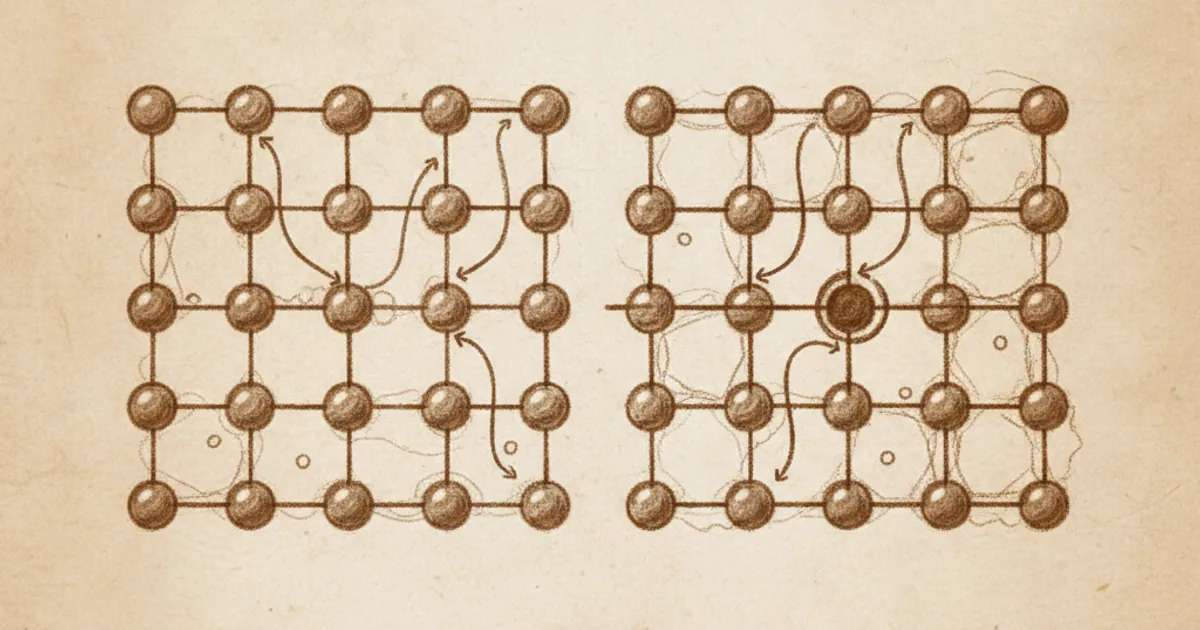
In pure iron at room temperature, atoms arrange in a regular body-centered cubic (BCC) crystal lattice — a 3D grid where each atom has 8 neighbors at the cube corners and one at the center. The structure is orderly but not rigid; under enough force, layers of atoms can shift past each other through tiny defects called dislocations that move through the crystal.
Dislocation movement is what allows metals to deform plastically — to bend rather than break. It's also what makes them relatively soft. The easier dislocations move, the more easily the metal deforms.
When you add carbon, two things happen:
1. Carbon atoms wedge into the iron crystal. Carbon atoms are much smaller than iron atoms — small enough to fit into the gaps ("interstitial sites") between iron atoms in the lattice without replacing them. These wedged-in carbon atoms distort the local crystal structure, making it harder for dislocations to slip past.
2. Iron carbide phases form. With enough carbon and the right temperature, some of the carbon combines with iron to form iron carbide (Fe₃C, also called cementite). This is a separate, very hard phase distributed through the iron matrix. The combination of soft iron with hard carbide regions creates a tougher composite.
The result: dislocations can't move as freely, the material resists deformation, and the steel is dramatically stronger than pure iron.
The exact behavior depends on the microstructure — how the iron, iron carbide, and other phases are arranged at microscopic scales. Two pieces of steel with the same composition can behave very differently depending on how they were heated, cooled, and worked.
The Goldilocks range of carbon
More carbon isn't always better:
- 0.0-0.05% carbon: very low-carbon steel (sheet metals, wire products). Soft, ductile, easy to weld and form. Used for car body panels, structural shapes, wire. Note: historical wrought iron is a separate product — almost-pure iron with a small amount of slag mixed in, made by puddling rather than modern steelmaking; it's not typically classified as steel.
- 0.05-0.3% carbon: low-carbon (mild) steel. Most common structural steel — I-beams, plates, structural shapes, automotive frames. Good balance of strength, toughness, and weldability.
- 0.3-0.6% carbon: medium-carbon steel. Harder, stronger. Used for shafts, axles, gears.
- 0.6-1.0% carbon: high-carbon steel. Very hard, less ductile. Used for tools, springs, knife blades.
- 1.0-2.1% carbon: very high-carbon (tool) steels. Hard and wear-resistant but more brittle. Used for cutting tools, dies.
- Above ~2.1% carbon (typically up to ~4.3%): this isn't steel anymore; it's cast iron. Very hard, very brittle, cracks rather than bends. Easy to cast into complex shapes (engine blocks, cookware, manhole covers) but unsuitable for structural beams.
Steel's range is the sweet spot: enough carbon to be hard and strong, not so much that it's brittle. The ~2.1% boundary is a useful rule of thumb from the iron-carbon phase diagram (the eutectic system); beyond it, the metallurgy fundamentally changes.
Heat treatment changes everything
Two pieces of steel with the same composition can be VERY different depending on how they're heat-treated:
Annealing: heat to high temperature, then cool slowly. The metal becomes soft, ductile, easy to machine.
Normalizing: heat then cool in air. Refines the grain structure for more uniform properties.
Quenching: heat to high temperature, then cool very fast — typically in water, oil, brine, or polymer solutions (air cooling counts as a "quench" only for certain high-hardenability alloy steels). Locks in a hard, brittle structure called martensite. Very strong but cracks easily.
Tempering: after quenching, reheat to a moderate temperature. Reduces brittleness while keeping much of the strength. Most hardened steel parts (knife blades, hammers, springs) are quenched and tempered.
Case hardening: harden only the surface (by adding carbon at the surface only, then heat-treating). Gives a tough core with a wear-resistant surface — used for gears, shafts, bearings.
Different combinations produce wildly different properties. The art of metallurgy is largely the art of controlling heat treatment.
Alloying: other elements join carbon
Modern steels usually contain other elements beyond just iron and carbon, each contributing specific properties:
Manganese (most steels, 0.5-2%). Improves hardenability and strength. Almost universally present.
Chromium (4%+ in chrome steels, 10.5%+ in stainless). Improves hardenability, hot strength, and corrosion resistance.
Nickel (some structural steels, 8%+ in austenitic stainless). Improves toughness and corrosion resistance.
Molybdenum (some structural and tool steels). Improves high-temperature strength and hardenability.
Vanadium (high-strength low-alloy steels, some tool steels). Refines grain, increases strength and toughness.
Silicon (springs, electrical steels). Strengthens, used in electrical-grade steels for transformers.
Tungsten (high-speed tool steels). Maintains hardness at high temperatures, used in cutting tools that need to stay sharp while red-hot.
Sulfur (in small amounts in free-machining steels). Improves machinability but reduces ductility.
Phosphorus (usually controlled below 0.04%). Generally avoided as it causes brittleness, though tiny amounts can help machinability.
Different combinations create thousands of steel grades for specific uses: structural steel for buildings, ship plate for marine use, rail steel for tracks, tool steel for cutting, stainless steels for kitchens and medical equipment, electrical steel for transformer cores, weathering steel that develops a stable rust patina that protects the underlying metal (the Angel of the North sculpture in England is weathering steel).
How steel is made
The dominant modern processes:
Basic Oxygen Steelmaking (BOS). Molten iron (from a blast furnace) is poured into a converter. Pure oxygen is blasted into the molten iron, oxidizing excess carbon (burning it off as CO₂) and other impurities. Scrap steel is added to dilute. The result is liquid steel that can be cast into shapes. About 69-71% of world steel (worldsteel data, mid-2020s).
Electric Arc Furnace (EAF). Scrap steel and direct-reduced iron are melted in a furnace using electric arcs between graphite electrodes. Less energy than BOS (especially if scrap-based), more flexible, easier to switch grades. About 29-31% of world steel and growing — particularly important for electric cars and renewable infrastructure because EAF can run on renewable electricity.
Some emerging technologies:
Direct Reduced Iron (DRI) with hydrogen. Instead of reducing iron ore with coal in a blast furnace (producing CO₂), use hydrogen — producing water as the byproduct. Demonstration and early commercial projects are operating or under construction (Sweden's HYBRIT, Germany's H2 Green Steel, others). Widespread deployment depends on low-cost clean hydrogen and new shaft-furnace capacity. Could decarbonize a huge fraction of the steel industry.
Before modern mass production, the dominant routes included crucible steel (medieval and early industrial), puddling/wrought iron processes (18th-19th centuries), then the Bessemer process (1856) and open hearth process (later 19th century). Bessemer and open hearth made affordable mass-produced steel possible for the first time; both are now historical.
Steel's carbon footprint
Like concrete, steel has a serious CO₂ problem.
Conventional steelmaking (blast furnace + basic oxygen converter) produces roughly 1.8-2.0 tonnes of CO₂ per tonne of steel. Multiplied by ~1.9 billion tonnes of annual steel production, steel accounts for about 7-8% of global energy-related CO₂ emissions — comparable to cement.
The main source: blast furnaces use coke (a coal product) as both fuel and reducing agent to convert iron ore (mostly iron oxides) to metallic iron. The chemistry: Fe₂O₃ + 3 CO → 2 Fe + 3 CO₂. The CO₂ is a direct chemical byproduct of the iron-making.
Lower-carbon alternatives:
EAF on scrap steel: roughly 0.3-0.5 tonnes CO₂ per tonne of steel, varying widely with electricity mix and scrap quality. With low-carbon electricity, modern scrap-based EAF can fall well below 0.3. Already widely used; expanding.
Hydrogen-based direct reduction: nearly zero CO₂ if hydrogen is made from renewable electricity. Commercial plants starting up.
Carbon capture at blast furnaces: still mostly experimental at scale.
Steel recycling: every recycled tonne avoids most of the emissions of new steel. Already significant — steel is one of the most-recycled materials globally.
The steel industry's decarbonization is among the most important industrial transitions for climate goals.
Why steel transformed building
Before steel was affordable (pre-1860 or so), tall buildings were limited by what wrought iron and masonry could do. The Home Insurance Building in Chicago (1885), often called the first skyscraper, used a steel frame — and at 10 stories was unprecedented.
Steel enabled:
- Tall buildings: skyscrapers with steel frames could go many times higher than masonry-bearing-wall construction.
- Long-span bridges: railroads and suspension bridges needed materials that could handle the tensions involved.
- Mass railways: rails, locomotives, and rolling stock all needed steel.
- Shipbuilding: steel-hulled ships replaced wood and iron.
- Reinforced concrete: steel rebar made concrete useful for tension-bearing structures.
- Mass machinery: the entire industrial revolution accelerated with steel availability.
Per capita steel consumption is one of the clearest measures of industrialization. Countries industrialize, steel use peaks, then per capita use declines as economies shift to services and infrastructure becomes mature.
What steel can't do
Steel has real limits:
Heavy. Steel weighs ~7,850 kg/m³. For applications where weight is critical (aircraft, vehicles), aluminum, titanium, magnesium, and composites compete.
Corrosion. Plain steel rusts in moist environments. Stainless steel and weathering steel help, but for many uses you need paint, galvanizing, or careful design to manage corrosion.
Fire performance. Steel loses much of its strength above ~550 °C. Structural steel in high-rise buildings needs fire protection (concrete encasement or fire-resistant coatings).
Fatigue. Repeated loading and unloading can crack steel over time, especially at stress concentrations. Important for bridges, cranes, aircraft, rotating machinery.
Cost of high-grade steels. Common mild steel is cheap. High-performance tool steels, exotic alloys, and stainless can be very expensive.
If you'd like a guided 5-minute course on steel metallurgy and how alloys actually work, NerdSip can generate one.
The takeaway
Steel is iron with a small fraction of carbon (typically 0.05-2.1%) plus often other alloying elements. The carbon atoms distort the iron crystal lattice and pin dislocations, making the material dramatically stronger and harder than pure iron while still bending rather than shattering under load. Heat treatment and alloying produce thousands of different steel grades for specific uses. Cheap mass-produced steel, made possible by the Bessemer process and its successors in the late 19th century, is the structural backbone of modern civilization. Like cement, its production has a large CO₂ footprint that the industry is working to reduce through hydrogen-based reduction, EAF expansion, and recycling.

Comments 0
No comments yet. Be the first to share your thoughts.