
The basic problem
A bridge spans an obstacle — a river, a valley, a railway, a busy road. The structural challenge: support the bridge's own weight, plus the weight of vehicles and pedestrians crossing it, plus wind and (in some climates) earthquake or snow loads, all while remaining stiff enough to use without obvious bouncing.
Several strategies exist for getting loads from the middle of a span to the ground at either end. Each turns the load into forces the available materials can handle well. The major bridge types are different solutions to the same problem.
Beam bridges — the simplest
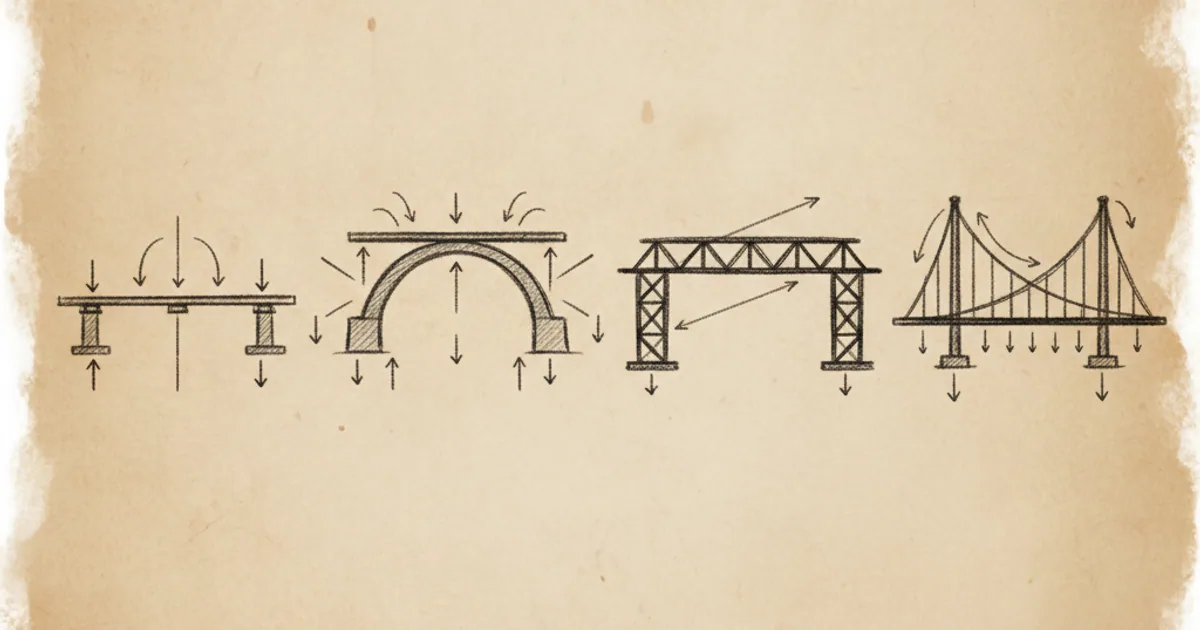
A beam bridge is exactly what it sounds like: a beam, supported at both ends, with loads in between. The bridge across a small creek, the overpass on a highway, the elevated guideway of a metro system — most short bridges in the world.
Under load, a beam bends. The top compresses; the bottom stretches. The middle of the span experiences the most bending stress; the supports experience shear and reaction forces.
Materials and shapes:
- Timber for very short spans, low loads (footbridges, rural).
- Reinforced concrete for moderate spans (most highway overpasses, 20-60 m). Pre-stressed concrete for longer spans.
- Steel I-beams for medium spans (industrial bridges, railroad overpasses).
- Box girders (hollow rectangular tubes of steel or concrete) for longer beam spans. The hollow shape is structurally efficient — material is far from the neutral axis, where it does the most work resisting bending.
Maximum span: usually around 50-100 m for simple beams; up to ~300 m for engineered box girders. Beyond that, beam bridges become inefficient — the beam needs to be so deep to handle the bending that it becomes uneconomical compared to other forms.
Continuous beam bridges run over multiple supports without breaks, sharing loads between spans. Cantilever bridges balance projecting arms against each other from supports.
Arch bridges — pure compression
An arch turns vertical loads into forces that push sideways against the supports (abutments). The bridge's weight and loads compress the arch downward; the arch transfers that compression into a horizontal thrust on the abutments at the ends.
Stone, brick, concrete, and even modern steel arches all use this principle. The arch is the structural form that lets pre-modern civilizations build things that lasted millennia — Roman aqueducts, medieval bridges, Egyptian temples all rely on arches and vaults.
Why this matters historically: stone is extremely strong in compression but very weak in tension. An arch is designed so that every stone is being squeezed (compression) and never pulled apart (tension). This means pre-modern engineers could build long-lasting structures from stone alone, with no need for tension-bearing materials.
Modern arch bridges:
- Stone or masonry arches: historical, still in use.
- Reinforced concrete arches: long spans up to ~400-420 m (the Wanxian Bridge in China, opened 1997, has a 420 m concrete arch span — among the largest in the world).
- Steel arches: longest modern arches. Notable examples include the New River Gorge Bridge in West Virginia (518 m weathering-steel arch, opened 1977) and the Chaotianmen Bridge in Chongqing (552 m).
The arch needs solid support at both ends (abutments) that can resist the horizontal thrust. Sites with rock or strong soil are ideal; arch bridges over soft ground require larger and more expensive abutments.
Truss bridges — triangles everywhere
A truss is a triangulated framework of straight members. Each member carries either pure tension or pure compression (no bending), which is much more material-efficient than a solid beam.
The key insight: a triangle cannot deform without changing the length of one of its sides. Rectangles can lozenge into parallelograms; triangles can't. Triangulating a structure means it can only deform by stretching or compressing members, not by bending.
In a truss bridge, the load passes through diagonal and vertical members from the load point to the supports. Top chords (running along the top) are typically in compression; bottom chords (along the bottom) in tension; diagonals alternate.
Types you might see:
- Pratt truss (named for Caleb Pratt): diagonals slope toward the center. Diagonals in tension, verticals in compression. Common in 19th-century railway bridges.
- Howe truss: diagonals slope away from the center. Diagonals in compression. Designed for wood.
- Warren truss: alternating triangles in a zigzag pattern, often with no verticals. Very efficient.
- K-truss, Baltimore truss, Pennsylvania truss: variations with additional members for very long or heavily loaded spans.
Many 19th- and early 20th-century railway bridges in North America and Europe are visible trusses. Modern truss bridges still exist for medium spans (200-500 m) where the efficiency of triangulation pays off.
The Forth Bridge in Scotland (opened 1890) is a famous cantilever truss bridge with a 521 m main span between massive trussed cantilevers.
Suspension bridges — cables in tension
For really long spans, suspension bridges dominate. The structural strategy:
- Two main cables drape over two towers, anchored to the ground at each end.
- Vertical suspender cables hang from the main cable down to the deck.
- The deck rides at a near-constant height regardless of the cable's curve above.
Loads transfer from the deck up through suspenders, then through the main cable, then to the towers (compressively) and to the anchorages (in tension).
Why suspension bridges work for long spans: steel cables are extraordinarily strong in tension — far stronger per unit mass than steel in compression or bending. By turning the bridge into a "hanging from cables" problem, you exploit steel's best property.
Famous suspension bridges:
- Brooklyn Bridge (1883, 486 m main span). Hybrid suspension + cable-stayed (cables also run directly from towers to deck for redundancy).
- Golden Gate Bridge (1937, 1,280 m). Iconic, with characteristic burnt-orange "International Orange" paint.
- Akashi Kaikyō Bridge (Japan, 1998, 1,991 m). Held the record for the longest main span until 2022.
- Çanakkale 1915 Bridge (Turkey, 2022, 2,023 m). Current record holder.
Maximum spans are limited by cable strength (the cable has to support its own weight in addition to the deck), tower height, and aerodynamic stability. Future bridges may exceed 3,000 m with high-strength steel cables and refined aerodynamic deck shapes.
The Tacoma Narrows Bridge collapse (1940) was a major lesson in aerodynamic flutter. The narrow, flexible deck oscillated dangerously in moderate wind, eventually tearing itself apart. Every long-span bridge since has accounted for aerodynamic stability through wind-tunnel testing, aerodynamically optimized deck shapes (often hollow box sections), and sometimes dampers.
Cable-stayed bridges — modern long spans
A cable-stayed bridge looks superficially like a suspension bridge but works differently. Cables run directly from the deck to the top of the tower (or towers), at various angles, with no horizontal main cable in between.
The result: the cables are in tension, pulling the deck upward; the tower is in compression, pushed down by all the cable tensions; the deck experiences both bending and axial compression (because the cable tensions have horizontal components that push the deck toward the tower).
Cable-stayed bridges have a sweet spot in the 200-1,000 m range — too long for efficient beam or truss bridges, too short for suspension bridges to be economical (because suspension bridges need huge anchorages that only pay off at very long spans).
Distinctive examples:
- Russky Bridge (Russia, 2012, 1,104 m). Held the cable-stayed length record for years.
- Changtai Yangtze River Bridge (China, 2024, ~1,176 m main span). Among the new generation of supertall cable-stayed bridges that now exceed Russky.
- Sutong Bridge (China, 2008, 1,088 m). Massive twin-tower cable-stayed crossing of the Yangtze.
- Millau Viaduct (France, 2004). Iconic multi-tower cable-stayed viaduct with the world's tallest bridge piers (343 m).
- Erasmus Bridge (Rotterdam, 1996). Asymmetric single-tower design that became a city symbol.
Cable-stayed bridges are visually dramatic and have become the dominant form for major bridges of medium-long span in the 21st century.
Picking the right type
A few rules of thumb for what bridge type fits what span:
- Up to ~30 m: short beam bridges (concrete or steel).
- 30-100 m: concrete beam, simple steel girder.
- 100-300 m: longer beams, trusses, smaller arches.
- 200-500 m: trusses, arches, smaller cable-stayed.
- 300-1,000 m: cable-stayed bridges.
- 800+ m: suspension bridges.
These ranges overlap and depend on cost, terrain, materials, and aesthetic considerations. The site usually constrains the options as much as the engineering — soft ground rules out arches without expensive foundations, navigation requirements set minimum vertical clearances, and ship-strike avoidance affects pier placement.
Beyond the main types
Several other bridge forms exist for specific situations:
Pontoon bridges: floating bridges supported by buoyant pontoons. Used where the water is too deep for piers but bridges need to stay low. The Evergreen Point Floating Bridge in Seattle is one of the world's longest at 2.35 km.
Movable bridges: open to let ships pass. Bascule (drawbridge), swing, vertical lift, and others.
Stress-ribbon bridges: thin band of tensioned concrete strung between abutments. Elegant for pedestrian crossings.
Lattice and tubular bridges: variants of trusses with different geometry.
Living bridges: traditional bridges grown from tree roots over decades in northeast India (the living root bridges of Meghalaya).
What kills bridges
Bridge failures are rare but instructive:
Scour: water flow at the base of piers can erode the soil supporting them. Most river-bridge collapses are scour-related during floods.
Fatigue: repeated loading and unloading from traffic gradually cracks steel members. The I-35W Mississippi River Bridge collapse in Minneapolis (2007) was traced to a gusset plate that had been under-designed and had cracked over decades.
Corrosion: rebar corrosion in reinforced concrete, cable corrosion in suspension bridges. Long-term maintenance issue.
Aerodynamic instability: Tacoma Narrows. Solved by modern design.
Overloading: vehicles much heavier than design loads. Less common as enforcement and weight monitoring improve.
Earthquake: especially older bridges in seismic areas. Retrofit programs in California and Japan have been ongoing for decades.
Ship strike: ships hitting bridge piers. The Skagit River Bridge in Washington (2013, oversized truck hit overhead clearance, collapsed) and the Francis Scott Key Bridge in Baltimore (2024, container ship hit support) are recent examples.
Routine inspection programs are how modern infrastructure stays safe — bridges in developed countries are typically inspected at least every two years, with detailed assessments more often for older structures.
If you'd like a guided 5-minute course on bridge types and what makes each one work, NerdSip can generate one.
The takeaway
A bridge is a structure that spans an obstacle. The engineering challenge: turn the load into forces the available materials can handle, and route those forces to the ground at either end. Five major strategies: beam (bends under load), arch (pure compression — stone-friendly), truss (triangulated, members in tension or compression), suspension (cables in tension, deck hanging below), and cable-stayed (cables directly from tower to deck). Each has a span range where it's most efficient. Modern bridge engineering combines structural mechanics, materials science, soil mechanics, wind and seismic engineering, and aesthetic judgment. The longest spans (Çanakkale 1915 at 2,023 m) push toward 2,000+ m suspension bridges; future spans may exceed 3,000 m with new materials and refined designs.

Comments 0
No comments yet. Be the first to share your thoughts.