
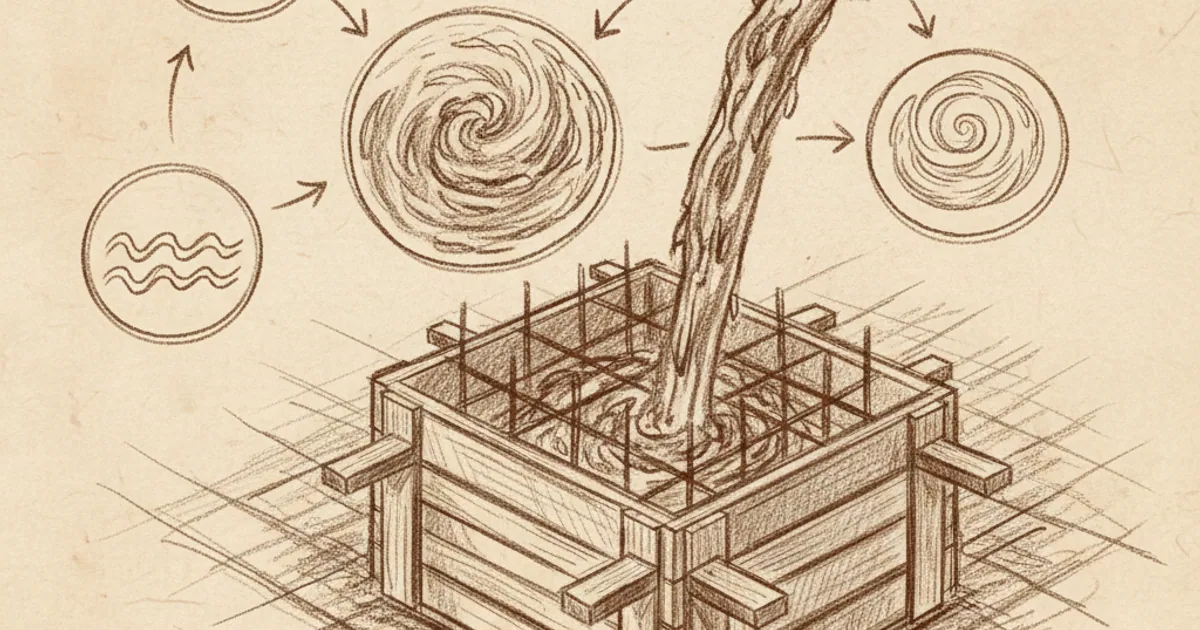
The scale
Concrete is the second most-used material on Earth after water. Estimates of annual concrete production vary by methodology, but most recent peer-reviewed work cites figures in the range of roughly 14-30 billion tonnes per year. Per capita, that's somewhere between about 1,700 and 3,700 kg of concrete per person per year worldwide.
Look around any city. Buildings, sidewalks, bridges, dams, subway tunnels, highway overpasses, runway aprons, harbor walls, foundations under nearly every structure. Even when you can't see it directly, concrete is usually doing the structural work underneath.
China alone has used more concrete in the years since 2003 than the United States used in the entire 20th century. Modern cities are physically made of concrete.
Why this much? Because the material is unusually well-positioned: cheap, strong, mouldable, available everywhere, fire-resistant, long-lived, and durable in most environments. No other material checks all those boxes at scale.
What concrete actually is
Concrete is a composite made of three main ingredients:
Cement (~10-15% by weight). The binder. A fine grey powder that reacts chemically with water to form a hard interlocking structure of microscopic crystals. The most common type is Portland cement, made by heating limestone, clay, and other ingredients to about 1,450 °C in a kiln, then grinding the resulting "clinker" into powder.
Aggregate (~60-75% by weight). The structural filler. Sand (fine aggregate, particles under ~5 mm) and gravel or crushed stone (coarse aggregate, 5-50+ mm). The aggregate is what gives concrete its strength and mass; the cement just glues the particles together.
Water (~10-15% by weight). Reacts with cement to start the hardening process. Too little water and the cement can't fully hydrate; too much and the concrete is weak and crack-prone.
Air (~1-6%). Some air is intentionally entrained into concrete for freeze-thaw resistance; some is unavoidable.
Admixtures (small additions). Chemicals added to modify behavior: plasticizers to make the mix flow without adding water, retarders to slow setting, accelerators to speed it, air-entrainers, water-reducers. Modern concrete mixes are highly engineered.
The proportions matter. A typical structural concrete mix might be 1 part cement, 2 parts sand, 4 parts gravel, with enough water for workability. Strength is partly controlled by the water-to-cement ratio — lower ratios produce stronger concrete (but harder to work with).
How it hardens
Concrete doesn't "dry" — it cures. The water doesn't evaporate away; it gets chemically locked into new compounds.
The simplified chemistry:
When water meets Portland cement, the cement minerals (mostly calcium silicates) react with water through a process called hydration. New compounds form — particularly calcium silicate hydrate (C-S-H), which is the glue that holds the aggregate together — along with calcium hydroxide and other phases.
The reaction is exothermic (releases heat). Large concrete pours can heat up noticeably; massive structures like dams need active cooling during construction to prevent thermal cracking.
The reaction proceeds over different timescales:
- First minutes: workable, can be placed and shaped.
- 30 minutes to several hours: starts to stiffen (initial set).
- 24 hours: hard enough to walk on, support light loads.
- 7 days: ~75% of final strength.
- 28 days: ~100% of design strength (this is the standard testing age).
- Years: concrete continues to gain strength slowly for decades.
This is why concrete must be kept moist after pouring for at least a week — if the water evaporates before the cement fully hydrates, the concrete is weaker and more crack-prone. Construction workers spray water, cover slabs with plastic, or apply curing compounds. "Curing concrete" is an active process, not waiting around.
Why concrete is great in compression, terrible in tension
Concrete is essentially artificial stone at the molecular level. The interlocked microscopic crystals can resist a lot of squeezing force — typical structural concrete handles 30-50 MPa in compression (300-500 kg/cm²), and high-strength concrete reaches 100+ MPa.
But under tensile force (pulling apart), the same crystal structure cracks easily. Plain concrete has only about 10% of its compressive strength in tension. A concrete beam under load will crack at the bottom (where it's in tension) at much lower loads than the top can handle in compression.
This means plain concrete is fine for compression-only structures:
- Foundations (everything pushes down on them).
- Walls (mostly carrying vertical load).
- Arches (designed so all forces are compression).
- Floor slabs over very short spans.
For anything in tension, concrete needs help. The help is steel reinforcement — usually steel bars (rebar) embedded in the concrete before it hardens.
Reinforced concrete
In reinforced concrete, steel bars are positioned where the tensile forces will act, and concrete fills the rest:
- Beams: rebar near the bottom (where tension occurs under downward loads).
- Columns: vertical rebar throughout (handles both compression buckling and any tension during bending).
- Slabs: rebar near the bottom in the direction of span; sometimes more near the top over supports.
- Walls: distributed rebar through the wall thickness.
The two materials work as a composite:
- Concrete handles compression.
- Steel handles tension.
- Concrete protects the steel from corrosion and fire.
- Steel and concrete have similar thermal expansion coefficients, so they don't separate as temperature changes.
- The bond between them (mechanical interlock from rebar's ribbed surface plus chemical adhesion) lets them work together.
Reinforced concrete is the dominant construction material of the modern world. The whole infrastructure built since ~1900 is largely reinforced concrete and structural steel.
Prestressed concrete is a variation where the steel (usually high-strength cables called "tendons") is tensioned before or after casting, putting the concrete into compression so it doesn't crack under service loads. Used for bridges, long-span beams, and parking garage slabs.
The carbon problem
Concrete's greatest weakness isn't structural — it's environmental.
Cement production is responsible for roughly 6-7% of global energy- and industry-related CO₂ emissions — among the largest single sources of industrial CO₂.
That's an enormous fraction. For context: cement emits more CO₂ globally than all aviation and shipping combined. The reason is split between two parts of the process:
1. Process emissions. Making cement involves heating limestone (CaCO₃) to drive off CO₂, leaving calcium oxide (CaO):
CaCO₃ → CaO + CO₂
This release is intrinsic to the chemistry — you can't make Portland cement without releasing CO₂ from the limestone itself. Process emissions account for roughly 60% of cement's CO₂ footprint.
2. Energy emissions. Heating the kiln to 1,450 °C is energy-intensive, traditionally using coal or natural gas. About 40% of cement's CO₂ comes from this combustion.
Per tonne of cement, roughly 0.6-0.9 tonnes of CO₂ is released (varies by plant efficiency and clinker content). Multiplied by global cement production of about 4.1-4.4 billion tonnes per year in the early 2020s, that's roughly 2.6-3.0 billion tonnes of CO₂ annually.
What's being done about it
Several approaches to lower-carbon concrete are in development or early deployment:
Replacement materials. Partial substitution of Portland cement with industrial byproducts (fly ash from coal plants, slag from blast furnaces, silica fume) reduces emissions. Limited by supply — these byproducts are declining as coal plants close.
Limestone calcined clay cement (LC³). A newer formulation that replaces some Portland cement with calcined clay and limestone, cutting emissions by ~30-40%. Deployed in some markets.
Alternative chemistries: Magnesium-based cements, geopolymers (using fly ash or slag with alkaline activators), and other novel binders. Some commercial products exist but adoption is small.
Carbon capture and storage at cement plants. Capturing the process CO₂ and storing it underground or using it in concrete itself (some companies inject CO₂ into curing concrete, which mineralizes it).
Mass-timber substitution. Engineered wood products (CLT — cross-laminated timber) can replace concrete and steel in mid-rise buildings, dramatically reducing emissions.
Reduced overdesign. Modern engineering can specify thinner slabs, more efficient shapes, and lower strength classes where they're sufficient — cutting cement use without changing the technology.
Renewable energy in cement plants reduces the combustion emissions.
The construction industry knows about this and is moving, slowly. Decarbonizing concrete is one of the harder climate challenges because the chemistry itself emits CO₂ and the material is irreplaceable for many uses.
Concrete's other quirks
Some practical realities about concrete:
Strength gain takes time. Most structural concrete is specified at "28-day strength" but continues to strengthen for decades. Historic structures sometimes are stronger now than when built.
Cracking is normal. All concrete cracks. The question is whether the cracks are small enough and located where they don't compromise the structure. Control joints (deliberately placed weak lines) ensure cracking happens in predictable patterns.
Freeze-thaw damage. Water in concrete pores expands when it freezes, gradually breaking the structure apart. Air-entrained concrete (with deliberate tiny air bubbles) gives the water room to expand without damage. Critical in cold-climate construction.
Rebar corrosion is the biggest long-term threat. When water and oxygen reach the rebar (through cracks, porous concrete, or chloride ions from sea air or de-icing salt), the steel rusts. Rust occupies about 7 times the volume of the original steel, splitting the concrete from the inside. Major maintenance issue for parking garages, bridges, and coastal structures.
Self-healing concrete is being researched — concrete with embedded bacteria or capsules that fill cracks. Limited commercial deployment as of 2026.
Reinforced concrete can be designed to be fire-resistant. The concrete protects the steel from heat for several hours, which is why high-rises are often required to be reinforced concrete or fireproofed steel.
If you'd like a guided 5-minute course on concrete chemistry and construction, NerdSip can generate one.
The takeaway
Concrete is a composite of cement (binder), sand and gravel (aggregate), and water. The cement chemically reacts with water (hydration) over hours-to-years to form an interlocking crystal structure that holds the aggregate in place. It's cheap, mouldable while wet, very strong in compression once set, and made from raw materials available almost everywhere. Weak in tension — solved by adding steel rebar, producing reinforced concrete, the workhorse material of modern construction. The major drawback is CO₂: cement production is roughly 6-7% of global energy- and industry-related emissions, with about 60% coming from limestone calcination chemistry and 40% from kiln fuel and electricity. Lower-carbon alternatives are in development but scale slowly. After water, it's the most-used material humans make.

Comments 0
No comments yet. Be the first to share your thoughts.