
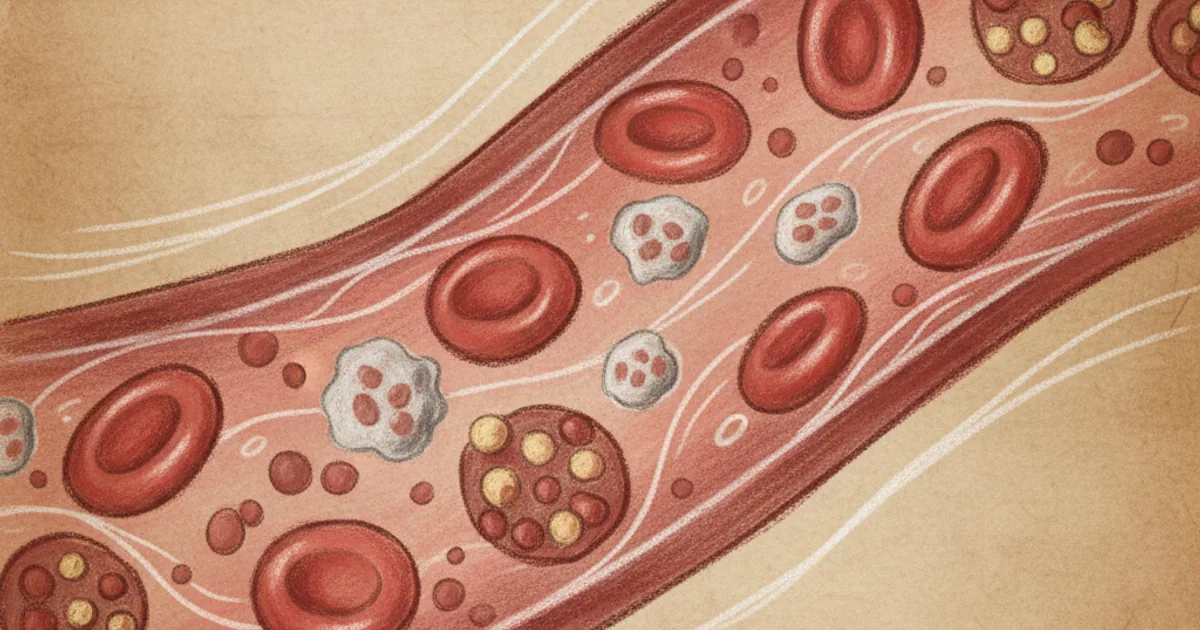
More than just a red liquid
When you cut yourself and see blood, you're seeing the most multi-purpose substance in your body. Blood does at least five distinct jobs simultaneously, never stopping. Every cell in your body — and you have 30 trillion of them — needs blood reaching it constantly.
A bird's-eye view of what's happening:
- Oxygen delivery from lungs to every tissue.
- Carbon dioxide removal in the reverse direction.
- Nutrient distribution — glucose, amino acids, fats, vitamins.
- Hormone transport for body-wide signalling.
- Immune cell deployment wherever invaders or damage are detected.
Plus secondary jobs: regulating body temperature, clotting at injuries, maintaining blood pressure, and buffering pH. All in one ~5-litre red liquid being pushed through about 100,000 km of vessels.
What blood is made of
About 55% of blood by volume is plasma — a pale yellow fluid that's about 92% water, with proteins, sugars, salts, hormones, and dissolved gases.
About 45% is cellular — three main types:
- Red blood cells (erythrocytes). The numerous ones, ~25 trillion of them. Each contains hemoglobin, which binds oxygen for transport. No nucleus, no organelles — they're effectively just bags of hemoglobin. They live about 120 days, then get recycled.
- White blood cells (leukocytes). Far fewer (~25 billion total) but multiple types — neutrophils, lymphocytes (T-cells, B-cells), monocytes, eosinophils, basophils. Each has a specific immune role.
- Platelets (thrombocytes). Small cell fragments that initiate clotting at injuries. About 1 trillion of them.
These are all made in bone marrow, mostly in the marrow of your hip bones, vertebrae, and ribs. The marrow continuously produces new blood cells at a staggering rate — about 2-3 million per second.
Job 1: oxygen delivery
This is hemoglobin's headline job. Hemoglobin is a four-unit protein with iron atoms at the centre of each unit. The iron binds oxygen reversibly.
In the lungs, where oxygen concentration is high, hemoglobin binds oxygen tightly. In tissues, where oxygen has been used up by cell metabolism, hemoglobin releases its oxygen. The release is also encouraged by lower pH and higher CO₂, which are both signs the tissue is metabolically active and needs more oxygen — a neat self-regulating mechanism.
Each red blood cell carries about 280 million hemoglobin molecules. A single hemoglobin can carry 4 oxygens. The total oxygen-carrying capacity of your blood is about 1 litre — modest by volume but constantly recycled.
Job 2: CO₂ removal
CO₂ produced by cell metabolism diffuses into the blood. About 70% of it gets converted to bicarbonate ions in red blood cells (via an enzyme called carbonic anhydrase) and dissolves into the plasma. About 20% binds to hemoglobin directly. About 10% dissolves in plasma as gas. In the lungs, these forms reverse — CO₂ comes out of solution, is exhaled.
The CO₂ buffer (bicarbonate ↔ CO₂) is also the main blood pH buffer. Breathing rate is adjusted automatically by your brain stem to keep CO₂ — and therefore pH — in range. Hyperventilation drops CO₂ and raises pH (alkalosis). Underventilation does the opposite (acidosis).
Job 3: nutrient distribution
After digestion, food molecules are absorbed across the intestinal wall and into the bloodstream. The first stop is the liver, which sorts and processes them. From the liver, plasma carries:
- Glucose to every cell as fuel.
- Amino acids to be assembled into proteins.
- Fatty acids for energy storage and membrane construction.
- Vitamins for enzyme cofactors.
Insulin (from the pancreas) tells cells when to take up more glucose; glucagon tells them when to release stored glucose back. The endocrine system continuously fine-tunes the levels.
Job 4: hormone transport
Hormones are chemical signals secreted by glands. Once released into blood, they travel everywhere but only act on cells with the right receptors. This is long-range slow signalling, complementing the fast, local signalling of the nervous system.
Some examples in your blood right now:
- Insulin (pancreas) regulates blood glucose.
- Cortisol (adrenals) responds to stress and inflammation.
- Thyroid hormones regulate metabolism.
- Sex hormones (estrogen, testosterone) circulate in the gonads and beyond.
- Adrenaline in spikes during stress, fight-or-flight.
- Growth hormone during sleep, especially in children.
Most hormones are present at vanishingly low concentrations (often nanograms per litre or less). The receptors are extremely sensitive to them.
Job 5: immune deployment
When there's a problem — injury, infection, allergic trigger — white blood cells must reach the site. The bloodstream is the highway. White cells circulate freely, can squeeze through capillary walls, and follow chemical signals released from infected or damaged tissues. Lymph nodes act as forward bases.
Different white cells handle different jobs. Neutrophils are the rapid-response infantry — first to arrive at most injuries, short-lived, swallow bacteria. Macrophages are larger and clean up debris. T-cells and B-cells handle the specific, adaptive immune response. (See how the immune system learns.)
Clotting
When you cut yourself, platelets recognize exposed collagen at the wound site and begin sticking together. A cascade of clotting proteins is activated, ultimately producing fibrin — a stringy protein that weaves into a mesh, trapping more cells and forming a clot.
The cascade is precisely tuned: too aggressive, and you get unwanted clots in undamaged vessels (causing strokes and heart attacks); too sluggish, and minor injuries become major bleeds. Hemophilia is a genetic disorder where part of the cascade fails. Anticoagulant drugs (warfarin, heparin, NOACs) deliberately dampen the cascade to prevent unwanted clotting.
Why deoxygenated blood is NOT blue
A common misconception: oxygen-depleted blood is blue. The "blue blood in veins" idea has been around since at least the 19th century.
It's wrong. Both oxygenated and deoxygenated blood are red, just different shades. Oxygenated arterial blood is bright cherry red; deoxygenated venous blood is darker, more burgundy. Neither is blue.
The blue appearance of veins through skin is a perceptual effect of how skin absorbs and scatters different wavelengths. Red light penetrates deeper into skin than blue light; blue light is more reflected from the surface; the deeper red light comes back darker, and your eye interprets the contrast as a bluish tint. The blood inside is the same dark red as in a syringe.
(This is one of the entries in the common misconceptions cluster — pop sources keep getting it wrong.)
If you'd like a guided 5-minute course on blood, hemoglobin, and circulation, NerdSip can generate one with quizzes.
The takeaway
Blood is your body's universal logistics network. It distributes oxygen, nutrients, hormones, and immune cells; removes CO₂ and waste; clots at injuries; helps maintain temperature; and buffers pH. Five litres of it flow through every cell in your body every minute or two. Hemoglobin makes the headline (oxygen delivery), but plasma carries dissolved nutrients and signalling molecules, and white cells handle defence. Most of what looks like "the body's chemistry" is delivered by blood.

Comments 0
No comments yet. Be the first to share your thoughts.