
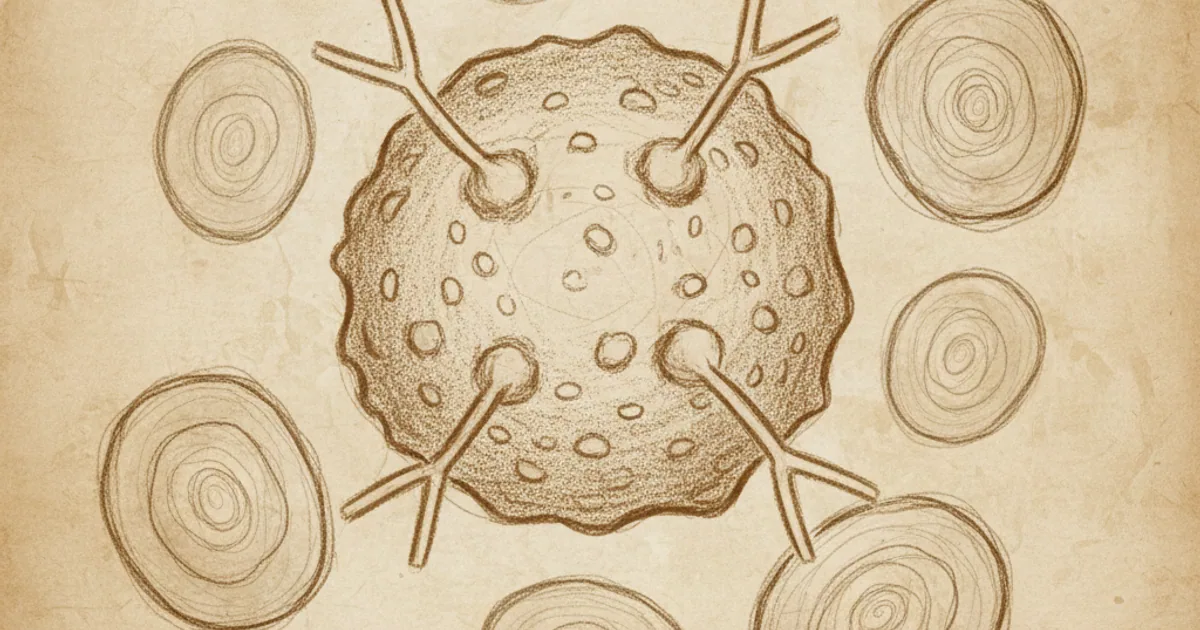
Two systems in one
Your immune system is really two systems working together.
The innate system is fast and generic. Skin, stomach acid, mucus, and a set of cells (macrophages, neutrophils, natural killer cells) that recognize broad signatures of "this isn't supposed to be here" — bacterial cell wall components, viral RNA in the wrong place, dead-cell signals. Innate responses start in minutes.
The adaptive system is slow and specific. It takes days to generate, but it produces a custom-tailored response to the exact pathogen — antibodies designed to fit one virus or bacterium, T-cells trained to recognize the specific molecular fingerprints of infected cells. And it leaves memory: once you've fought off measles, your adaptive system remembers.
This article is mostly about the adaptive system, because its mechanism is the genuinely strange one.
The selection problem
Imagine the design problem: build a defense system that can recognize any pathogen the body might ever encounter, including ones nature hasn't invented yet. How would you do it?
You can't anticipate every possible foreign molecule. There are too many. New viruses keep emerging.
The body's solution is wild: make a random library so large that any specific threat will, by chance, fit some entry. Then keep the entries that work and discard the rest.
This is the same logic as evolution itself — generate variation, let selection do the design work. But the immune system does it over days, not generations.
How the library is built
In your bone marrow, immature B-cells are generating their antibodies. Each B-cell carries gene segments labeled V, D, and J (for variable, diversity, joining). The cell randomly picks one V, one D, and one J segment and splices them together to make a unique combination. With other variable regions added, there are about 10¹¹ possible antibody designs — far more than the number of distinct B-cells in your body.
Every mature B-cell carries a unique antibody shape on its surface. None of them was designed for any specific pathogen. They're just there, in case.
T-cells go through a similar shuffling for their T-cell receptors, generating another huge diverse library.
What happens when a pathogen arrives
Say a flu virus enters your bloodstream. Out of ~10¹¹ possible antibody shapes, some small number of B-cells happen to have antibodies that fit the virus's surface proteins. Maybe a few hundred B-cells out of trillions.
These rare matching cells encounter the virus, bind it, and receive activation signals. They start dividing rapidly — a process called clonal expansion. Within a few days, you have millions of copies, all producing the matching antibody.
The antibodies, secreted into the blood and lymph, bind to the virus particles and either neutralize them directly or flag them for destruction by other immune cells. The system has effectively designed an antibody for this virus — except the design came from random pre-generated diversity, plus selection.
A second mechanism — somatic hypermutation — refines the antibody. During clonal expansion, the antibody-coding region mutates at a high rate, and cells with better-fitting variants are preferentially selected. Over a few weeks, the antibody response gets more precise and stronger-binding.
T-cells: a different recognition strategy
B-cells handle free-floating pathogens with antibodies. But what about cells that are already infected, like cells hiding a virus inside?
T-cells handle these. Every cell in your body continuously displays small fragments of its internal proteins on its surface, attached to molecules called MHC (major histocompatibility complex). When a cell is infected by a virus, fragments of viral proteins show up in this display.
Cytotoxic T-cells (killer T-cells) scan these displays. Each T-cell has a unique receptor (also generated by random shuffling). When a T-cell finds a cell displaying a fragment that matches its receptor, it triggers the displayed cell's destruction — killing the infected cell before the virus can use it to make more copies.
Helper T-cells coordinate the response, releasing signaling molecules that activate B-cells, other T-cells, and macrophages.
How memory works
After the infection is cleared, most of the activated B-cells and T-cells die. The ones that don't are memory cells. They persist for years, sometimes for life.
If the same pathogen returns later, the memory cells respond fast — days become hours. The new wave of antibodies is already pre-optimized from the previous infection.
This is why you generally get most viral infections only once. It's also why vaccines work: a vaccine exposes the immune system to a fragment of a pathogen (or a weakened version), triggering memory-cell formation without causing the disease. When you encounter the real pathogen later, memory cells are ready.
If you'd like a guided 5-minute course on how vaccines train the immune system, NerdSip can generate one on the topic.
The self/non-self problem
The immune system has to distinguish "self" (your own cells) from "non-self" (pathogens). With a random library of antibody shapes, some will inevitably match your own proteins. If those B-cells were active, they'd attack your own tissue.
The body's solution: during B-cell and T-cell maturation in bone marrow and thymus, cells that strongly bind self proteins are deleted before they leave. This is called central tolerance.
A second layer, peripheral tolerance, suppresses self-reactive cells that escape the first filter. Regulatory T-cells help maintain this in mature tissues.
When tolerance fails, you get autoimmune disease. Type 1 diabetes is the immune system attacking pancreatic beta cells. Multiple sclerosis is it attacking the myelin sheathing on nerves. Rheumatoid arthritis is it attacking joints. The maintenance of self-tolerance is one of the immune system's hardest jobs, and failures are devastating.
Why pathogens win sometimes
The immune system is enormously powerful, but pathogens evolve too. They have a few strategies:
- Antigenic variation. Flu and HIV change their surface proteins constantly, so old antibodies don't fit new strains. This is why we need a new flu shot every year.
- Hiding. Herpesviruses can hide in nerve cells in a non-replicating state for years, invisible to T-cells.
- Suppression. HIV destroys helper T-cells directly, dismantling the coordination layer.
- Mimicry. Some bacteria coat themselves with proteins that look like host molecules.
Each is a different exploit of immune-system rules.
The takeaway
The adaptive immune system is a learning system in the only sense that mattered before AI: it pre-generates massive random diversity, lets the environment select what works, and remembers the winners. The mechanism is biological (clonal expansion of cells with matching receptors, plus somatic hypermutation for refinement), not computational, but the logic is the same. Once you see it as random library + selection + memory, the whole immune system stops being a mysterious black box and becomes a comprehensible — if astonishingly elegant — algorithm.

Comments 0
No comments yet. Be the first to share your thoughts.