
The two jobs
Every breath does two things:
- Brings oxygen in for cellular respiration (the chemistry by which cells generate energy from glucose).
- Removes carbon dioxide produced as a waste product by that same chemistry.
Cells burn glucose in the presence of oxygen to make ATP (the cell's energy currency). The reaction:
glucose + 6 O₂ → 6 CO₂ + 6 H₂O + energy
Without oxygen, cells can only do anaerobic respiration, which is far less efficient and produces lactic acid as waste. Brain neurons die after minutes without oxygen. So breathing isn't optional on any timescale relevant to staying alive.
How the lungs do it
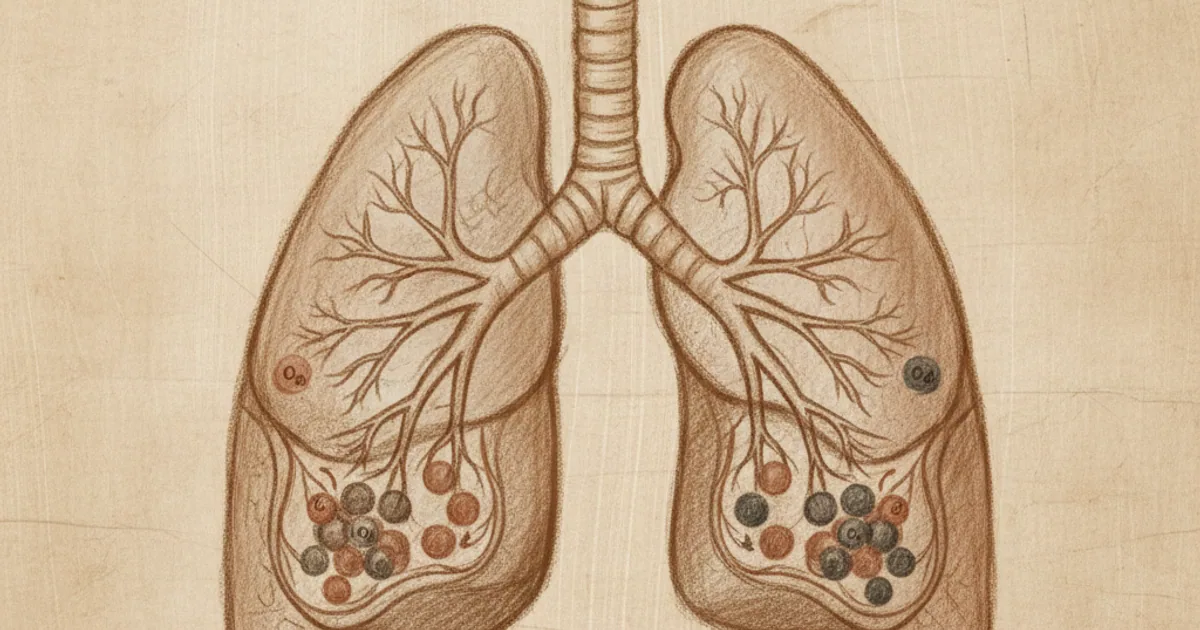
Your lungs are a branching network of airways. Air enters through the trachea, splits into bronchi (one per lung), then into smaller bronchioles, and finally into tiny sacs called alveoli. There are about 300 million alveoli per lung.
The alveoli are wrapped in capillaries — the tiniest blood vessels. The wall between the alveolar air and the capillary blood is incredibly thin (about 0.5 micrometers). Oxygen diffuses across this membrane into the blood; CO₂ diffuses out of the blood into the air. The total surface area available for this exchange is about 70 square meters per lung — roughly the floor of a small apartment, packed into your chest.
Gas exchange is passive diffusion — gases move from where they're plentiful to where they're scarce. No energy is required for the actual exchange. What does require energy: getting fresh air in and stale air out. That's what breathing muscles do.
The mechanics of inhalation
Inhalation isn't a "sucking" — it's a pressure change. The diaphragm (a sheet of muscle below the lungs) contracts and moves downward; the rib muscles contract and lift the rib cage outward. Both actions expand the chest cavity.
Expanding the chest enlarges the volume containing the lungs. Larger volume at the same number of gas molecules = lower pressure. Air outside is now at higher pressure than inside, so it flows in. That's inhalation.
Exhalation is mostly passive: the muscles relax, the chest collapses back, pressure rises, air flows out. Forced exhalation (sneezing, blowing out a candle) uses additional muscles.
The CO₂ trigger
Here's the counterintuitive part: the trigger to breathe is not low oxygen. It's high CO₂.
Your brain stem (specifically the medulla) continuously monitors blood pH. Rising CO₂ levels acidify the blood (CO₂ + H₂O → H₂CO₃, a weak acid). Once blood pH dips below threshold, the brain stem signals a breath.
This is why holding your breath gets increasingly uncomfortable: CO₂ is building up, your blood is getting more acidic, your brain stem is screaming for a breath. You feel uncomfortable not because your oxygen is critically low (it usually isn't yet) but because your CO₂ is too high.
This has practical consequences:
Hyperventilating before underwater swimming is dangerous. If you breathe rapidly and deeply before submerging, you flush extra CO₂ out of your blood. Now you can hold your breath longer because your CO₂ has further to climb before triggering the breath signal. But your oxygen reserves haven't increased. You might run out of oxygen before you feel the breathing urge — and pass out underwater. This is shallow water blackout and kills experienced swimmers regularly.
Carbon monoxide poisoning is silent. CO binds hemoglobin much more tightly than oxygen does, displacing it. Your blood can be losing oxygen capacity rapidly, but CO doesn't trigger the breathing reflex (it's not CO₂). Victims often don't feel breathless. They get tired, confused, then unconscious. This is why CO is so dangerous and why CO detectors exist.
Altitude sickness gets you twice. At altitude, you have less oxygen per breath. The body tries to compensate by breathing faster, which drops CO₂. Low CO₂ means low breathing drive — but you actually need more breaths, not fewer. The body has multiple compensating systems, but they take time to kick in. People who fly into high altitudes and immediately try to exert themselves can collapse before acclimatization.
How fast and deep
A resting adult breathes about 12-20 times per minute, exchanging about 500 mL of air per breath. Per day: roughly 11,000 litres of air through the lungs, with about 550 litres of pure oxygen delivered to the blood.
During exercise, breathing rate can climb to 40-50 breaths per minute, and each breath becomes deeper. The total air moved can go up by a factor of 20.
The brain stem coordinates this automatically based on:
- Blood CO₂ levels (primary trigger).
- Blood pH (related).
- Blood oxygen (a secondary backup, only kicks in if oxygen really crashes).
- Conscious overrides from the cortex (you can hold your breath, talk while breathing, etc.).
What lung damage does
Lungs can be damaged by:
- Smoking. Tar accumulates in alveoli; cilia (the tiny hairs sweeping mucus out) die; alveoli walls break down (emphysema). Surface area for gas exchange drops, leading to progressive shortness of breath.
- Asthma. Airways inflame and constrict; mucus production increases. Air has to push past a narrower channel. Especially difficult during exhalation, when airways are already smaller.
- Pneumonia. Alveoli fill with fluid and pus from infection. Gas can't exchange in flooded sacs.
- Pulmonary embolism. A clot blocks a blood vessel in the lungs. Air enters but blood can't get to the affected alveoli.
- Fibrosis. Lung tissue becomes scarred, less stretchy. Harder to inflate, less gas exchange.
- COVID-19. Multiple effects on lung tissue depending on severity; acute respiratory distress syndrome in severe cases.
Each disease reduces the effective gas exchange area or the airflow capacity. The body tries to compensate (faster breathing, more red blood cells), but if the damage is severe enough, you become hypoxic — chronically low on oxygen.
If you'd like a guided 5-minute course on the respiratory system, NerdSip can generate one with quizzes.
A note on yawning
We don't really know why we yawn. The folk theory (yawning brings in extra oxygen when blood oxygen is low) has been tested and doesn't hold up. Current best guesses: yawning helps regulate brain temperature, or signals arousal level (sleepiness, transitions). Contagious yawning seems to be a social-bonding mechanism, present in humans, chimps, dogs, and some other social mammals. None of these explanations is fully proven.
The takeaway
Breathing brings oxygen to cells and removes CO₂. Each breath is a pressure change driven by the diaphragm and rib muscles, expanding the lungs and pulling in air. Gas exchange happens by passive diffusion across the membrane of 600 million alveoli. The trigger to breathe is CO₂ levels (not oxygen), which has surprising consequences for divers, climbers, and victims of carbon monoxide. The lungs are one of the most efficient gas-exchange organs in nature — but they're also among the most exposed and vulnerable.

Comments 0
No comments yet. Be the first to share your thoughts.