Subject
Cells, DNA, immune cells — your body is full of tiny machines running on rules clearer than you'd think.
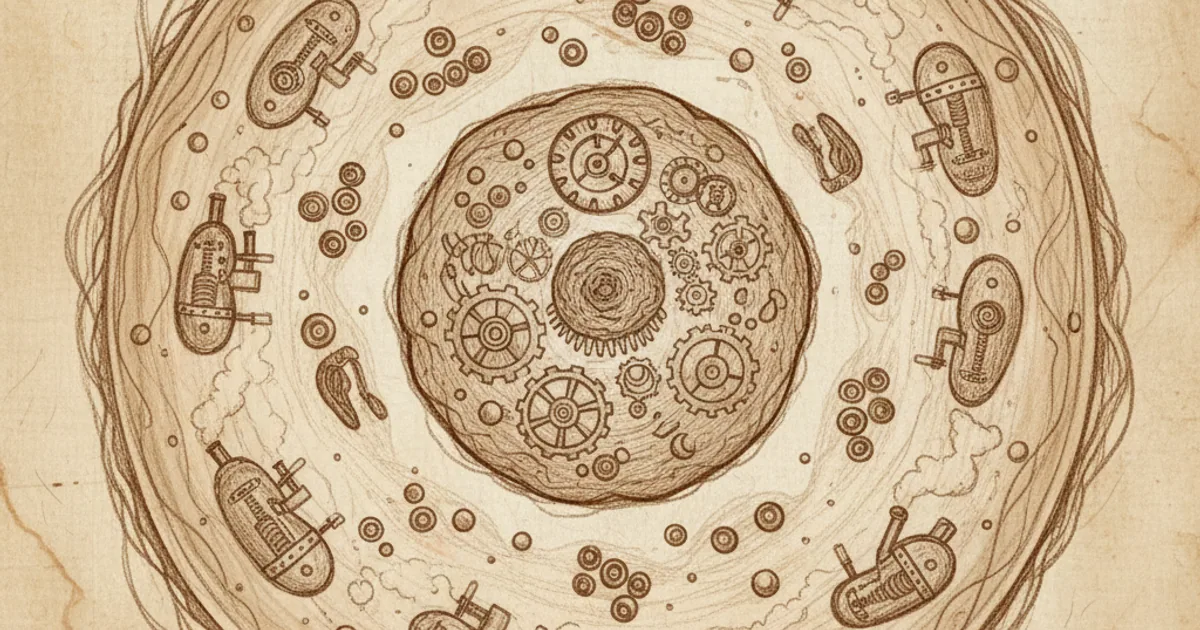
The word "cell" is misleading. It suggests a bag of liquid, maybe with a few floating bits. The reality is a densely packed chemical factory — proteins crammed together at concentrations approaching a saturated solution, structural fibres holding everything in place, energy machines pumping continuously, and information flowing from DNA to RNA to functional proteins about a hundred times a second.
If you scaled a cell up to the size of a small city, the molecular machines inside would be the size of buses, packed bumper-to-bumper, all running 24/7. It's not jelly. It's traffic at peak hour.
Everything you'll read in the other articles in this cluster — DNA copying, mitochondria, immune cells, CRISPR — happens inside this packed environment. Knowing the architecture makes the details make sense.
1. The membrane. A double layer of fat molecules (a "lipid bilayer") that wraps the cell. Studded with protein channels that let specific things in and out: ions, sugars, water, signals. Without selective transport, the cell wouldn't have an inside chemistry different from the outside.
2. The nucleus. Storage for the DNA — about 2 meters of it, compressed into something a few microns across. The nucleus has its own double membrane with controlled pores, so the DNA stays separated from the cytoplasmic chemistry. The instructions for every protein the cell can make live in here.
3. The ribosomes. The cell's machines for reading instructions and building proteins. There are millions of them in a single cell. They float in the cytoplasm or attach to a structure called the rough ER, and they convert RNA messages (copies of DNA segments) into chains of amino acids. Those chains fold into proteins, which do everything functional.
4. The mitochondria. Energy converters. They take sugar and oxygen and produce ATP — the cell's universal energy currency. A liver cell has about 2,000 of them. Without mitochondria producing ATP, almost everything stops within minutes.
That's the headline. The supporting cast — endoplasmic reticulum, Golgi apparatus, lysosomes, peroxisomes, cytoskeleton — handles transport, modification, recycling, and structure. Each is a specialized factory wing.
Most of "what cells do" is actually "what proteins do." Proteins are the workers.
The instructions for every one of these proteins are stored as DNA sequences in the nucleus. To make a specific protein, the cell transcribes the corresponding DNA into RNA, then translates the RNA into amino acids at a ribosome. Transcription happens in the nucleus; translation happens at ribosomes in the cytoplasm.
ATP — adenosine triphosphate — is the cell's energy currency. Almost every energy-requiring reaction uses ATP. Mitochondria spend most of their time producing it from food and oxygen.
The process, called oxidative phosphorylation, is one of biology's most clever mechanisms:
ATP synthase is literally a rotating motor at the nanometer scale. It's been crystallized and watched in action. Each of your mitochondria has thousands of them, spinning continuously.
Cells without functioning mitochondria — like red blood cells, which extrude theirs during maturation — can only generate ATP through the much less efficient process of fermentation. They produce about 18 times less ATP per glucose molecule.
Cells need to coordinate with each other. They do this with signaling pathways:
A single signal can trigger 100,000 downstream changes within seconds. Most diseases that affect specific tissues — diabetes, cancer, hormone disorders — turn out to be failures of specific signaling components.
Want to keep building this kind of mental picture across more biology? You can generate a personalized 5-minute course on any organelle or pathway with NerdSip.
The cell's many compartments aren't decoration. They solve fundamental chemistry problems:
The whole architecture is about running incompatible chemistries side by side without them interfering. Membranes are the cell's way of saying "different rules apply over here."
Most diseases are cellular failures:
Once you see the cell as a factory, "disease" becomes "this specific part is broken."
A cell is a chemical factory — densely packed, highly compartmentalized, running thousands of simultaneous reactions managed by protein machines whose instructions are stored in the nucleus. Everything biology does, from a heartbeat to memory formation to fighting an infection, eventually traces back to specific cells doing specific things with specific molecules. Once you've internalized the architecture, the rest of biology gets much easier.
A short editorial reading list. Pick whichever fits how you like to learn.


Comments 0
No comments yet. Be the first to share your thoughts.