
The strangest sentence in biology
The structures producing energy inside every cell of your body were once free-living bacteria.
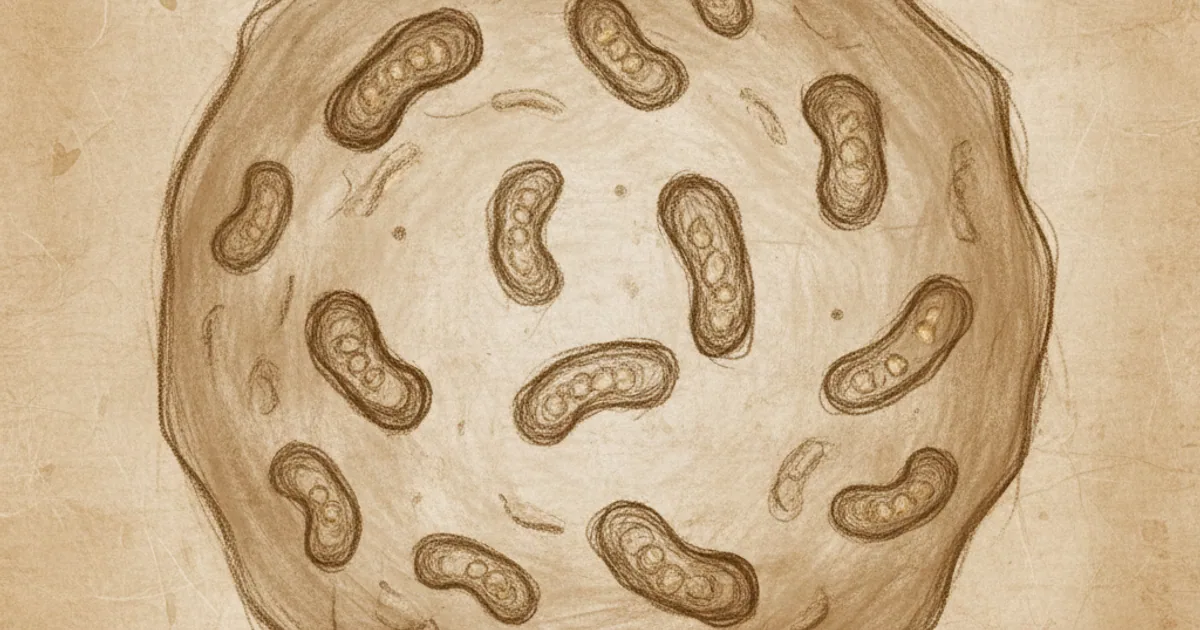
Two billion years ago, a larger prokaryote engulfed a smaller bacterium. Instead of digesting it — the usual fate — the host kept it alive inside. Over evolutionary time, the arrangement became permanent. The bacterium became an organelle. Today, every animal, plant, and fungus on Earth descends from that ancient pairing, and we carry billions of its descendants in our cells.
This idea, called the endosymbiotic theory, sounded absurd when Lynn Margulis proposed it in 1967. Her paper was rejected by 15 journals before being published. It's now one of the most thoroughly-confirmed pieces of evolutionary biology.
Why anyone believed it
Mitochondria didn't fit. They had several features that made them look more like guests than like normal cell parts.
Their own DNA. Mitochondria carry their own genome, separate from the nuclear DNA. The mitochondrial genome is circular — the same shape bacterial genomes have — not linear like eukaryotic chromosomes.
Their own ribosomes. The protein-building machines inside mitochondria are smaller than the ribosomes in the surrounding cytoplasm. They're bacteria-sized, and many antibiotics that block bacterial protein synthesis also affect mitochondrial protein synthesis (one of the reasons certain antibiotics have side effects on humans).
They divide by binary fission. Mitochondria don't get manufactured by the cell; they grow and split, like bacteria do. A cell with no mitochondria can't make new ones; it would have to inherit them from its parent.
Double membrane. Most organelles have one membrane. Mitochondria have two — exactly what you'd expect if the outer one came from the engulfing event (the host's membrane wrapped around the bacterium) and the inner one is the bacterium's original membrane.
Antibiotic sensitivity. Drugs like chloramphenicol or doxycycline that block bacterial protein synthesis can also impair mitochondrial protein synthesis, sometimes causing side effects. Eukaryotic cytoplasmic ribosomes are immune to these drugs.
When you list out these features, the bacterial-origin hypothesis becomes the simplest explanation. The endosymbiotic theory just says: stop trying to explain these features as if they evolved from scratch inside cells. They didn't. They came from a bacterium that moved in.
The genetic confirmation
Once DNA sequencing became practical, the theory got a stronger test. If mitochondrial DNA descended from a specific bacterial lineage, we should be able to find its closest relatives.
We can. Mitochondrial genes cluster, by sequence similarity, with alpha-proteobacteria — a specific bacterial group. The closest free-living relatives we know are bacteria like Rickettsia, which today are obligate parasites that live inside other cells. The link is unmistakable.
In a sense, the bacteria that became mitochondria were doing something modern Rickettsia still do — living inside other cells. The difference is that Rickettsia exploit their hosts; the mitochondrial ancestor settled into a long-term, mutually-beneficial partnership.
How most of the original genes ended up in the nucleus
The bacterium that became the mitochondrion would have had a few thousand genes. Modern human mitochondria have 37. Where did the rest go?
The answer: to the nucleus. Over the past 2 billion years, genes have migrated from the mitochondrial genome to the nuclear genome. Some have been lost entirely (the host already had a version). Some now live in the nucleus and their proteins are tagged for shipment back to the mitochondrion. Some moved only relatively recently — different organisms have had different genes leave at different times.
You can spot the migrating genes by sequence comparison. Many nuclear genes for mitochondrial proteins still have telltale bacterial features that mark them as former mitochondrial residents.
Why did the migration happen? Mostly because keeping a separate gene system inside the mitochondrion has costs: every mitochondrion has to maintain its own DNA-copying and protein-making machinery. Moving genes to the nucleus consolidates this and probably reduces the error rate over generations. The genes that stuck around in the mitochondrion may have been too important to move — the proteins they encode might need to be made on-site for assembly into the inner membrane.
What this means for medicine
Because mitochondria have their own genome, mitochondrial diseases are their own category. Mutations in mitochondrial DNA cause disorders that don't follow normal Mendelian inheritance (they're inherited only through the mother, since sperm mitochondria are usually destroyed at fertilization).
There's no easy cure for most mitochondrial diseases — you can't selectively edit only the mitochondrial genome. But there's experimental work on mitochondrial replacement therapy, sometimes called "three-parent IVF," where the nuclear DNA from one egg is transferred to a donor egg whose mitochondria are healthy. The resulting child has nuclear DNA from one parent and mitochondrial DNA from a donor.
The technique is controversial but legal in a few countries. The fact that it works at all is a vivid demonstration that nuclear and mitochondrial genomes are genuinely separate.
A second wave: chloroplasts
The mitochondrial endosymbiosis happened about 2 billion years ago. Roughly 1.5 billion years ago, another endosymbiotic event happened: an early eukaryote (now equipped with mitochondria) engulfed a photosynthetic cyanobacterium. That bacterium became the chloroplast.
Chloroplasts have the same fingerprints as mitochondria: their own DNA, their own ribosomes, double membranes, binary fission. They descend from cyanobacteria, just as mitochondria descend from alpha-proteobacteria.
Plants, then, are the result of two separate ancient mergers: one with the proto-mitochondrion, one with the proto-chloroplast. Animals only had the first.
The full deep-time story is genuinely strange. If you'd like a structured 5-minute walkthrough, NerdSip can generate a course on endosymbiotic theory with quizzes.
What you're made of, by ancestry
Roll all this together. Every animal cell contains:
- A nucleus with DNA inherited from your two parents.
- Cytoplasm and membranes inherited from the long line of eukaryotic cells.
- Mitochondria — descended from a bacterium that joined the lineage 2 billion years ago, inherited specifically from your mother.
You are, in a real sense, a chimera. The energy that powers every thought, every heartbeat, every muscle contraction is being produced by descendants of a bacterium that signed a permanent contract with one of your ancestors before complex life existed.
The takeaway
Mitochondria are the proven case of a bacterium becoming an organelle. The evidence is genetic, structural, and biochemical — independent confirmations all pointing the same way. The implications run through everything: why mitochondrial diseases are inherited from the mother, why some antibiotics have mitochondrial side effects, why chloroplasts in plants share the same origin story but with a different bacterium. Once you see it, the architecture of eukaryotic cells stops looking like one design and starts looking like an old merger that worked out.

Comments 0
No comments yet. Be the first to share your thoughts.