
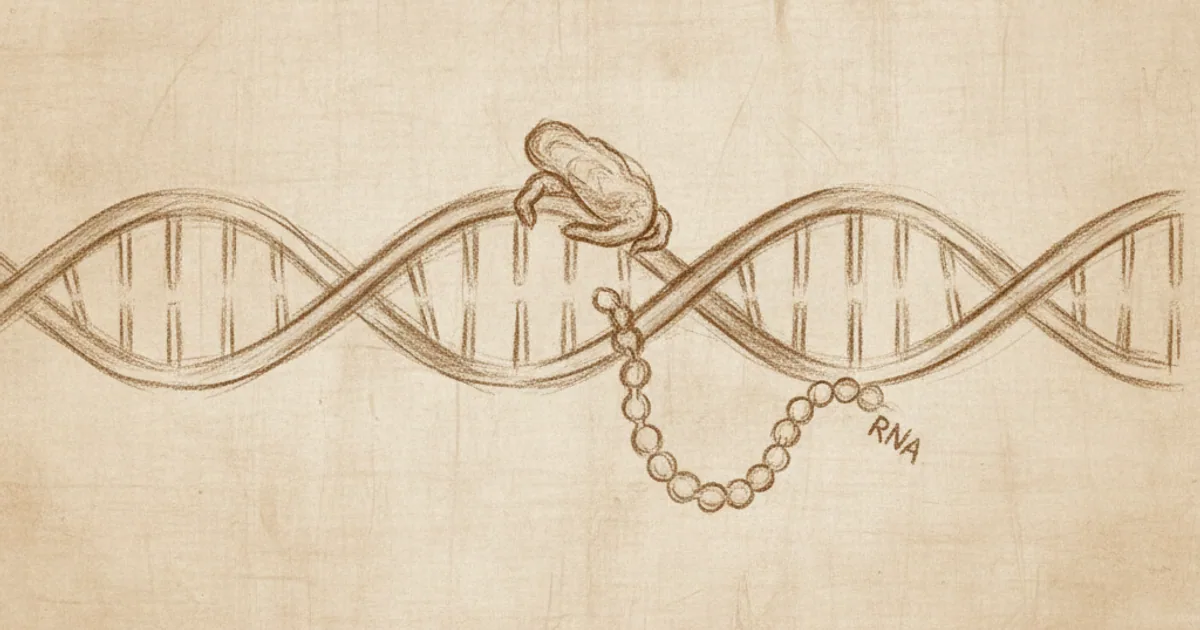
A bacterial defence system
In the 1980s and 90s, microbiologists noticed something odd in bacterial genomes: short repeating sequences with unrelated DNA fragments tucked between them. The pattern was named CRISPR — clustered regularly interspaced short palindromic repeats — and nobody could figure out what it was for.
In the late 2000s, the answer emerged. Bacteria are constantly attacked by viruses (called bacteriophages, or just phages). When a bacterium survives a phage attack, it sometimes captures a small piece of the phage's DNA and inserts it into its CRISPR region. The CRISPR region thus becomes a memory bank of past viral attacks.
Next time a similar phage attacks, the bacterium transcribes the relevant memory entry into a short RNA, hands that RNA to an enzyme called Cas9 (CRISPR-associated protein 9), and Cas9 uses the RNA as a guide to find and cut the matching phage DNA. The phage is destroyed before it can replicate.
CRISPR is a bacterial immune system. That's what it is in nature.
What scientists realized
Around 2012, Jennifer Doudna, Emmanuelle Charpentier, and others (independently Feng Zhang and George Church for mammalian use) showed something powerful: the guide RNA can be replaced.
If you give Cas9 a custom RNA matching any DNA sequence — bacterial, viral, human, mouse, plant, anything — it will find that sequence and cut it.
This turned a niche bacterial defence system into a programmable molecular scissors. Want to cut a specific gene in a human cell? Design a guide RNA matching it, deliver it with Cas9 to the cell, and the cut happens.
The cut itself isn't the edit. The edit happens when the cell repairs the cut, which it does automatically. Two main repair pathways:
- Non-homologous end joining (NHEJ). Quick and sloppy. The two cut ends are sewn back together but often with a few bases inserted or deleted at the join. Result: the gene is disrupted. This is the easiest way to disable a gene.
- Homology-directed repair (HDR). Slower and more precise. If you supply a DNA template alongside the cut, the cell can use it to fill in the gap with an exact sequence. This lets you make specific changes — e.g., correcting a disease-causing mutation.
Together, these two pathways let CRISPR either knock out a gene or rewrite it precisely.
How it actually works
The mechanism step by step:
- Design the guide RNA. A 20-base sequence matching the target DNA, plus a longer scaffold that lets it bind Cas9.
- Deliver Cas9 and the guide to the cell. Typically with a lipid particle, a viral vector, or direct electroporation.
- Cas9 + guide scan the genome. They float through the nucleus, looking for any DNA that matches the guide's 20 bases.
- The PAM check. Cas9 won't cut without a specific 3-base "PAM" sequence right next to the guide-matching region. This prevents Cas9 from accidentally cutting the bacterial genome where the same memory sequence is stored without the PAM nearby.
- The cut. When a match with PAM is found, Cas9 cuts both strands of the DNA.
- The cell repairs. Either via NHEJ (sloppy, disrupts the gene) or HDR (template-guided, lets you make specific edits).
Each step has been crystallized, watched in real time, and engineered for variations.
What's hard
CRISPR has limits.
Off-target cuts. Cas9 sometimes cuts at sequences similar but not identical to the guide. Refinements (high-fidelity Cas9 variants, careful guide design, paired nickases) have reduced this dramatically but not to zero.
Delivery. Getting CRISPR into the right cells in the body is hard. For blood disorders, you can extract stem cells, edit them in a dish, then transplant them back (this is how Casgevy works). For organs deep in the body, delivery is much harder.
HDR efficiency. Precise editing via HDR works well in dividing cells but poorly in non-dividing cells (most adult tissue). For these, you can disrupt genes but not easily rewrite them.
Mosaicism. When you edit an embryo, the edit might happen after the first division, so some cells get edited and others don't. The resulting animal is a "mosaic" — different cells have different genomes.
Each of these has produced new technology in response. Base editors (changing a single base without cutting), prime editors (more flexible precise edits), and Cas-variant proteins (alternative PAMs, different cutting behaviour) all extend CRISPR's reach.
What it's used for
Research labs use CRISPR routinely. Disrupt a gene in mice, see what changes. Knock in a fluorescent tag to watch a protein move. Build a cell line missing a specific pathway. The technology has compressed years of work into weeks.
Agriculture has CRISPR-edited crops in the field: mushrooms that don't brown, soybeans with healthier oil, wheat resistant to powdery mildew. Many are regulated less strictly than older GMOs because no foreign DNA is introduced — just specific edits.
Medicine has CRISPR-based therapies in clinical trials for cancer, sickle cell disease, beta-thalassemia, transthyretin amyloidosis, and a handful of inherited eye diseases. Casgevy, approved in 2023, treats sickle cell disease by editing bone marrow stem cells to reactivate fetal haemoglobin production. It's a one-time treatment that essentially cures the disease.
The future likely includes more in-vivo editing (delivered directly to organs), more precise editing tools, and — controversially — possibly germline editing (changes inheritable by future generations), which is currently restricted by most countries.
If you'd like a guided 5-minute course on CRISPR — what it does, what it doesn't, and what therapies are coming — NerdSip can generate one tailored to wherever you want to start.
The ethics layer
CRISPR makes germline editing — changes inheritable by future generations — technically straightforward. This is unprecedented: a single decision could affect not just one person but everyone who inherits from them.
In 2018, He Jiankui announced he had edited the embryos of twin girls in China to try to make them HIV-resistant. The international scientific community condemned the experiment as premature, ethically reckless, and badly executed. He served a 3-year prison sentence. The twins, now young children, are healthy but it's unclear what long-term effects, if any, the edits will have.
Most countries now legally prohibit germline editing. Whether it should ever be allowed, and for what conditions, is one of the live debates in biology and bioethics.
The takeaway
CRISPR took an obscure bacterial defence system and turned it into the most flexible gene-editing tool ever built. The mechanism — Cas9 cutting DNA at a location specified by a custom guide RNA — is conceptually simple. The implications, in research, agriculture, and medicine, are enormous. We're a decade in, with one approved therapy and dozens in trials; the next decade will see far more. The mechanism is biology that we discovered, not invented — but turning it into something we could direct was one of the most consequential applied-science moves of the 21st century.

Comments 0
No comments yet. Be the first to share your thoughts.