Subject
Below the chemistry of atoms is a whole layer of more fundamental particles — protons, neutrons, electrons, then quarks, the Higgs boson, antimatter, neutrinos. What's actually down there, and how do we know?
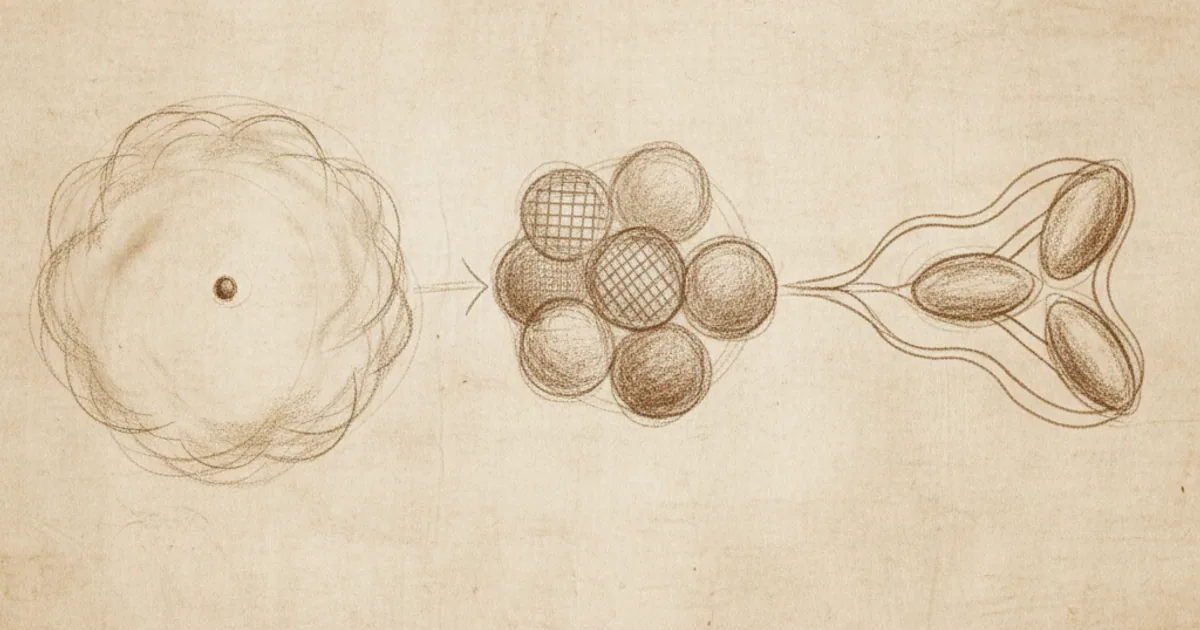
Take a single hydrogen-1 atom. It has a single negative-charge electron loosely associated with a nucleus consisting of one proton — total mass about 1.67 × 10⁻²⁷ kg. Its overall size, as measured by where the electron is likely to be found, is roughly 1 × 10⁻¹⁰ m (an angstrom, or 0.1 nanometer). (Heavier atoms have nuclei containing both protons and neutrons; hydrogen-1 is the simplest case where the nucleus is just a single proton.)
Most of that volume is empty. The nucleus — in hydrogen-1, just a single proton — has a radius around 10⁻¹⁵ m (a femtometer). The ratio is about 100,000:1. If the nucleus were the size of a marble, the electron would be (in some loose sense) a probability cloud roughly half a kilometer across.
This empty-but-not-empty arrangement is the basic structure of every atom. Larger atoms have more protons + neutrons in a slightly bigger but still tiny nucleus, surrounded by more electrons in larger probability clouds.
Three particles make up the atoms in nearly all ordinary matter:
Protons (charge +1, mass ~1.673 × 10⁻²⁷ kg, ~1,836× the electron mass). Found in the nucleus. The number of protons defines the element. Stable on their own (or essentially so).
Neutrons (charge 0, mass slightly more than a proton, ~1.675 × 10⁻²⁷ kg). Found in the nucleus alongside protons. Unstable when free — decay with a half-life of about 10.2 minutes to a proton + electron + antineutrino. Stable inside most atomic nuclei because the nuclear binding energy makes the decay energetically unfavorable.
Electrons (charge -1, mass ~9.11 × 10⁻³¹ kg). Occupy probability clouds around the nucleus. Stable. Carry electrical current, mediate chemistry.
These three account for essentially all the mass and behavior of ordinary matter. Chemistry, biology, materials science, the visible world — all of it is interactions of these three particles.
But protons and neutrons are not fundamental. They're composite particles with internal structure.
In the 1960s-70s, particle physics experiments revealed that protons and neutrons are composed of smaller particles called quarks, bound together by an even stronger force.
A proton contains three quarks: two up quarks (charge +2/3 each) and one down quark (charge -1/3). Net charge: 2(+2/3) + (-1/3) = +1. ✓
A neutron contains one up quark (+2/3) and two down quarks (-1/3 each). Net charge: (+2/3) + 2(-1/3) = 0. ✓
The quarks are held together by the strong nuclear force, mediated by particles called gluons. The strong force has a remarkable property: it gets STRONGER with distance rather than weaker. Try to pull quarks apart and the force resists like a stretching elastic band. At some point the energy invested in pulling them is enough to create a new quark-antiquark pair from the vacuum — and what you end up with isn't an isolated quark but two new particles. This is quark confinement. Free quarks have never been observed.
Detail in what quarks really are.
Beyond the up and down quarks, there are four more quark types, called flavors:
First generation: up, down. The ones in ordinary matter. Second generation: charm, strange. Heavier; unstable. Third generation: top, bottom. Even heavier; very short-lived.
So six quark flavors total.
There are also six leptons (particles that don't feel the strong force):
First generation: electron, electron neutrino. Second generation: muon, muon neutrino. Third generation: tau, tau neutrino.
Six leptons total.
Most particles have an associated antiparticle — same mass, opposite charge. The antiparticle of an electron is a positron (charge +1). The antiparticle of a quark is an antiquark. Some particles (the photon, Z boson, and Higgs boson) are their own antiparticles. See what antimatter actually is.
Plus force-carrier particles (gauge bosons) that mediate the fundamental forces:
And one more particle, discovered most recently:
That's the whole list of fundamental particles in the Standard Model of particle physics. Everything we've found from particle accelerators or cosmic rays fits into this framework.
Particle interactions are governed by four fundamental forces:
Gravity: attraction between masses. By far the weakest of the four for fundamental particles, but adds up over astronomical scales because it's always attractive. Not yet incorporated into the Standard Model — quantum gravity is an unsolved problem.
Electromagnetism: between charged particles. Mediated by photons. Holds electrons in atoms; runs chemistry, light, electronics. See how electromagnetism actually works.
Weak nuclear force: between quarks and leptons. Mediated by W and Z bosons. Responsible for beta decay (a neutron in some isotopes decays to a proton + electron + antineutrino) and some other quark-flavor-changing processes. Critical for the Sun's fusion (proton-proton chain involves weak interactions).
Strong nuclear force: between quarks. Mediated by gluons. Binds quarks into protons and neutrons; secondarily binds protons and neutrons into nuclei. The strongest force per fundamental interaction, by a factor of about 10⁴⁰ over gravity at relevant scales.
The three non-gravity forces are all described by quantum field theories within the Standard Model. Each force has its characteristic interactions, particles, and consequences.
Almost all the mass of ordinary matter comes NOT from the rest masses of the quarks themselves, but from the binding energy of the strong force inside protons and neutrons.
A proton's rest mass is about 938 MeV/c² (in particle physicist units). Adding up the rest masses of the valence quarks inside gives only roughly 9 MeV/c² as a heuristic — less than 1% of the proton mass. The remaining ~99% comes from quark kinetic energy and the gluon-field energy of the strong-force dynamics binding everything together. The decomposition is a useful intuition pump, but in modern QCD the proton's mass emerges from quark-gluon dynamics as a whole rather than from a clean particle-by-particle sum.
This is E = mc² in action. The energy bound up in the strong force inside protons becomes (by Einstein) the mass we measure. Most of YOUR mass comes from this binding energy, not from the rest masses of the elementary particles you're made of.
Electrons get most of their mass from a different source: their interaction with the Higgs field, an all-pervading field that fills space. Fundamental particles "drag" through the Higgs field, and the strength of that drag determines their mass. Particles with no interaction with the Higgs (photons, gluons) are massless. The W and Z bosons interact strongly with it and are heavy. The top quark interacts most strongly with the Higgs field of all known particles, making it by far the heaviest fundamental particle.
The Higgs boson, discovered at CERN in 2012, is the quantum excitation of this field. Its discovery confirmed the mass-generation mechanism predicted in 1964 (independently by Peter Higgs, François Englert, Robert Brout, and others).
The atomic structure was worked out gradually:
1897: J.J. Thomson discovers the electron by studying cathode rays.
1909: Rutherford's gold foil experiment shows that most of an atom's mass is concentrated in a tiny nucleus.
1913: Bohr proposes quantized electron orbits to explain atomic spectra.
1925-26: Schrödinger and Heisenberg formulate quantum mechanics, replacing Bohr's orbits with wavefunctions.
1932: Chadwick discovers the neutron.
1950s-60s: Particle accelerators discover dozens of new particles ("particle zoo"). Murray Gell-Mann and George Zweig propose the quark model in 1964.
1968-69: Deep inelastic scattering at SLAC confirms quark-like substructure inside protons.
1973: Quantum chromodynamics (QCD) developed as the theory of the strong force.
1983: W and Z bosons discovered at CERN.
1995: Top quark discovered at Fermilab.
2012: Higgs boson discovered at the LHC at CERN.
Each discovery filled a slot in the framework. The Standard Model was substantially complete by the 1970s, with the Higgs boson the last major piece confirmed.
Beyond the intellectual satisfaction of understanding what stuff is made of, the Standard Model has practical consequences:
Chemistry and materials: ultimately reducible to electromagnetic interactions of electrons and nuclei. Modern computational chemistry uses quantum mechanics derived from this framework.
Nuclear physics and energy: understanding the strong and weak forces is what enables both nuclear power and nuclear weapons. Also nuclear medicine (PET scans, radiation therapy).
Particle accelerators: medical applications (proton therapy for cancer), industrial applications (semiconductor inspection), scientific tools (synchrotron radiation, neutron beams). About 30,000 accelerators are in use worldwide as of 2026, most for non-research applications.
Cosmology and astrophysics: matching particle physics with cosmology helps us understand the very early universe, dark matter candidates, baryogenesis (why there's more matter than antimatter), and stellar physics.
Future technology: speculative but plausible — quantum sensors, antimatter applications, new energy sources. Many depend on continued understanding of subatomic physics.
Despite the Standard Model's success, several big questions remain:
Gravity: not in the Standard Model. Quantum gravity is one of the largest open problems in physics. String theory, loop quantum gravity, and others are candidates, but no consensus.
Dark matter: about 27% of the universe's mass-energy doesn't fit any known particle. Various candidates (WIMPs, axions, primordial black holes) are being searched for; no detection as of 2026.
Dark energy: about 68% of the universe's mass-energy drives accelerating cosmic expansion. Even more mysterious than dark matter; no known particle physics origin.
Matter-antimatter asymmetry: the early universe should have produced equal amounts of matter and antimatter, but we observe almost only matter. Why?
Neutrino masses: the Standard Model originally assumed neutrinos were massless. Experiments (Super-Kamiokande, others) showed they have tiny but nonzero masses. The mechanism isn't cleanly accommodated in the basic Standard Model.
Why these particles?: Why six quarks and six leptons, not three? Why these specific masses and charges? Why are the forces' strengths what they are? The Standard Model has about 19 free parameters that we measure but don't derive.
Hierarchy problem: the Higgs boson's mass is suspiciously small compared to the natural scale of quantum gravity. Why?
Vacuum stability: the measured Higgs mass puts our universe near the boundary between stable and metastable vacuum. The implications are speculative but real.
Beyond-Standard-Model physics is an active research area. Whether the next discoveries come from larger colliders, precision measurements, astrophysics, or theory advances is uncertain.
A few numbers:
These are scales far below any biological or chemical structure. The particle physics frontier is exploring distances 100 million times smaller than an atom.
If you'd like a guided 5-minute course on what's inside an atom, NerdSip can generate one.
An atom is mostly empty space. Its tiny nucleus (~10⁻¹⁵ m) contains protons and neutrons; electrons occupy probability clouds at ~10⁻¹⁰ m. Inside each proton and neutron are three quarks held together by the strong force (mediated by gluons). The full set of fundamental particles — six quarks, six leptons, force-carrier bosons (photon, W, Z, gluons), and the Higgs — makes up the Standard Model of particle physics, which has been confirmed experimentally for over half a century. The Standard Model doesn't include gravity, doesn't explain dark matter or dark energy, and has unsolved theoretical issues — but for the particles and energies it describes, it's one of the most precisely-tested theories in science.
A short editorial reading list. Pick whichever fits how you like to learn.


Comments 0
No comments yet. Be the first to share your thoughts.