
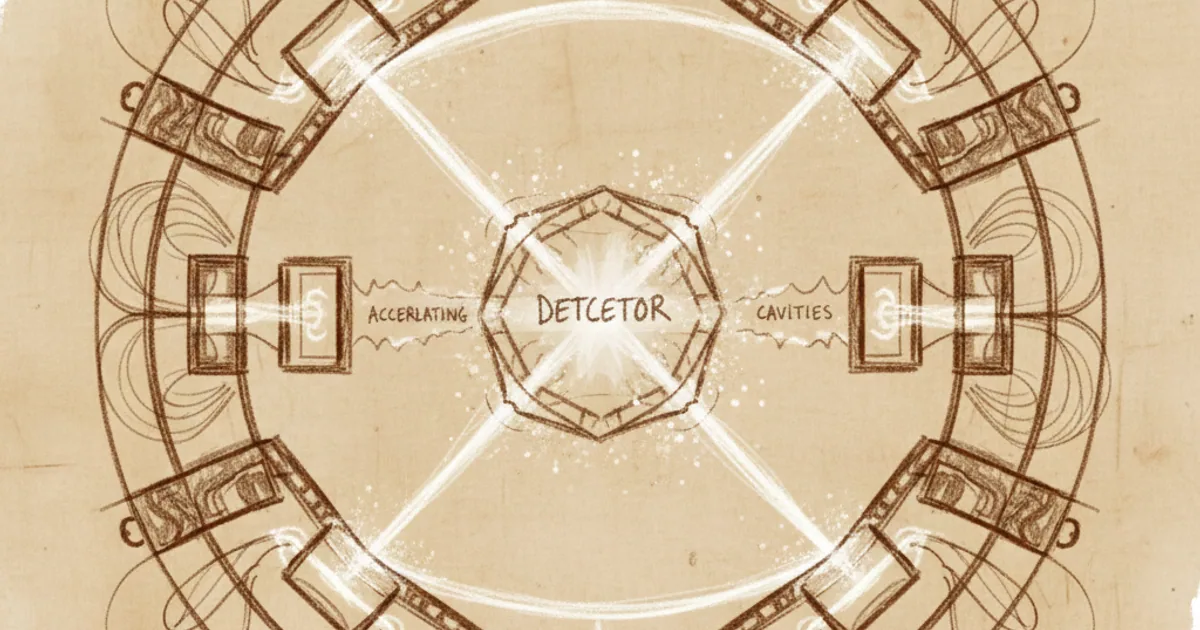
What an accelerator is
A particle accelerator is a machine that speeds up charged particles — typically electrons, protons, or ions — to high energies using electric and magnetic fields. At sufficient energy, the particles can be made to collide with each other (or with fixed targets), producing showers of new particles that reveal the underlying physics of the subatomic world.
The popular image is the LHC at CERN — a 27 km ring under the French-Swiss border, smashing protons at 13.6 TeV to look for new physics. But this is the famous tip of a much larger iceberg. More than 30,000 particle accelerators are in operation worldwide, the overwhelming majority doing medicine, industry, or applied research rather than discovery physics.
Cancer therapy, semiconductor manufacturing, food sterilization, materials analysis, X-ray production — all these depend on accelerator technology that was originally developed for fundamental physics. Particle physics is a small fraction of accelerator use today.
How an accelerator works
The basic physics: a charged particle in an electric field experiences a force (qE), causing it to accelerate. If the field points in the direction of motion, the particle speeds up. Reverse the field and reverse the direction, or maintain the field as the particle passes through, and you can keep adding energy with each cycle.
In practice, modern accelerators use radio-frequency (RF) cavities — chambers filled with oscillating electromagnetic fields at GHz frequencies, synchronized with the particles' arrival times so that each particle gets pushed forward each time it passes through.
To keep particles in a controllable path, accelerators use magnetic fields to bend the trajectory:
Bending magnets turn the particles around circular paths or steer them between sections.
Focusing magnets (quadrupoles, sextupoles, etc.) keep the beam tightly bunched together so particles don't spread out and hit the walls.
Beam diagnostics measure the beam's position, energy, and intensity continuously, feeding back to the steering magnets to keep the beam stable.
To accelerate efficiently, the accelerator must operate in vacuum — particles in air would scatter and lose energy too quickly. Modern accelerator beamlines operate at ultra-high vacuum (10⁻⁹ Pa or lower).
For very-high-energy machines, the magnets and cavities are often superconducting to reduce power consumption.
The two main geometries
Linear accelerators (LINACs): particles travel in a straight line, accelerating through successive RF cavities. Energy scales with length. Existing examples span an enormous range, from medical LINACs at MeV scales to SLAC's 50 GeV electron linac and the European XFEL's 17.5 GeV superconducting linac. The proposed International Linear Collider would reach 250-500 GeV at the collision point if built.
Advantages: no synchrotron radiation losses (which limit circular machines at high electron energy). Compact for moderate energies.
Disadvantages: each particle passes through accelerating sections once, so length scales with energy.
Circular accelerators (synchrotrons, cyclotrons): magnetic fields bend particles back to pass through accelerating cavities repeatedly. Energy can be ramped up over many turns.
Advantages: very high energies achievable in a fixed-size machine (LHC: 27 km circumference, 6.8 TeV per beam).
Disadvantages: charged particles in circular motion emit synchrotron radiation, losing energy. This loss is especially severe for electrons (which are light) — the LEP electron-positron collider had to operate at lower energy than the LHC (in the same tunnel) because of this. Protons (much heavier) emit much less synchrotron radiation per unit energy, allowing higher energies.
The LHC chose protons partly for this reason.
What the big colliders do
A short tour of major research accelerators:
LHC (Large Hadron Collider, CERN, Geneva): 27 km circumference, currently 13.6 TeV proton-proton collisions. Discovered the Higgs boson (2012). Continues searching for physics beyond the Standard Model. Major experiments: ATLAS, CMS, LHCb, ALICE.
Tevatron (Fermilab, US): 6.3 km circumference, proton-antiproton collisions at 1.96 TeV. Operated 1983-2011. Discovered the top quark (1995). Decommissioned after the LHC came online.
RHIC (Relativistic Heavy Ion Collider, Brookhaven, US): 3.8 km circumference. Specialized in heavy-ion collisions (gold-gold at 200 GeV per nucleon). Produced and studied quark-gluon plasma. Still operating.
SLAC LINAC (Stanford, US): 3 km linear accelerator. Reaches electron energies of ~50 GeV. Originally for particle physics; now mainly serves the LCLS X-ray free-electron laser for materials science.
KEKB / SuperKEKB (KEK, Japan): asymmetric electron-positron collider for B-meson physics. SuperKEKB began operation in 2018 and is upgrading.
J-PARC (Japan): multi-purpose accelerator producing neutrino beams (T2K experiment), neutrons, muons.
FAIR (Germany): under construction. Heavy-ion and antiproton research.
EIC (Electron-Ion Collider, US): under construction at Brookhaven. Will study the structure of protons and neutrons.
HL-LHC: upgrade to LHC, ramping up to higher luminosity (collision rate) later this decade.
FCC (Future Circular Collider, proposed): 91 km circumference, potentially up to 100 TeV proton-proton. Could begin operating in the 2050s if approved.
These big machines cost billions of dollars and take decades to plan and build. They're operated by international collaborations involving thousands of physicists.
What the accelerator does for medicine
Radiation therapy LINACs: by far the most common type of medical accelerator. About 12,000 are in operation worldwide. Electrons accelerated to 4-25 MeV produce X-rays that are aimed at tumors to destroy cancer cells. About 14 million radiotherapy treatments per year globally.
Proton therapy: roughly 200+ proton therapy centers worldwide as of the mid-2020s, with the number rising. Protons accelerated to 200-250 MeV deposit most of their energy at a precise depth (the "Bragg peak"), allowing targeted tumor irradiation with less damage to surrounding tissue. Especially valuable for pediatric tumors and tumors near critical organs.
Carbon-ion therapy: ~15+ facilities globally as of the mid-2020s, concentrated in Japan, China, and parts of Europe. Heavier ions deposit more energy at the Bragg peak, useful for radioresistant tumors.
Isotope production: accelerators (typically cyclotrons) produce short-lived radioisotopes for PET scans (fluorine-18, carbon-11, others), SPECT imaging (technetium-99m, though this is mostly reactor-produced), and targeted radionuclide therapy. ~1,200 medical cyclotrons worldwide.
Boron neutron capture therapy: emerging treatment where boron-10 in tumor cells absorbs neutrons (produced by an accelerator) and decays into high-LET particles that destroy the cell.
Medicine is the largest single application of accelerator technology by both number of machines and economic value.
What the accelerator does for industry
Ion implantation for semiconductors: ion implantation is widely used and essential in modern chip fabrication — accelerating boron, phosphorus, arsenic, or other ions to keV-MeV energies and embedding them at specific depths in silicon to create transistors. The semiconductor industry uses thousands of ion implanters globally.
Electron beam welding: high-power electron beams (typically 30-200 kV) weld metals in vacuum. Used in aerospace, nuclear, and precision manufacturing.
Materials processing: surface modification, cross-linking polymers for tougher wire insulation, vulcanization of rubber.
Food sterilization: electron beam or gamma irradiation kills pathogens in food, extends shelf life. Used widely for spices, meat products, and produce.
Sterilization of medical equipment: electron beam sterilization of single-use medical devices, replacing chemical methods.
Polymer modification: electron beam radiation crosslinks polymers for stronger, more durable plastics and cables.
Inspection: cargo container inspection using accelerator-produced X-rays at ports. Non-destructive evaluation of aerospace components.
Industry uses thousands of medium-energy accelerators (~1-10 MeV electron beams or proton beams) for these applications. The total market is in the billions of dollars annually.
What the accelerator does for science (beyond particle physics)
Synchrotron light sources: ~50 operating worldwide. Circular accelerators that produce intense X-ray, UV, and IR light for materials science, structural biology, chemistry, geology, and many other fields. Crystallographic determination of protein structures — including for drug development — relies heavily on synchrotron radiation.
Free-electron lasers (FELs): more than 20 facilities operating or under construction as of the mid-2020s, depending on how soft-X-ray, hard-X-ray, and IR/UV machines are counted. Produce ultrashort, ultra-bright pulses of coherent X-rays. Enable observation of molecular processes on femtosecond timescales. Major facilities: LCLS at SLAC, European XFEL, SACLA in Japan, PAL-XFEL in Korea, SwissFEL.
Neutron sources: accelerator-driven spallation neutron sources (ISIS in UK, SNS in US, J-PARC in Japan, ESS in Sweden) produce neutron beams for materials science, condensed matter physics, and biology.
Ion beam analysis: PIXE, RBS, ERDA, and other techniques use ion beams to characterize materials with high sensitivity. Used in archaeology, geology, art conservation, and forensic science.
Accelerator mass spectrometry (AMS): dating archaeological samples (carbon-14 dating), tracking rare isotopes in environmental samples. Much more sensitive than conventional mass spectrometry.
Nuclear physics: heavy-ion accelerators for studying nuclear structure and reactions. Discoveries include creating superheavy elements (oganesson, the heaviest known element, was created at JINR in Russia using a heavy-ion accelerator).
Detectors: where the accelerator's work shows up
Without detectors, accelerators wouldn't produce any useful information. Modern detectors are extraordinary engineering achievements.
The ATLAS detector at the LHC:
- About 25 m diameter, 46 m long, 7,000 tonnes.
- Multiple concentric layers detecting different particle types.
- ~100 million electronic readout channels.
- Records about 1 billion proton-proton collisions per second, filtering down to ~1,000 per second for offline analysis.
CMS, the other major LHC detector, is similar scale with different design choices.
Detection methods include:
- Tracking chambers: silicon strip detectors record charged particle paths to micrometer precision.
- Calorimeters: measure particle energies by absorbing them and measuring the resulting shower of secondary particles.
- Muon chambers: outer layers detecting muons (which penetrate most materials).
- Particle identification systems: Cherenkov detectors, time-of-flight measurements, transition radiation detectors.
The raw data rates inside the detectors are enormous, but multi-stage trigger systems reduce the flow to manageable levels — the LHC experiments handle on the order of 100-200 PB of stored data per year across all the detectors. Modern detectors are partly small-scale physics experiments unto themselves.
What's coming next
HL-LHC (High-Luminosity LHC): scheduled to begin operations later this decade. Will increase the collision rate (luminosity) by a factor of about 7, enabling much more precise measurements of the Higgs boson and rare processes.
Electron-Ion Collider (EIC) at Brookhaven: in the design/construction phase, with first operations expected in the early 2030s. Will probe the spin structure of protons, gluon dynamics, and the role of gluons in nucleon mass.
Future Circular Collider (FCC): proposed at CERN. ~91 km circumference. Initial phase as electron-positron collider for Higgs precision measurements, later as proton-proton collider at ~100 TeV. Decision and construction would span the 2030s-50s; operation potentially mid-21st century.
Linear collider proposals: ILC in Japan (electron-positron) and CLIC at CERN have been proposed but not yet approved.
Compact accelerators: research into plasma-wakefield acceleration could enable much smaller, cheaper accelerators with energies comparable to current giant machines. Demonstrations have shown GV/m acceleration gradients — roughly 1000x current accelerator gradients. Practical commercial use is still years away.
Muon colliders: proposed but technically challenging. Muons are much heavier than electrons, so emit less synchrotron radiation, allowing higher circular-collider energies. Cooling and storing muons is the main challenge.
If you'd like a guided 5-minute course on particle accelerators and what they're used for, NerdSip can generate one.
The takeaway
A particle accelerator uses electric fields to speed charged particles to high energies and magnetic fields to steer them. Collisions of accelerated particles with each other or with fixed targets produce showers of new particles that detectors analyze, revealing the underlying physics. The LHC at CERN is the most famous, but accelerators dominantly serve medicine (radiation therapy, proton therapy, isotope production), industry (semiconductor manufacturing, sterilization, materials processing), and applied science (synchrotron light, X-ray FELs, neutron sources). More than 30,000 accelerators are in use worldwide; only a few dozen do fundamental discovery physics. The underlying technology, originally developed for particle physics research, now contributes billions of dollars annually to medicine and industry — one of the major "spinoff" success stories of fundamental research.
The same physics — controlling charged particles with electric and magnetic fields to probe matter — also powers the everyday-lab cousin of accelerator imaging: scanning electron microscopy, where a small focused electron beam scans a sample to produce images at the nanometer scale.

Comments 0
No comments yet. Be the first to share your thoughts.