
The puzzle they solved
In the 1950s and 60s, particle accelerators were creating dozens of new short-lived particles every year. The "particle zoo" was rapidly becoming embarrassing — particle physics was supposed to be about a few elegant fundamentals, not a chaotic collection of hundreds of slightly-different particles.
In 1961, Murray Gell-Mann noticed patterns in this menagerie. Hadrons (the strongly-interacting particles, including protons, neutrons, pions, kaons, and many others) fell into geometrical groupings — octets and decuplets — when organized by their properties. The patterns were too clean to be coincidence; there must be some underlying structure.
In 1963, Gell-Mann (and independently George Zweig) proposed an explanation: hadrons are composite particles made of more fundamental constituents. Gell-Mann named them quarks, taking the word from James Joyce's Finnegans Wake. Zweig called them "aces." Gell-Mann's name stuck.
The model required quarks to have fractional electric charges — +2/3 or -1/3 of an electron charge. This seemed strange at the time (all observed particles had integer charges), but the math worked. Three quarks of types u (charge +2/3) and d (charge -1/3) could combine to produce the entire observed pattern of hadrons.
By the late 1960s, experiments at SLAC (Stanford Linear Accelerator Center) provided direct evidence: shooting electrons into protons at high energy revealed that protons have substructure — hard, small, point-like scatterers inside them. Quarks.
The 1969 Nobel Prize in Physics went to Gell-Mann for the quark model. Subsequent decades filled in the rest of the picture.
The six quark flavors
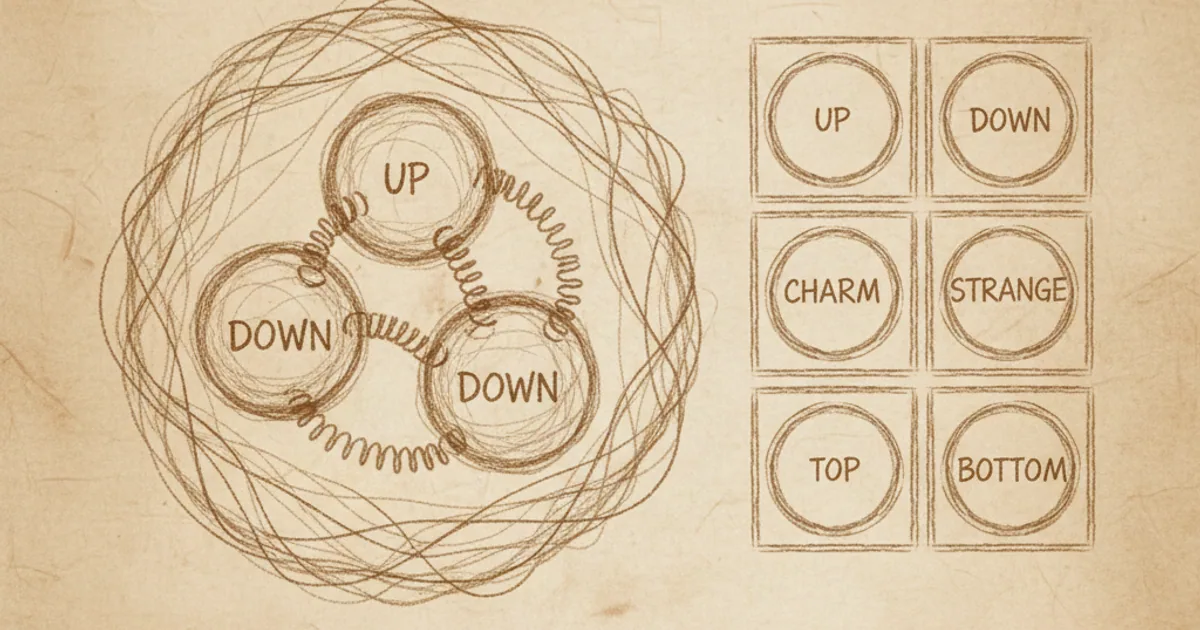
There are six flavors of quark, organized into three generations:
| Generation | Up-type (+2/3) | Down-type (-1/3) |
|---|---|---|
| 1st | up (u) | down (d) |
| 2nd | charm (c) | strange (s) |
| 3rd | top (t) | bottom (b) |
Each successive generation is much heavier than the one before. The lightest (up and down quarks) are the constituents of ordinary matter. The heavier flavors appear briefly in cosmic ray interactions, particle accelerator collisions, and decays — they decay quickly into lighter quarks via the weak force.
Approximate masses (in MeV/c², the units particle physicists use):
- up: ~2.2
- down: ~4.7
- charm: ~1,270
- strange: ~95
- top: ~173,000 (heaviest fundamental particle known)
- bottom: ~4,180
The top quark is so massive it's by far the most massive fundamental particle in the Standard Model — about 184 times the proton mass.
Hadrons: what quarks build
Quarks don't exist alone (quark confinement, see below). They combine into composite particles called hadrons. There are two main types:
Baryons are made of three quarks (or three antiquarks for antibaryons). Examples:
- Proton: u-u-d. Charge: 2(+2/3) + (-1/3) = +1.
- Neutron: u-d-d. Charge: (+2/3) + 2(-1/3) = 0.
- Lambda baryon (Λ): u-d-s. Charge: 0. Contains a strange quark, so it's "strange" baryon.
- Delta baryons: various combinations of u and d with different spin alignments.
- Many others involving heavier quarks.
Mesons are made of one quark and one antiquark. Examples:
- Pion (π⁺): u + anti-d. Charge: +1.
- Kaon (K⁺): u + anti-s.
- J/psi (J/ψ): c + anti-c. Famous discovery (1974) confirming the existence of the charm quark.
- Upsilon (Υ): b + anti-b. Discovery (1977) confirming the bottom quark.
The full list of observed hadrons numbers in the hundreds. Modern experiments at the LHC and elsewhere continue to discover new exotic hadrons — including pentaquarks (5-quark systems) and tetraquarks (4-quark systems), confirmed in the 2010s.
Color charge and the strong force
Quarks carry another property beyond electric charge: color charge. This is the source of the strong nuclear force.
Color charge has three possible values, conventionally called red, green, and blue. (These names are arbitrary labels — they have nothing to do with actual colors of light.) Each quark carries one color. Each antiquark carries an anti-color.
The rule: hadrons must be color-neutral. This means:
- A baryon contains one red, one green, and one blue quark (combining to "white" = neutral, analogous to combining colored lights).
- A meson contains a quark of one color and an antiquark of the matching anti-color.
The strong force is mediated by particles called gluons, which carry color charge themselves. There are 8 distinct gluons. They bind quarks into hadrons and also bind hadrons (especially protons and neutrons) into atomic nuclei.
This branch of physics — describing quarks, color charge, and gluons — is called quantum chromodynamics (QCD). Chromodynamics literally means "color dynamics."
The remarkable feature of the strong force: it gets stronger with distance, unlike gravity or electromagnetism. At very short distances (inside a proton), quarks move almost freely. At larger distances (around a femtometer), the force is enormous.
Quark confinement
The distance-dependent strong force has a dramatic consequence: you can never isolate a single quark.
Try to pull a quark out of a proton. Initially, you can move it a short distance. But as you stretch the connection, the strong force grows. The energy in the elastic "color string" between the separated quarks increases.
At some point, the energy invested in pulling them apart exceeds the energy needed to create a new quark-antiquark pair from the vacuum. Rather than separating, the system spontaneously produces a new quark-antiquark pair somewhere along the stretched string. Now you have two hadrons (each color-neutral) instead of a stretched quark pair.
So no matter how hard you try, you never get a free quark. You get jets of hadrons instead.
This is confinement. It's empirically observed at every energy probed; theoretically expected from QCD; and one of the most distinctive features of strongly-interacting matter.
The one exception: top quarks. They're so massive that they decay (via the weak force) before they have time to combine with other quarks. The decay timescale (5 × 10⁻²⁵ s) is shorter than the hadronization timescale (10⁻²³ s). So top quarks effectively exist briefly as "naked" quarks, then decay before forming a hadron. This is why top quarks are studied separately and provide unique access to quark physics.
Where most of your mass comes from
A surprising fact: most of the mass of ordinary matter does NOT come from the rest masses of the quarks inside.
A proton's rest mass is about 938 MeV/c². The three quarks inside have rest masses summing to about 9 MeV/c² (two up at ~2.2 each plus one down at ~4.7). That's about 1% of the proton's mass.
The other 99% comes from:
- Kinetic energy of the quarks: they're moving fast inside the confined region.
- Binding energy of the strong force: the gluon field carries significant energy.
By E = mc², energy IS mass. The strong force binding the quarks contributes most of what we measure as the proton's mass.
So when you weigh yourself, you're mostly weighing the gluon-field energy holding quarks together inside your protons and neutrons. The actual quark and electron rest masses are a small fraction. The mass-from-binding-energy is a beautiful illustration of Einstein's E = mc² in everyday matter.
The Higgs field is responsible for the rest of the mass — particularly for electrons (which have no internal structure to generate mass from binding) and for the small rest masses of the quarks themselves. See what the Higgs boson actually does.
How we know quarks exist
A natural question: if you can't isolate a single quark, how do we know they exist?
Several lines of evidence:
1. Deep inelastic scattering: shoot high-energy electrons into protons. The electrons scatter off small, hard, point-like things inside the proton. The scattering pattern reveals three "partons" (later identified as quarks) inside. Done at SLAC starting in the late 1960s; Friedman, Kendall, and Taylor shared the 1990 Nobel Prize.
2. Jets in high-energy collisions: when energy is high enough to "knock a quark out," it doesn't isolate; it produces a collimated spray of hadrons (a "jet") in the direction the quark would have gone. The energy and angular distribution of jets match quark predictions precisely.
3. Mass spectrum of hadrons: the predicted masses of hadrons based on quark content match observed values across hundreds of particles.
4. Properties of mesons: bound quark-antiquark states (like J/psi and upsilon) have observed energy spectra that match QCD predictions to high precision.
5. Discovery of predicted new particles: the Omega-minus baryon (Gell-Mann's prediction) and the charm, bottom, and top quarks (all predicted) were subsequently observed with the predicted properties.
6. Lattice QCD calculations: numerical simulations of QCD on supercomputers reproduce the observed hadron mass spectrum to about 1% accuracy. This is a tour-de-force computation that confirms the theory works.
So quarks aren't directly observable as free particles, but the evidence for them is overwhelming and quantitative.
The exotic hadrons
In the 2000s and 2010s, the LHC and other experiments confirmed several long-suspected types of "exotic" hadrons:
Tetraquarks: bound states of four quarks (two quarks + two antiquarks). The Z(4430) and X(3872) are early candidates; many more have been observed.
Pentaquarks: bound states of five quarks (four quarks + one antiquark). LHCb at CERN confirmed the existence of pentaquarks in 2015.
Glueballs: hypothetical bound states of gluons alone, with no quarks. Searched for but not yet definitively identified.
Hybrid mesons: mesons containing both a quark-antiquark pair and an excited gluonic component. Some candidates have been identified.
These exotic hadrons are predicted by QCD but were hard to detect — they're typically heavy, short-lived, and produced rarely. The expanding catalog confirms our understanding of strong-force binding.
Quark colors as a unified field
In the Standard Model, the strong force is described by a gauge theory with the symmetry group SU(3) — corresponding to the three color charges. The exchange of gluons mediates the force.
The electroweak interaction (combining electromagnetism and the weak force) has symmetry group SU(2) × U(1).
Combining these (SU(3) × SU(2) × U(1)) gives the gauge structure of the Standard Model.
The full theory describes:
- Quarks (six flavors, three colors each).
- Leptons (six flavors).
- Gauge bosons (gluons, photon, W, Z).
- The Higgs boson.
Each particle interacts via specific forces determined by which charges it carries:
- Strong force: only particles that carry color charge (quarks and gluons themselves; leptons don't feel it).
- Weak force: quarks and leptons.
- Electromagnetic force: all charged particles.
- Gravity: all particles (but extremely weak per particle).
The whole structure is mathematically beautiful and empirically successful — particle physics' "Standard Model" really does describe the underlying physics of ordinary matter.
If you'd like a guided 5-minute course on quarks and the strong force, NerdSip can generate one.
The takeaway
Quarks are the fundamental constituents of protons, neutrons, and many other hadrons. There are six flavors (up, down, charm, strange, top, bottom) with fractional electric charges (+2/3 or -1/3). They carry color charge, which is the source of the strong nuclear force mediated by gluons. Quark confinement means free quarks have never been observed — they always come in color-neutral combinations. Most of the mass of ordinary matter comes from the kinetic and binding energies inside hadrons, not from the quarks' tiny rest masses. The quark model, developed in the 1960s and confirmed by experiments since then, is one of the central achievements of 20th-century physics and a key component of the Standard Model.

Comments 0
No comments yet. Be the first to share your thoughts.