
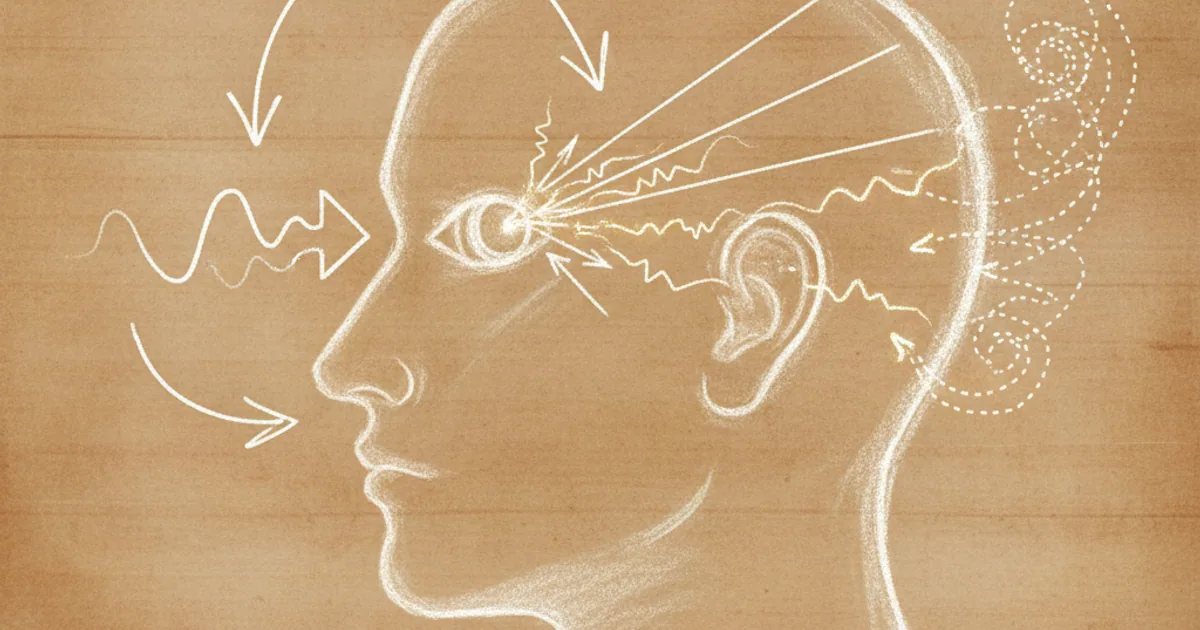
The one idea behind every sense
Here's a thing worth sitting with: your brain, sealed inside a dark bony box, has never once touched the outside world. It has never seen light, never felt a breeze, never smelled coffee. It sits in silence and darkness its whole life. Everything you experience — every colour, every sound, every taste — is a story the brain builds from a single kind of raw material: electrical pulses running down nerves.
That's the whole game. And once you see it, all five senses stop looking like five different miracles and start looking like five versions of the same trick.
A sense is a transducer
A transducer is just a device that turns one kind of energy into another. A microphone is a transducer — it turns sound into electricity. A solar cell turns light into electricity. Your senses are biological transducers, and each one is built to convert a particular physical thing into the one currency the brain understands: nerve signals.
Look at what each sense actually takes in:
- Sight converts light — electromagnetic waves.
- Hearing converts pressure waves travelling through air.
- Smell and taste convert molecules — actual bits of stuff, floating in air or dissolved in spit.
- Touch converts pressure, stretch, heat and cold.
Four completely different physical things going in. But the same thing comes out of all of them: a train of electrical pulses heading for the brain. The nose doesn't send "smell" to the brain any more than the eye sends "light." They both send pulses. The difference is only in which wire the pulses travel on.
Receptors: the front door
The conversion happens at cells called receptors. A receptor is a specialist. It's built to respond to one kind of stimulus and ignore the rest.
In your eye, the receptors are rods and cones — cells packed with a pigment that changes shape when a particle of light hits it. That shape change opens the door to an electrical signal. In your ear, the receptors are hair cells, tiny cells with hair-like bundles that bend when sound vibrations pass; bending them triggers a signal. In your nose, receptor cells carry molecular "locks" that only fit certain odour molecules — the molecule slots in like a key, and the cell fires. In your skin, different receptors handle light touch, deep pressure, and temperature.
Different machinery, same job every time: something physical arrives, and the receptor answers with electricity.
The signal travels, unchanged in kind
Once a receptor fires, the signal travels along a nerve to the brain. And here's the surprising part: the signal is basically identical no matter where it came from. A nerve impulse from your eye is the same kind of electrical event as one from your toe. There's no "colour" flowing up the optic nerve and no "pain" flowing up from a stubbed toe — just voltage spikes, all more or less alike.
So how does the brain tell them apart? By address. Each nerve plugs into a specific region of the brain. Signals arriving in the visual cortex get read as sight, no matter what actually caused them. Signals arriving in the auditory cortex get read as sound. Scientists call this the labelled line principle: the meaning is in the destination, not the message.
You can prove it to yourself. Press gently on the corner of your closed eye and you'll see a faint glowing spot — a "phosphene." There's no light there. You've mechanically triggered the eye's nerve, and because that signal arrives in the visual cortex, the brain has no choice but to interpret it as light. Poke the seeing-wire and you see, even in the dark.
Perception happens in the brain, not the world
This is the punchline, and it's a strange one. The colours, sounds, and smells you experience are not out there — they're constructed in here.
Out in the world there's light of various wavelengths, but "red" is something your brain makes. There are pressure waves at various frequencies, but "middle C" is something your brain makes. There are molecules of a certain shape, but the "smell of rain" is something your brain makes. The physical world supplies raw signals; the experience is assembled inside your skull.
And the brain doesn't just passively translate. It actively interprets — filling in gaps, guessing at missing pieces, cleaning up noise, and predicting what should come next. Your eye has a blind spot where the optic nerve leaves the retina, a genuine hole with no receptors at all. You never notice it, because the brain quietly paints over the gap with a best guess. Most of what you "see" at any instant is actually memory and inference, not fresh data.
Which is exactly why senses can be fooled
Because perception is a construction, it can be built wrong. An illusion is what happens when you feed the brain input that its normal shortcuts handle badly.
A drawing on flat paper can look three-dimensional because it contains the depth cues your brain evolved to trust. A ventriloquist "throws" their voice because your brain assumes sound comes from the moving mouth it can see. A cold room can feel colder after a hot bath because touch reports change, not absolute temperature. In every case nothing is broken — the same guessing machinery that lets you recognise a friend's face in a crowd, or hear your name across a noisy party, is simply being fed an input it wasn't tuned for.
Illusions aren't failures of the senses. They're the fingerprints of how the senses work.
The through-line
So here is the map for everything that follows. Every sense is a transducer that converts a physical stimulus into electrical signals. The conversion happens at receptors tuned to one kind of input. The signals travel down nerves to specific brain regions, where meaning comes from the destination, not the message. And the final experience — the colour, the note, the flavour — is built by the brain, which is why it's so vivid, so useful, and so easy to fool.
Look at any single sense — how your eyes turn light into sight, how you hear, or how smell and taste work together — and you'll find the same four steps underneath. Different front door, same house.

Comments 0
No comments yet. Be the first to share your thoughts.