
The senses that taste the world itself
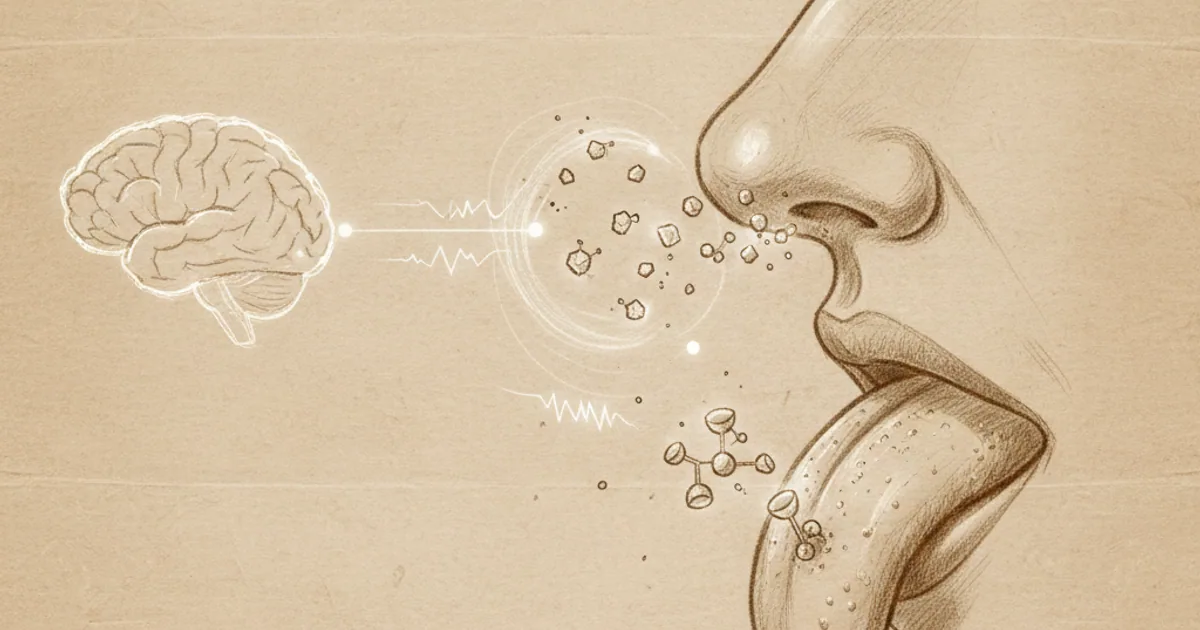
Sight and hearing keep the world at a distance. Light and sound arrive as waves; you never touch the thing you're seeing or the source you're hearing. Smell and taste are different, and it's worth pausing on how strange they are: they're the senses where you detect the world by catching literal pieces of it. A smell is molecules of an object that have drifted off and floated into your nose. A taste is molecules dissolved in your spit, landing on your tongue. For this reason they're grouped together as the chemical senses — the ones that work by chemistry, not physics.
They feel like one experience when you eat, but they're two separate systems doing two different jobs. Understanding how they split — and how the brain glues them back together — is the whole story of flavour.
Smell: molecules as keys
Sniff, and you pull air into the top of your nasal cavity, up where a patch of specialised cells waits. These are your olfactory receptors, and they sense by shape. Each receptor is built with a molecular pocket, and an airborne odour molecule fits into that pocket like a key into a lock. When a molecule of the right shape docks in, the cell fires an electrical signal. There's the transduction: a physical molecule, converted straight into a nerve impulse.
Here's the clever part. You have roughly 400 different types of these receptors, but the number of distinguishable smells is vastly larger than that. How? Because most odour molecules aren't a perfect match for a single receptor — they partly fit several. A given smell activates a whole pattern of receptors, some strongly, some weakly, most not at all. Coffee lights up one combination; cut grass lights up another; your grandmother's kitchen lights up a third. The brain doesn't read individual receptors — it reads the pattern across all of them, like reading a chord instead of a single note. A few hundred receptors, combined this way, let you tell apart an enormous range of odours.
Those signals run a short hop into the brain's smell centre — notably one of the very few sensory pathways that reaches deep emotional and memory regions before passing through the brain's usual relay station. That shortcut is why a smell can drop you into a vivid childhood memory faster than any photograph.
Taste: only five notes
Now the tongue — and the surprise is how little it does on its own. Scattered across your tongue (and parts of the mouth and throat) are taste buds, small clusters of sensing cells. Despite all the variety of things you eat, those cells report just five basic tastes:
- Sweet — flags energy, sugars.
- Salty — flags salt and minerals your body needs.
- Sour — flags acidity, often a sign of unripe or spoiled food.
- Bitter — flags many toxins, which is why it triggers instinctive caution.
- Umami — the savoury, brothy taste of protein-rich foods, meats, aged cheese, mushrooms, tomatoes.
That's essentially it. Each taste bud carries cells for these qualities, and each works by chemistry — dissolved molecules trigger the matching cells to fire. Notice how practical the list is: these five are the things a survival machine most needs to know about food. Is there energy here? Salt? Protein? Is it going off? Is it poison? Taste is a blunt but ancient safety-and-nutrition report.
And a myth to bury while we're here: the old "tongue map", with sweet at the tip and bitter at the back, is wrong. All five tastes are detected across essentially the whole tongue. There are no separate zones.
The twist: flavour is mostly smell
So if the tongue only knows five things, where does the endless richness of eating come from — the way a strawberry differs from a raspberry, coffee from cocoa, a fine wine from grape juice? Almost none of that is taste. It's smell.
As you chew and swallow, warmth and motion release odour molecules from the food, and they waft up the back of your throat into your nasal cavity from behind. This back-door route is called retronasal smell, and it's smell doing its full molecular pattern-recognition trick — just entering from the throat instead of the nostrils. Your brain then does something sneaky: it takes that flood of smell information and the tongue's five basic tastes and fuses them into a single unified experience it labels "flavour." The fusion is so seamless that you swear the whole thing is happening in your mouth. It isn't. The mouth supplies five notes; the nose supplies the melody.
You can prove it in ten seconds. Pinch your nose shut and eat something — a jelly bean is perfect. You'll get sweet, and maybe a vague sourness, but you often can't tell which flavour it is. Let go of your nose mid-chew and the identity floods back instantly: oh, that's lemon. Nothing changed on your tongue. You simply reconnected the sense that was doing most of the work. It's also why food goes flat and unidentifiable when a cold blocks your nose — the taste buds are fine, but the smell channel is shut, and flavour collapses down to its five bare tastes.
The same idea, one more time
Smell and taste look like an odd couple, but they're built on the pattern shared by every sense. Both are transducers that turn a physical stimulus into nerve signals — except here the stimulus is molecules of the world itself. Smell reads a pattern across a few hundred receptors to distinguish a vast range of odours; taste reports a spare, survival-focused set of five basic qualities. And the experience you consciously call flavour is neither one alone — it's the brain fusing them together, mostly out of smell, into a single sensation that feels like it lives on your tongue.
Which loops back to the big idea behind all your senses: the world outside supplies raw physical signals, and the experience — the smell of rain, the taste of home — is assembled inside your head.

Comments 0
No comments yet. Be the first to share your thoughts.