
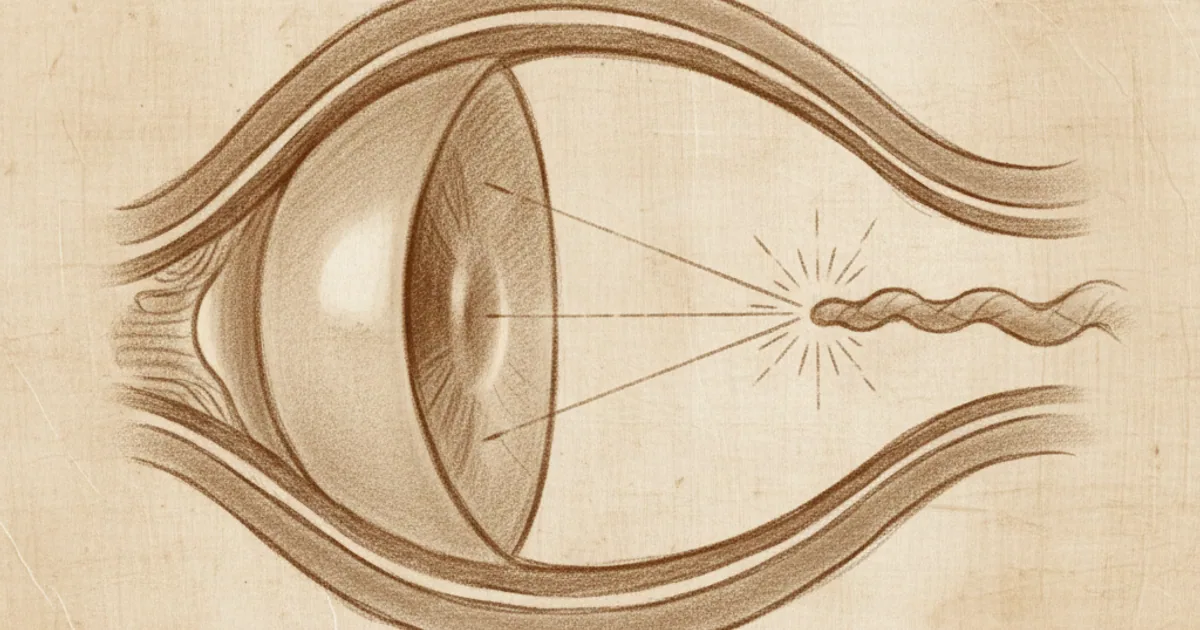
The eye is a camera made of jelly
If you want to understand the eye, start with a camera — because the eye is one, built out of water and living tissue instead of glass and metal. Light comes in the front, gets bent so it lands in sharp focus on a screen at the back, and the screen turns that light into signals. That's the whole apparatus. Every part of the eye is in service of those two jobs: focus the light, then convert it.
And like every sense, the eye is only the sensor. The picture you actually experience is built later, in the brain. Keep that split in mind — it explains almost everything strange about vision.
Bending the light into focus
Light from the world hits the front of your eye and immediately starts bending. Most people think the lens does the focusing, but the biggest bend actually happens at the cornea, the clear dome on the very front. Light slows down as it enters that curved layer of tissue, and slowing down on a curve makes it turn — the same reason a straw looks bent in a glass of water.
The cornea does the bulk of the focusing with a fixed amount of bend. The lens behind it does the fine-tuning. Tiny muscles squeeze the lens fatter or let it go thinner, changing exactly where the light comes to a point. Look at something far away and the lens relaxes thin; bring a book close and the muscles pull it fat to keep the focus sharp. That constant adjustment is called accommodation, and it's the same principle that governs how any lens actually works.
In between, the coloured iris opens and closes like a camera's aperture, widening in the dark to let more light in and shrinking in bright sun to protect the sensor and sharpen the image.
The retina: where light becomes signal
All that focusing aims the light at the retina, a thin sheet of light-sensitive cells lining the back inside of the eyeball. This is the film, the sensor chip — the place where the actual transduction happens, where light stops being light and becomes electricity.
The retina's sensing cells come in two flavours, and they split the work:
Rods are the low-light specialists. They're wildly sensitive — a rod can respond to a single particle of light — but they're colour-blind and a bit fuzzy on detail. Rods are why you can find your way across a dark room, why a moonlit world looks grey rather than colourful, and why faint stars vanish when you look straight at them but reappear when you glance slightly to the side. There are more than a hundred million rods spread across the retina.
Cones are the daylight specialists. They need more light to fire, but they give you colour and crisp detail. You have three types, tuned to roughly red, green and blue wavelengths of light. Your brain compares how strongly each type responds and reads that ratio as colour — which is the real reason things have colour at all. Cones cluster densely at a tiny central pit called the fovea, the spot of your sharpest vision. Everything you look at directly is landing on the fovea; everything else is surprisingly blurry, though you'd never guess it.
Inside both rods and cones sit molecules of a pigment that physically changes shape the instant a particle of light strikes it. That shape change is the trigger. It sets off a chain of chemistry that produces an electrical signal — light, converted into the brain's only language.
Down the optic nerve, into the dark
The retina bundles all its signals into a thick cable, the optic nerve, which runs out the back of the eye and into the brain. But here's a quirk with real consequences: the optic nerve has to pass through the retina to exit. At that exit point there's no room for rods or cones. It's a genuine hole in your vision — a blind spot in each eye where you literally cannot see.
You never notice it. Two things hide it. First, your eyes point in slightly different directions, so one eye's blind spot is covered by the other eye. Second, and stranger, even with one eye shut the brain simply fills in the gap — it looks at the pattern surrounding the hole and paints a plausible best guess right over it. You can catch the brain doing this with a simple blind-spot test: close one eye, stare at a dot, and a second mark off to the side will silently vanish as it falls on the hole — and you'll see unbroken background where the mark used to be.
The brain assembles the picture
Now the payoff. What arrives at the brain is a mess by any camera's standard. The image is upside down and flipped left-to-right, because the lens crossed the rays over on their way in. It's split down the middle and shared between both hemispheres of the brain. It's razor-sharp in a tiny central patch and blurry everywhere else. It has two holes in it. And it's jittering constantly, because your eyes flick around several times a second.
You experience none of that. You experience a stable, seamless, right-way-up, fully-coloured, sharp-everywhere scene. That scene is the brain's construction. The visual cortex takes the raw, broken, upside-down signals and reassembles them: it settles the orientation, stitches the two eyes into one 3D view, fills the blind spots, sharpens up the periphery from memory, and smooths over the jitter so the world holds still.
This is why seeing is not something your eyes do — it's something your brain does with what your eyes send it. The eye is a superb sensor. But the picture, the actual visual experience, is manufactured behind it. That's also why the eye can be fooled so easily: hand the brain the right misleading cues and it will confidently build you a scene that isn't there.
The chain, start to finish
Light bends through the cornea and lens, comes to a focus on the retina, and there the rods and cones convert it into electrical signals. Those signals run down the optic nerve — past the unavoidable blind spot — into the brain, which flips, merges, fills, sharpens and stabilises them into the single vivid picture you call sight. Focus, convert, transmit, construct. A camera made of jelly, wired to the most powerful image processor known.

Comments 0
No comments yet. Be the first to share your thoughts.