
Sound is just air being pushed
Before we open up the ear, get clear on what it's actually catching. Sound is not a substance. It's a pattern — a wave of pressure moving through air. When something vibrates, say a guitar string or your vocal cords, it shoves the air next to it, which shoves the air next to that, and so on. The push travels outward as a ripple of slightly-squeezed and slightly-stretched air. Nothing flies from the string to your ear; the air mostly stays put and just jiggles in place, passing the disturbance along like a crowd doing the wave.
Two things about that ripple carry all the information. How big the squeeze is sets the loudness. How fast the squeezes come — the frequency — sets the pitch. Fast ripples are high notes, slow ripples are low notes. That's the entire raw material your ear has to work with. Everything else is the machinery for reading it.
And like every sense, the ear is a transducer: its whole purpose is to convert that pressure wave into electrical signals the brain can interpret. It does the job in a relay of clever stages.
Stage one: catching the wave
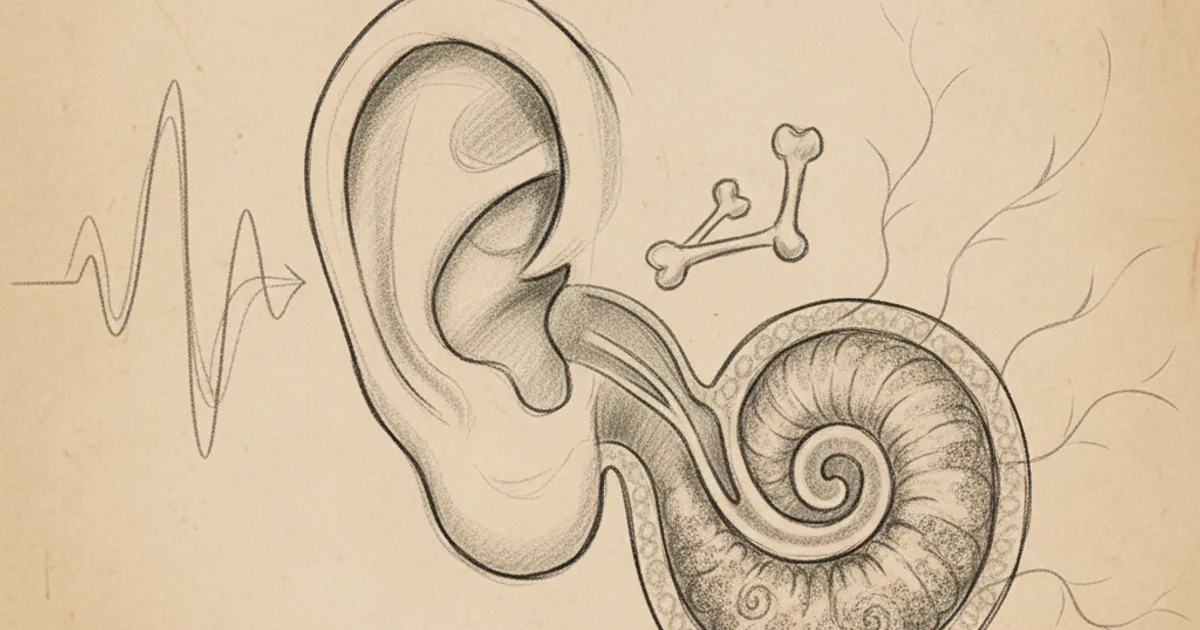
The visible, floppy part of your ear — the pinna — is a funnel. Its odd folds and ridges aren't decoration; they gather sound and channel it into the ear canal, and they subtly shape it in ways that help you tell whether a sound came from above, below, in front or behind.
At the end of the canal sits the eardrum, a thin, tightly stretched membrane. When the pressure wave arrives, it pushes and pulls on this membrane, and the eardrum vibrates in perfect step with the incoming sound. A high note wobbles it fast; a low note wobbles it slow; a loud sound swings it far. The airborne wave has now become a mechanical vibration in a piece of tissue. First conversion done.
Stage two: the three smallest bones you own
Behind the eardrum is an air-filled space crossed by three linked bones — the smallest bones in your body. From their shapes they're nicknamed the hammer, the anvil, and the stirrup. They form a little chain: the hammer is glued to the back of the eardrum, it taps the anvil, the anvil nudges the stirrup, and the stirrup pushes on a small membrane-covered window leading into the inner ear.
Why bother with a bony relay instead of a direct connection? Because of a real physics problem waiting on the other side. The inner ear is filled with fluid, and fluid is far harder to push than air. If the eardrum's vibration hit that fluid directly, most of it would simply bounce off, and you'd hear almost nothing — the same way shouting at a swimming pool doesn't disturb a swimmer underwater. The three bones fix this. They act as a lever, and they funnel the eardrum's wide, gentle motion down onto a tiny window. Concentrating the force onto a small area cranks up the pressure enough to actually move the fluid. The bones are, in effect, an amplifier and matchmaker between air and liquid.
Stage three: the spiral that sorts sound
Now the fluid. The cochlea is a fluid-filled tube coiled like a snail shell, and this is where hearing truly happens — where vibration finally becomes nerve signal.
When the stirrup pushes on the window, it sends a ripple travelling through the cochlear fluid. Running the length of the spiral is a flexible strip, the basilar membrane, and here's the beautiful trick: that strip is not the same all the way along. Near the entrance it's stiff and narrow; deep in the coil it's floppy and wide. Because of that gradient, different frequencies make it ripple most strongly at different places. A high note peaks the ripple right near the entrance. A low note carries deeper before it peaks. Every pitch has its own address along the spiral.
Sitting on that membrane are the sensors themselves: rows of hair cells, each topped with a bundle of tiny hair-like projections. When the fluid ripples and the membrane moves beneath them, those hair bundles bend. Bending them yanks open microscopic gates, and the cell fires an electrical signal. A hair cell only fires strongly when the ripple peaks at its spot — which means each hair cell is effectively tuned to its own frequency. The cochlea has thousands of them laid out from high pitch to low, so it doesn't just detect sound; it takes a complex jumble of frequencies and splits it into its component notes before a single signal reaches the brain. It's a mechanical spectrum analyser made of fluid and hair.
Stage four: up to the brain
Every firing hair cell feeds into the auditory nerve, the cable running to the brain. And now the labelled-line principle does its work: the brain reads which fibres are firing as which pitch, and how hard they fire as how loud. A signal from the entrance end means "high note"; one from deep in the coil means "low note." Timing differences between your two ears — a sound reaching one ear a hair earlier than the other — let the brain work out direction.
From that stream of signals the brain builds the whole rich experience: a melody, a friend's voice picked out across a noisy room, the meaning of speech. As always, the ear only ever sends electrical pulses. The sound you actually hear is assembled in the brain — which is exactly why it can be fooled, why two pure tones close in pitch can produce a throbbing "beat" that isn't physically there, and why you can seem to hear your name through a wall of party chatter.
The relay, end to end
Trace the whole path and it's one handoff after another. A pressure wave in the air funnels down the canal and sets the eardrum vibrating. Three tiny bones carry and amplify that vibration, matching air to fluid, and push on the cochlea. Inside the spiral, a fluid ripple bends hair cells tuned to different frequencies, converting the motion into nerve signals sorted by pitch. The auditory nerve carries them to the brain, which turns the sorted signals back into music, voices, and meaning. Wave, vibration, ripple, signal — that's how you hear.

Comments 0
No comments yet. Be the first to share your thoughts.