
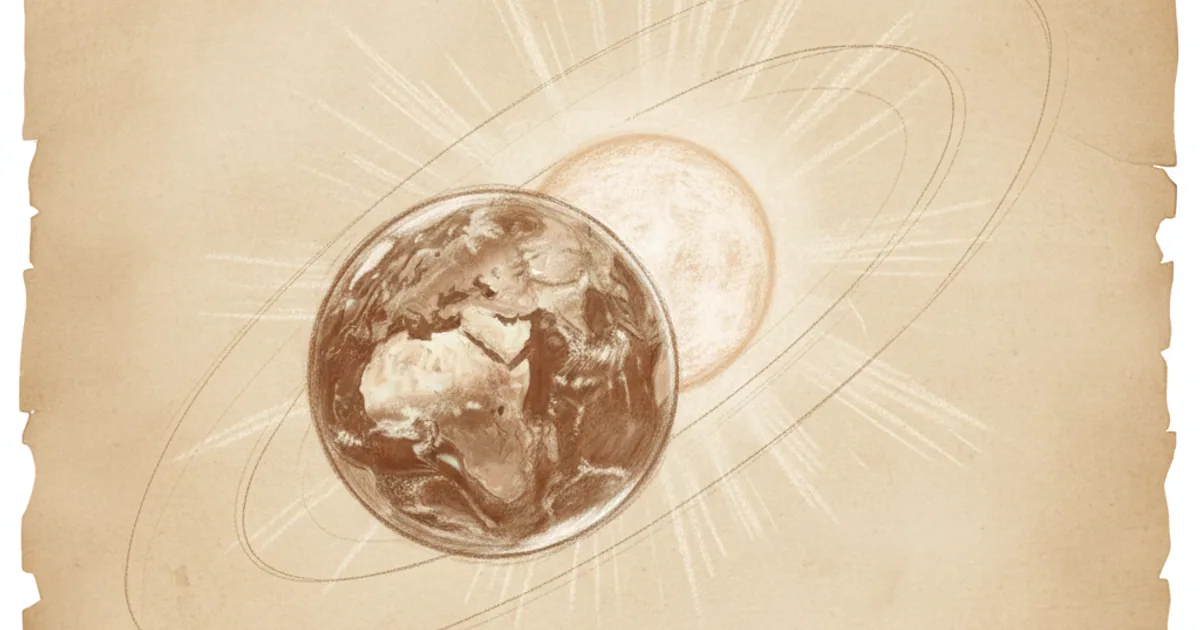
The misconception
Many people, including a famous study of recent Harvard graduates, believe seasons happen because Earth's distance from the Sun varies — closer in summer, farther in winter.
It's wrong. The northern hemisphere is in winter when Earth is at its closest point to the Sun (perihelion, around January 3rd). It's in summer when Earth is at its farthest (aphelion, around July 4th). The hemispheres also have opposite seasons at the same time, which would be impossible if distance were the cause.
What actually drives seasons is Earth's axial tilt.
The mechanism
Earth's axis of rotation is tilted about 23.5° relative to its orbital plane. This tilt stays roughly constant as Earth orbits the Sun. So at different times of year, different hemispheres point more toward the Sun.
When the northern hemisphere is tilted toward the Sun (June solstice):
- The Sun's rays hit more directly. Sunlight comes in at a steeper angle, so each square meter of ground gets more energy.
- Days are longer. The Sun is above the horizon for more hours.
- The Sun reaches higher in the sky at noon.
The combination of more energy per square meter and more hours of energy is what makes summer warm.
When the same hemisphere is tilted away (December solstice):
- Sun rays hit at a shallow angle.
- Days are shorter.
- The Sun stays low in the sky.
That's winter.
The southern hemisphere experiences the opposite at the same times — December solstice is southern summer, June solstice is southern winter.
Why the angle of incidence matters
A flashlight pointed straight at a wall makes a bright circle. Tilt the flashlight so the beam strikes the wall at a glancing angle, and the light spreads out into an oval — the same energy spread over more area, so it's dimmer per square meter.
The same physics applies to sunlight. When the Sun is overhead, sunlight is concentrated. When it's low on the horizon, the same beam of sunlight spreads over much more ground.
At the equator, the Sun is high all year — there are no strong seasons. At the poles, the Sun is always near the horizon (when it's up at all) — temperatures stay low. In between, the tilt creates the rhythm of seasons.
The four key dates
- June 21 (June solstice). Northern hemisphere maximally tilted toward Sun. Longest day in north, shortest in south.
- September 22 (September equinox). Earth's axis perpendicular to the Sun-Earth line. Day and night equal length almost everywhere.
- December 21 (December solstice). Northern hemisphere maximally tilted away from Sun. Shortest day in north, longest in south.
- March 20 (March equinox). Earth's axis perpendicular again. Day and night equal.
At the equator, day length is nearly constant year-round (~12 hours). At the Arctic Circle (66.5° N), the June solstice has 24 hours of daylight and the December solstice has 24 hours of darkness.
Why peak heat lags peak sunlight
The longest day is around June 21. The hottest day in most of the northern hemisphere is somewhere in late July to early August. Why the delay?
Because the planet has thermal inertia. The oceans, atmosphere, and land take time to warm up and cool down. On the summer solstice, solar input is at its maximum, but the planet hasn't yet reached the temperature where it radiates away as much as it absorbs. So it keeps heating for several more weeks until the lagging cooling catches up.
Same logic explains why the coldest days of winter are usually mid-January to early February — a month after the December solstice — and why oceanic climates (which have lots of thermal inertia) lag more than continental climates.
A note on extreme tilts
Earth's 23.5° tilt is moderate. Other worlds in the Solar System show what other tilts look like:
- Venus: ~3° tilt. Essentially no seasons. The whole planet bakes uniformly.
- Mars: ~25° tilt. Earth-like seasons, though longer (one Martian year is 687 Earth days).
- Jupiter: ~3°. No real seasons.
- Uranus: ~98°. Tipped over on its side. The poles take turns pointing at the Sun, creating extreme seasons where each pole has 42 Earth-years of continuous daylight followed by 42 of darkness.
Earth's tilt isn't fixed forever. It oscillates between about 22.1° and 24.5° over a 41,000-year cycle, due to gravitational tugs from the Moon and the other planets. These small variations contribute to the natural cycles of ice ages, as part of the Milankovitch cycles.
If you'd like a guided 5-minute personalized course on Earth's orbit, seasons, and the Milankovitch cycles, NerdSip can generate one.
The takeaway
Seasons are caused by Earth's axial tilt (23.5°), not by orbital distance variation. As Earth orbits the Sun, different hemispheres point more or less toward the Sun, changing both the angle at which sunlight hits the ground and how many hours per day the Sun is up. The combination drives the temperature cycles of summer and winter. Earth's distance to the Sun varies by only about 3% over a year — far too little to matter. The most-confidently-stated misconception about astronomy is just wrong.

Comments 0
No comments yet. Be the first to share your thoughts.