
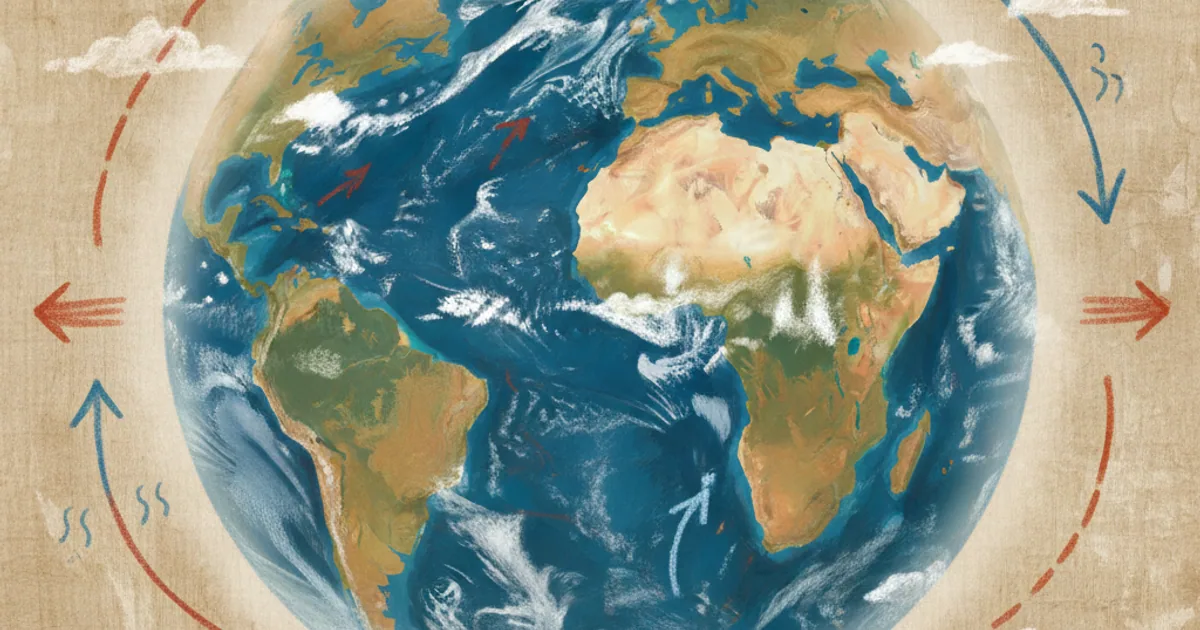
A planet as a machine
Earth, from a physics standpoint, is a chemistry-rich rocky planet with a thin envelope of fluids — air and water — sitting at just the right distance from a stable star. Energy arrives mostly from the sun; some heat leaks up from radioactive decay in the core. The planet uses that energy to drive weather, ocean currents, the carbon cycle, and a thin film of life.
If you treat Earth as one coupled system, weather, climate, geology, and ecosystems become aspects of the same machine. The other articles in this cluster zoom in on specific pieces: the greenhouse effect, ocean currents, plate tectonics, and the carbon cycle. This article gives the big picture.
The four subsystems
Earth scientists usually divide the planet into four interlocking subsystems:
Atmosphere. The thin layer of gas. About 78% nitrogen, 21% oxygen, less than 1% argon, water vapour, carbon dioxide, and trace gases. Total mass: ~5 × 10¹⁸ kg, which sounds enormous but is less than a millionth of the Earth's total mass.
Hydrosphere. All water in all forms — oceans, lakes, rivers, groundwater, glaciers, polar ice. Total: ~1.4 × 10²¹ kg, with 97% as salt water in the oceans. The cryosphere (ice specifically) is sometimes treated as a separate subsystem.
Lithosphere. The rocky outer layers — crust, plus the upper part of the mantle that moves with the tectonic plates. Mostly silicate rock. Total: a few percent of Earth's mass, but it's where all the geology happens.
Biosphere. Life. All the organisms taken together. By mass it's tiny — about 5 × 10¹⁴ kg, mostly plants — but biologically it's transformed the planet, particularly through producing the oxygen in the atmosphere.
These subsystems aren't really separate; they interact intensely. Water evaporates from oceans (hydrosphere → atmosphere), falls as rain (atmosphere → hydrosphere or lithosphere), is taken up by plants (lithosphere → biosphere → atmosphere as it transpires). Carbon moves between rocks, atmosphere, plants, and oceans on timescales from years to millions of years.
The energy budget
Earth receives about 174 petawatts (1.74 × 10¹⁷ W) of energy from the sun. To stay in equilibrium, it must radiate the same amount back to space. The details of how this happens drive almost everything.
Of incoming sunlight:
- About 30% is reflected back to space (clouds, ice, surfaces). This is Earth's albedo.
- About 23% is absorbed by the atmosphere (clouds and gases).
- The remaining 47% reaches the surface and is absorbed.
The surface and atmosphere then re-emit this energy as longer-wavelength infrared radiation. Most of it escapes to space; some is intercepted by greenhouse gases (water vapour, CO₂, methane) and re-radiated downward, warming the surface above what it would otherwise be. This is the greenhouse effect, and without it, Earth would average about −18°C instead of +15°C.
The whole system has to balance: in equals out. When something disrupts the balance (more CO₂ trapping more outgoing heat, more ice melting and lowering albedo, more clouds reflecting sunlight), the system adjusts until equilibrium is restored — often at a different temperature.
Heat redistribution
The equator gets much more solar energy per square meter than the poles. Without atmospheric and ocean circulation, equator surfaces would heat up dramatically and poles would freeze.
But the atmosphere and oceans redistribute heat:
- Atmospheric circulation. Hot air rises at the equator, flows toward the poles at high altitude, descends in the subtropics, and returns to the equator near the surface. This is the Hadley cell, the first of three big cells of atmospheric circulation. Combined with Earth's rotation, these cells produce the trade winds, the jet streams, and the prevailing wind patterns.
- Ocean circulation. Surface currents driven by wind, plus a slower "thermohaline circulation" driven by salinity and temperature differences. The Gulf Stream carries warm water from the tropics into the North Atlantic, warming Europe substantially. Without it, European winters would be significantly harsher.
Both heat-transport mechanisms together keep the temperature difference between equator and poles much smaller than it would otherwise be. They're also the engines that drive weather.
The water cycle
Water moves constantly between the subsystems:
- Evaporation from oceans, lakes, and surface water (~500,000 cubic km per year globally).
- Transpiration from plants moves water from soil into atmosphere.
- Condensation into clouds.
- Precipitation as rain or snow back to the surface.
- Runoff in rivers back to the ocean. Some seeps into groundwater.
The whole cycle is powered by solar energy. The average water molecule spends a few weeks in the atmosphere, a few thousand years in the deep ocean, a few hundred years as groundwater. Different reservoirs turn over at very different rates.
The carbon cycle
Like water, carbon cycles between reservoirs — but on much longer timescales for some flows. The major reservoirs:
- Atmosphere (currently ~420 ppm CO₂, about 880 GtC).
- Oceans (about 38,000 GtC, mostly dissolved).
- Biosphere (about 550 GtC in living things, much more in soils).
- Sedimentary rocks (immense reservoir, but very slow turnover).
- Fossil fuels (originally part of the biosphere/sediment, now being rapidly released).
Some flows are fast: plants take up CO₂ during photosynthesis, return it via respiration; the ocean exchanges CO₂ with the atmosphere over years. Others are slow: weathering of rocks removes CO₂ over hundreds of thousands of years; volcanic outgassing returns some over the same timescales.
Human activity (mainly fossil fuel burning) is adding CO₂ to the atmosphere about 100 times faster than natural processes can remove it. The carbon cycle article covers this in detail.
Plate tectonics
Earth's outer rocky shell is broken into a few large plates that slowly drift, driven by convection in the underlying hot mantle. Plate motions:
- Create mountain ranges where plates collide (the Himalayas, the Andes).
- Open new oceans where plates separate (the Atlantic, still growing about 2 cm per year).
- Produce volcanoes and earthquakes at plate boundaries.
- Recycle ocean floor crust back into the mantle at subduction zones.
This is the slowest of Earth's major dynamics — plates move at the speed your fingernails grow — but over million-year timescales it reshapes continents and oceans. See the plate tectonics article.
Feedbacks
What makes Earth's systems hard to predict precisely is the network of feedback loops:
- Ice-albedo feedback. Ice reflects ~80% of sunlight; ocean reflects ~7%. As ice melts, more sunlight is absorbed, more warming, more ice melts. Positive feedback.
- Water vapour feedback. Warmer air holds more water vapour, which is a strong greenhouse gas. More water vapour, more warming. Positive feedback.
- Lapse rate feedback. Warmer surfaces produce a different vertical temperature profile that radiates heat more efficiently to space. Negative feedback.
- Cloud feedback. Different cloud types do different things. The net is uncertain.
- Carbon-cycle feedback. Warmer oceans absorb less CO₂; warmer soils release more methane. Positive feedback.
The net effect of all feedbacks determines how sensitive the climate is to disturbances. Best estimates of "climate sensitivity" (how much warming results from doubling CO₂) are around 2.5–4°C. The range reflects the difficulty of pinning down feedbacks precisely.
Why this matters
Almost every applied environmental question is some version of: how do changes in one subsystem propagate through the others?
- Climate change. CO₂ increase → heat trapping → temperature rise → ice melt → sea level rise → ocean circulation change → ecosystem shifts → human consequences.
- Air pollution. Particles from industry/wildfires affect cloud formation, atmospheric chemistry, and ultimately surface temperature.
- Deforestation. Loss of tropical forest → less evapotranspiration → less rainfall → drought stress → more forest loss.
- Fisheries collapse. Overfishing → ecosystem shift → different species dominate → can take decades to recover.
Each is multi-subsystem. None can be understood in isolation.
Want a guided 5-minute course on any of these earth-system loops? NerdSip can generate one on the specific topic you're curious about.
The takeaway
Earth is a coupled system of atmosphere, water, rock, and life, exchanging energy and matter through interlocking cycles. Solar energy drives the climate; mantle convection drives the plates; living things drive the carbon-oxygen balance. Understanding the planet means seeing these as one machine rather than separate fields. The other articles in this cluster zoom in on key pieces — greenhouse effect, ocean currents, plate tectonics, carbon cycle — each one of which is a real subsystem in its own right.

Comments 0
No comments yet. Be the first to share your thoughts.