
The simplest version
A siren approaches you. The pitch sounds high. It passes. The pitch drops. As it recedes, the pitch is lower than when it was stationary.
The siren itself didn't change anything. It emits the same sound the entire time. What changed is the wavelengths reaching your ear.
When the siren is moving toward you, each new sound wave is emitted slightly closer to you than the last. The waves bunch up. Compressed waves = shorter wavelength = higher frequency = higher pitch.
When the siren is moving away, each new sound wave is emitted slightly farther from you than the last. The waves spread out. Stretched waves = longer wavelength = lower frequency = lower pitch.
That's the Doppler effect, after Christian Doppler who described it in 1842.
Numbers
For sound at everyday speeds, the math is approximately:
f_observed = f_source × v / (v − v_source)
where v is the speed of sound (343 m/s in air) and v_source is the speed of the source toward the listener. Negative if moving away.
A siren emitting 1000 Hz approaching at 30 m/s (108 km/h, highway speed):
f = 1000 × 343 / (343 − 30) ≈ 1000 × 1.096 ≈ 1096 Hz
That's almost a full musical step higher than the original 1000 Hz. The drop as it passes — from 1096 Hz to about 920 Hz — is the audible pitch shift you hear.
Doppler for light
The same effect works for light, but with two differences:
No medium. Light doesn't propagate through air or water; it propagates through vacuum (or transparent media at slower speeds). So the Doppler effect for light depends only on the relative motion between source and observer.
Relativistic corrections. When the relative speed gets close to the speed of light, special relativity adjusts the simple formula. Even at slower speeds, there are subtle relativistic corrections you can ignore for most purposes.
For light, the shift looks like:
- Source moving toward you: light is blueshifted. The wavelength is shorter, the frequency higher. Observed colors shift toward the blue end of the spectrum.
- Source moving away from you: light is redshifted. The wavelength is longer, the frequency lower. Observed colors shift toward the red end.
The same words — "redshift" and "blueshift" — are used in astrophysics to describe galaxies' velocities relative to Earth.
Hubble's discovery
In the 1920s, Edwin Hubble used the new 100-inch Hooker telescope to measure the spectra of distant galaxies. Spectra are the breakdowns of incoming light by wavelength — they have characteristic "absorption lines" produced by specific elements in the source.
Hubble found that the absorption lines of nearly every galaxy were shifted toward the red. The interpretation: those galaxies were moving away from us.
Even more strikingly, the farther a galaxy was, the more its spectrum was redshifted. Farther galaxies were moving away faster.
This was the first concrete evidence that the universe is expanding — that every galaxy is receding from every other galaxy. The rate of expansion (Hubble's constant) is one of the foundational measurements in modern cosmology.
The mechanism isn't quite Doppler in the simple sense; cosmological redshift is more about space itself stretching between us and distant galaxies than about galaxies moving through space. But for nearby galaxies, the math works out the same as Doppler, and the original interpretation in those terms is what set the stage for the Big Bang theory.
Where else Doppler shows up
Radar guns. Police speed-detection radar bounces a radio signal off your car. The reflected signal's Doppler shift reveals your speed. Same physics, much higher frequency (~10 GHz radio waves).
Doppler ultrasound. Medical ultrasound uses Doppler to measure blood flow. Sound waves bounce off red blood cells; the frequency shift reveals their velocity. Without Doppler, ultrasound would only show structure, not motion.
Weather radar. Doppler radar maps the velocity of raindrops, revealing wind speed and direction inside storms. Critical for forecasting tornadoes.
Submarines. Active sonar uses Doppler in the same way as radar but with sound.
Exoplanet detection. Some stars wobble slightly as orbiting planets tug them. The tiny Doppler shifts of their spectra reveal the wobble. This is how thousands of exoplanets have been found — by measuring the parent star's micro-Doppler.
The "Doppler illusion"
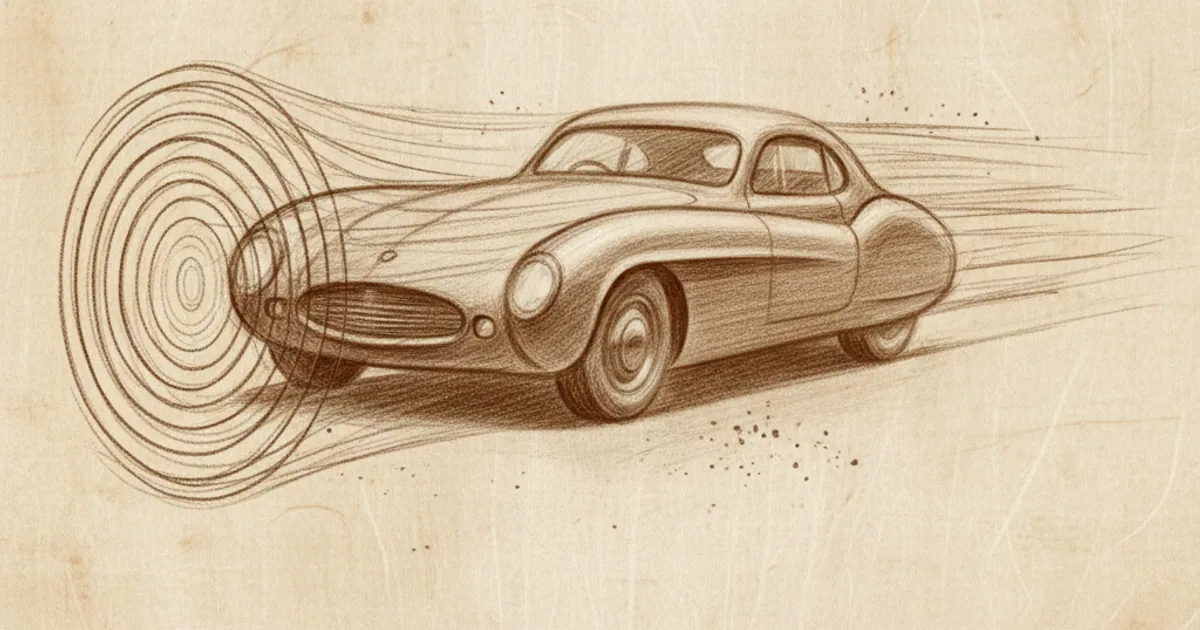
A common visual: if you imagine a stationary source emitting waves in all directions, the waves form perfect concentric circles. If the source moves, the circles squash together in front (compressed) and spread out behind (stretched). It's a clean geometric picture.
But here's something subtle: the source isn't "compressing" or "stretching" anything. Each wave, once emitted, travels outward at the wave's speed (343 m/s for sound, c for light), regardless of what the source is doing. The compression comes from the fact that consecutive waves are emitted from different locations.
This matters when you're trying to figure out who experiences the shift. The wave you receive depends on when and where it was emitted, plus how far it had to travel. With moving sources, those wave-by-wave starting points sit in different places, producing the compression or stretching you observe.
Doppler shifts you can actually hear
A common experience: the change in pitch as a fast train passes. Trains at highway speed (~30 m/s) produce roughly a 5% pitch shift. The horn, originally 400 Hz, sounds about 420 Hz approaching and 380 Hz receding — about a third of a musical step on each side, easily noticeable.
Aircraft are louder. A jet at 250 m/s flying overhead produces nearly a factor-of-2 pitch shift, which is why low-flying jets sound like dramatic swooping tones. Most of what you hear as "Doppler-like" in films is exaggerated for effect, but the underlying physics is real.
Want to internalize the Doppler effect more deeply? NerdSip can generate a 5-minute course with quizzes covering sound and light variants.
The takeaway
The Doppler effect is the apparent change in wavelength (and therefore frequency, pitch, or colour) caused by relative motion between a wave source and an observer. The waves are compressed ahead of motion and stretched behind. For sound, you hear it as pitch shifts in passing sirens and trains. For light, it's the redshift and blueshift astronomers use to measure cosmic motion — and the discovery that everything is shifting away from us is what told us the universe is expanding. One mechanism, applied across spectacular scales, from passing ambulances to the edge of the observable universe.

Comments 0
No comments yet. Be the first to share your thoughts.