
The simplest weird experiment in physics
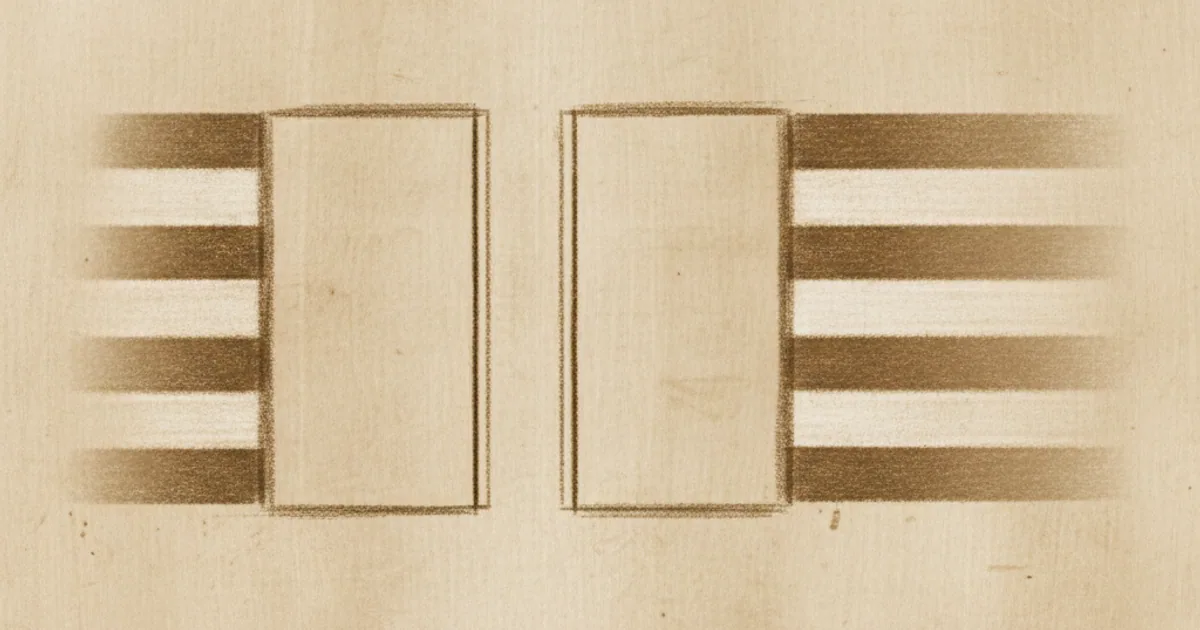
You have a wall with two narrow vertical slits cut in it. Behind that wall, a screen that records anything that hits it. In front of the wall, a source firing something at the slits.
Three versions of the experiment:
- Fire marbles at it. They go through one slit or the other and pile up in two stripes on the screen behind. No surprises.
- Send water waves at it. Each slit acts as a new wave source. The two emerging waves interfere — bands of constructive and destructive interference fan out across the screen. Also no surprises.
- Fire electrons (or photons, or atoms) at it. Each one lands at a single point, like a marble. But the pattern that builds up over many shots is the interference pattern, like a wave.
The third result, when first observed clearly with electrons in the 1920s, broke physics' intuition. It's still the cleanest single demonstration of the quantum weirdness.
The build-up is the punchline
If you fire many electrons fast, the screen looks blurry — you see an interference pattern emerging. You might think the particles are crashing into each other and self-interfering.
Slow the rate down. Fire one electron per minute, ten minutes between each, no possibility of any two being in the apparatus simultaneously. Watch the dots accumulate, one at a time.
Each individual dot lands at a single random-looking spot. But the cumulative pattern is the same interference pattern. Each electron, somehow, knows where to go to contribute to bright and dark bands as if it were a wave.
This was shown beautifully in a 2012 experiment by Bach et al. where individual electrons were detected one at a time over hours, and the camera replay shows a wave pattern self-assembling out of point-like impacts. The video is on YouTube; it's worth the four minutes.
What does this mean
Each electron's wavefunction propagates through both slits simultaneously, the two emerging waves interfere with each other before reaching the screen, and the final probability of detection at any point follows the interference pattern.
The electron isn't a wave hitting the screen and turning into a particle. It's a wavefunction whose squared magnitude tells you where the particle is probably going to be detected. The wavefunction does the interfering. The detection event picks one outcome from that probability distribution.
This is the superposition principle in action: the electron is in a superposition of "went through slit A" and "went through slit B," and the two amplitudes interfere when they reach the same point on the screen.
The crucial test: detect which slit
Here's where it gets even stranger. Add a detector at one slit that tells you which slit each electron went through. Maybe a photon-scattering setup or a quantum non-demolition measurement.
The interference pattern vanishes. You get the classical two-band marble pattern.
It doesn't matter how gentle the detector is, or whether you actually look at the data. As long as the information about which slit the electron took is recordable somewhere in the universe, the interference is destroyed.
This is the complementarity principle: wave behaviour (interference) and particle behaviour (which-path information) are mutually exclusive. You can't have both.
Turn off the slit detector — interference comes back. Turn it on — interference vanishes. This has been done over and over, in increasingly precise variants, since the 1980s.
The quantum eraser
A delicious twist: in the quantum eraser experiment, you can collect which-slit information, then erase it before checking the screen. When erased, the interference returns. When preserved, it stays gone. The decision can even be made after the electrons have hit the screen (delayed-choice variants).
This sounds like the future is changing the past, but it isn't. What's happening is that the patterns you sort by — which-path detected vs which-path erased — are statistical groupings, and the underlying quantum mechanics is consistent no matter when you do the sorting. The 'after' decision doesn't reach back in time; it changes which subset of data you label as "interfering" vs "not interfering."
The takeaway: which-path information determines the kind of pattern. The presence or absence of that information at any later point determines what subset of data shows interference vs not.
What it doesn't mean
The electron is not literally a wave. It's a quantum object whose state is described by a wavefunction. The wavefunction has wave-like properties. The electron, when detected, is point-like.
Consciousness is not collapsing wavefunctions. The detector at the slit doesn't need a human looking at it. Any interaction that creates an irreversible record of which-slit information is enough. Decoherence handles it; conscious observers are not required.
The pattern doesn't 'know' you're watching. Each electron interacts with the detector or doesn't. If it does, that interaction physically changes its wavefunction. If it doesn't, the wavefunction is undisturbed. The change in pattern is a consequence of physical interactions, not knowledge.
Other things that double-slit
The experiment has been performed with:
- Photons (the original Young setup, 1801, before quantum mechanics existed)
- Electrons (1920s, Davisson–Germer)
- Neutrons
- Atoms (1991, helium)
- Molecules — including buckminsterfullerene (C₆₀, 1999), and as of the 2020s, complex molecules with 2000+ atoms
The interference is real for objects much larger than electrons, as long as you can keep them coherent (cold, isolated). The limit on what shows interference isn't fundamental — it's an engineering question about decoherence control.
The takeaway
The double-slit experiment is the cleanest single demonstration of why classical intuitions don't survive at quantum scales. Particles fired one at a time pile up into interference patterns. Knowing which path each took destroys the interference. The wavefunction is the carrier of probability — it does the interfering, and the particle is what the wavefunction's collapse picks out at the moment of detection. Everything strange in quantum mechanics, Feynman said, is in this one experiment. If a single setup can hold that much strangeness, it's a fine reminder of how rewarding it is to chase the things that puzzle you all the way down.

Comments 0
No comments yet. Be the first to share your thoughts.