
Start with what a gene has to do
Every cell in your body is a tiny factory, and almost everything a factory does — digesting food, building bone, sensing light, carrying oxygen — is done by machines called proteins. A protein is a long chain of small parts (amino acids) folded into a specific shape, and the shape is everything: it's why one protein can grab oxygen and another can chop up a sugar.
But a protein can't build itself. Something has to store the instructions for which parts go in which order. That something is DNA, and a gene is one instruction: a stretch of DNA that spells out how to build one particular protein.
That's the whole core idea. A gene is not a thing that "does" biology directly. It's a set of written instructions. The doing is done by the protein the gene describes.
The cookbook analogy (and where it's honest)
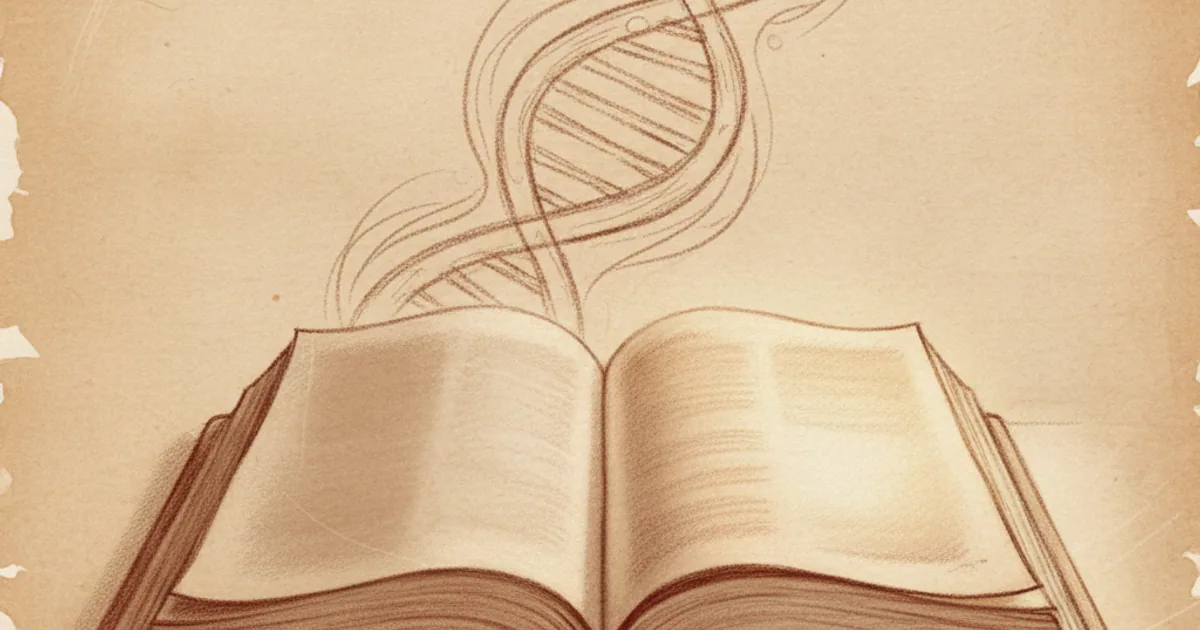
Picture your entire set of DNA — your genome — as one enormous cookbook. It's absurdly long: about three billion letters, enough to fill a stack of ordinary books taller than a person.
Now, a cookbook isn't just one continuous stream of text. It's divided into recipes. Each recipe is a gene: a self-contained set of instructions for making one dish (one protein). "Chocolate cake" is a recipe; "haemoglobin" is a gene. The book has around 20,000 such recipes.
This analogy is genuinely good, and it's worth pushing a little further:
- The recipe doesn't contain the cake. It contains the instructions for the cake. A gene doesn't contain a protein; it contains the ordering information to build one.
- Having a recipe in the book doesn't mean you're cooking it right now. Most recipes sit unused most of the time. Likewise, in any given cell, most genes are switched off — a liver cell and a nerve cell have the identical cookbook but cook completely different dishes.
- A lot of the cookbook isn't recipes at all. It's the table of contents, the notes in the margins, the "cook this one only on holidays" instructions. In DNA these are regulatory regions: stretches that don't code for a protein but control when and how much other genes get used.
That last point matters. Some genes' whole job is regulation — they produce molecules that turn other genes up or down. So a fuller definition: a gene is a stretch of DNA that codes for a functional product — usually a protein, sometimes a regulatory molecule.
What's actually written in a gene
If you could read a gene, you'd see a sequence of just four letters — A, T, G, and C — the chemical "bases" of DNA. The order of those letters is the instruction. Read in groups of three, they spell out which amino acid comes next in the protein chain, over and over, until the protein is complete. (The mechanics of that four-letter code are their own story — see how DNA carries information.)
The key intuition: the information is in the order of the letters, exactly the way the information in a sentence is in the order of its letters, not in the ink itself.
Genotype versus what you actually see
Here's where genetics gets misunderstood, so let's be careful.
The particular version of a gene you carry is your genotype. The trait that actually shows up — brown eyes, your height, whether you can roll your tongue — is your phenotype. These are not the same thing, and confusing them is the single most common mistake people make about genes.
Why do they come apart? Because between "instruction written in DNA" and "trait you can see," a lot happens:
- Other genes get involved. Traits are usually built by many genes cooperating.
- The environment intervenes. A plant with "tall" genes stays short in poor soil. Your adult height depends on childhood nutrition as much as on your DNA.
- Genes get switched on and off. Two people with identical genes can end up different because the genes were used differently.
So your genome is not a blueprint that draws you deterministically. It's more like a recipe collection handed to a cook (your cells) working in a particular kitchen (your environment). Same recipes, different kitchen, different meal.
Why "a gene for X" is usually wrong
You'll hear "the gene for height" or "a gene for intelligence." Be suspicious of that phrasing. It's occasionally true — a few traits really do trace to a single gene, and those are mostly genetic disorders, where one broken recipe causes one clear problem (cystic fibrosis, sickle-cell anaemia, Huntington's disease).
But the traits people find most interesting are polygenic — built from many genes at once. Human height involves hundreds of genetic variants, each contributing a tiny amount, and together they still explain only part of the picture; nutrition fills in much of the rest. There is no "height gene" any more than there's a single ingredient that makes a cake a cake.
Skin colour, personality, athletic ability, risk for common diseases like diabetes or heart disease — all of these are the summed output of many genes plus a lifetime of environment. When you read a headline claiming scientists found "the gene for" some complex human trait, the honest version is almost always "a gene that slightly shifts the odds of."
Pulling it together
A gene is a stretch of DNA that spells out how to build one product — usually a protein, sometimes a regulator. Your full set of genes is the genome, best imagined as a vast cookbook of maybe 20,000 recipes, most of them switched off in any given cell. The letters written in a gene are its instruction; the order of those letters is where the information lives.
And the trait you see (phenotype) is not the gene you carry (genotype). Between them sit other genes, the environment, and the on/off switches that decide which recipes get cooked. Genes load the dice. They rarely, on their own, decide the roll.
That single correction — genes as instructions and probabilities, not blueprints and destinies — clears up most of the confusion people carry about DNA. Everything else in genetics builds on it: how those four letters store information, why you resemble your parents, and what happens when a letter changes.

Comments 0
No comments yet. Be the first to share your thoughts.