
You get two of almost everything
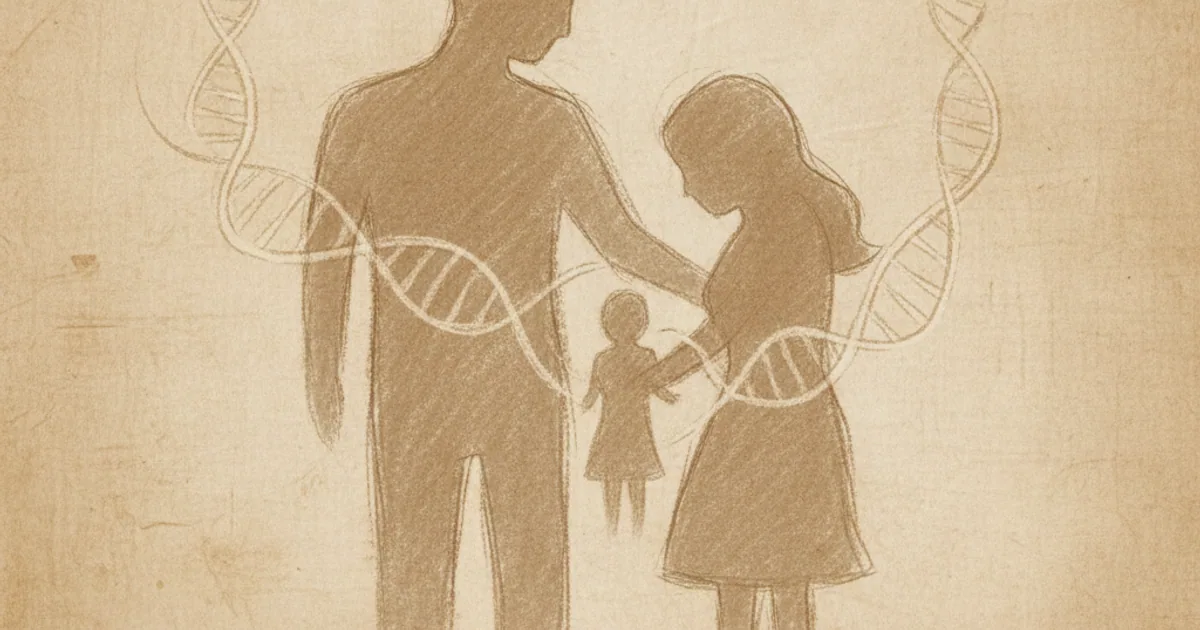
Start with the fact that explains most of inheritance: you carry two copies of nearly every gene — one you got from your mother, one from your father. Two copies of the gene for a blood-clotting protein, two copies of the gene involved in pigment, and so on, for essentially all of your roughly 20,000 genes.
(There are exceptions — the sex chromosomes, X and Y, don't come in matched pairs in the same way — but for the great majority of your genes, two copies is the rule.)
Those two copies don't have to be identical. A gene can come in different versions — different spellings of the same recipe — and each version is called an allele. Maybe the maternal copy of some pigment gene is a version that makes lots of pigment, while the paternal copy is a version that makes little. You now hold two different alleles of the same gene. What happens next is the heart of inheritance.
Dominant and recessive: the tug-of-war
When your two alleles of a gene disagree, sometimes one wins the visible outcome. The version whose effect shows up is called dominant; the version that gets hidden is called recessive.
The classic textbook example is a made-up "flower colour" gene. Say the allele for purple flowers (call it P) is dominant, and the allele for white flowers (p) is recessive. A plant's visible colour depends on its pair:
- PP → purple (two purple alleles)
- Pp → purple (the dominant P wins over the hidden p)
- pp → white (only when there's no P at all)
Notice the consequence: a purple plant might secretly be Pp, carrying a white allele that doesn't show. This is why a trait can skip a generation. Two purple Pp plants can have a pp offspring — white — because each parent quietly passed on their hidden white allele. Nothing appeared from nowhere; the recessive allele was there all along, just masked.
One crucial correction while we're here: dominant does not mean stronger, better, or more common. It only means "shows up even with one copy." Plenty of dominant alleles are rare, and some cause disease. Dominance is about visibility, not superiority.
The worked example everyone gets taught — and why it's wrong
Now the honest part, because this is where genetics is routinely oversimplified.
You were probably taught that eye colour works like the flower example: brown (B) is dominant, blue (b) is recessive, so:
- BB or Bb → brown eyes
- bb → blue eyes
And from this, the neat prediction: two blue-eyed (bb) parents can only ever have blue-eyed children, because neither parent has a brown allele to pass on.
Here's the problem: that prediction is false. Two blue-eyed parents can, uncommonly, have a brown-eyed child. It's documented. And if eye colour truly ran on one dominant/recessive gene, that would be flat-out impossible.
So what's actually going on? Eye colour is polygenic — it's built by many genes working together, at least a dozen that meaningfully contribute, layering different amounts and types of pigment in the iris. The single "brown-beats-blue" gene is a teaching cartoon. It captures a rough tendency (brown-eyed alleles often do dominate) but it can't handle the real range: hazel, green, grey, the way some babies' eyes darken over months, or those surprising recombinations.
This isn't nitpicking. It's the single most important lesson in inheritance: the tidy one-gene, dominant-versus-recessive picture is the exception, not the rule. It genuinely describes a handful of traits — including several genetic disorders caused by one broken gene. But the everyday traits people care about — height, skin tone, hair, most of your face, and yes, eye colour — are the summed work of many genes, often nudged further by environment. When someone offers you a clean single-gene story for a rich human trait, be politely skeptical.
Why siblings differ
If two children have the same two parents, why aren't they the same?
Because each child gets a random shuffle. Remember, each parent has two alleles of every gene but passes only one of them to each child, and which one is essentially a coin flip. For a single gene that's a small difference. But you have about 20,000 genes, and the flips are independent.
Do the arithmetic loosely and it's staggering. Even considering just the genes where your parents carry two different alleles, the number of distinct combinations a child could inherit runs into the billions upon billions — more possible children than there are people who have ever lived. Two siblings are just two different draws from that unimaginably large deck.
There's an extra layer that makes it wilder still. When sperm and egg cells form, the chromosomes physically swap segments in a process called recombination, reshuffling alleles that used to travel together. So you're not even dealt whole chromosomes intact from a grandparent — you get patchworks. Every child is a genuinely new mixture that has never existed before and never will again.
The only exception is identical twins, who come from a single fertilised egg that split, and so share the same shuffle. Everyone else — even fraternal twins — is a separate draw.
Pulling it together
You look like your parents because you're literally built from a fifty-fifty mix of their instructions: two copies of nearly every gene, one from each of them. When your two copies of a gene are different alleles, sometimes one dominant version masks a recessive one — which is how traits hide and reappear across generations.
But hold that model loosely. The clean dominant/recessive story is real for a few traits and wrong for most, including eye colour, which is built by many genes at once — which is exactly why two blue-eyed parents can occasionally surprise everyone. And you differ from your siblings not because the genes are different but because the shuffle is: each of you got a unique random hand from the same two decks.
If you want the layer underneath this — what a gene and an allele actually are — start with what a gene is. And to see what happens when the copying introduces a brand-new spelling that neither parent had, read what mutations actually are.

Comments 0
No comments yet. Be the first to share your thoughts.