
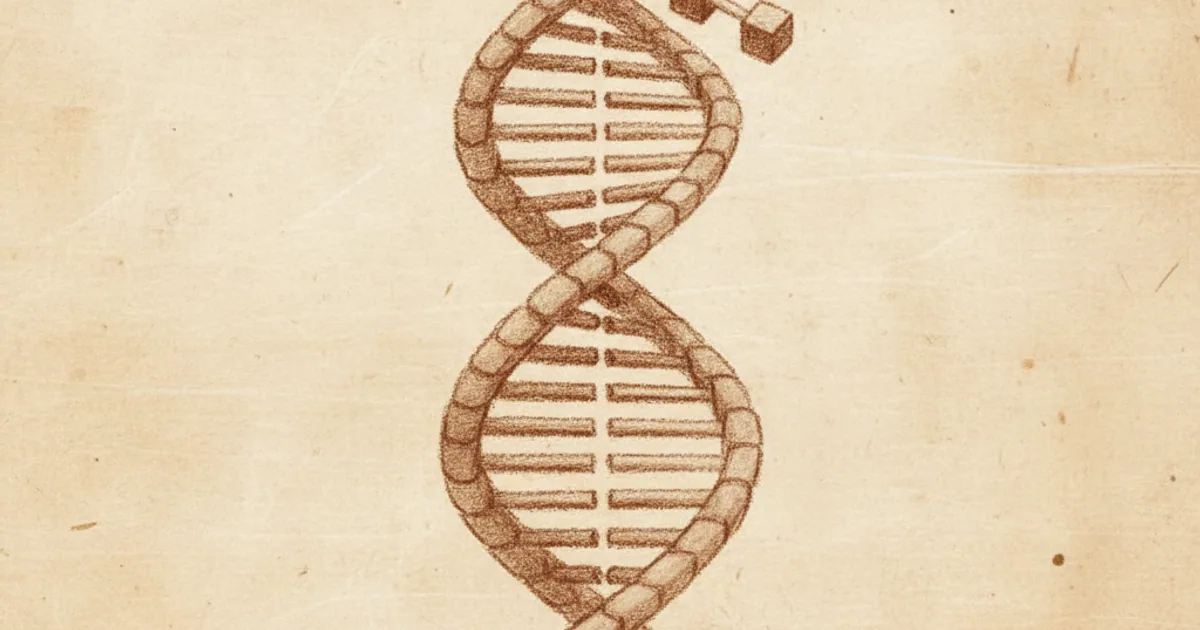
A mutation is a typo
Strip away the drama and a mutation is one plain thing: a change in the sequence of DNA letters. A recipe in your genetic cookbook had one spelling, and now it has a slightly different one. A letter got swapped, or dropped, or an extra one got inserted. That's it. A mutation is a typo in the instructions.
Because DNA is written in the four-letter alphabet A, T, G, C, a mutation is a change to those letters — an A where there used to be a G, say. And because the meaning of DNA lives entirely in the order of its letters, changing a letter can change what the recipe says. Sometimes that matters enormously. Usually it doesn't matter at all. The interesting part is understanding why "usually it doesn't matter" is true.
Where mutations come from
Two broad sources, and they're worth separating because people tend to imagine only the second.
Copying errors. Every time one of your cells divides, it has to copy all three billion letters of your DNA into the new cell. Think about that scale — three billion letters, transcribed correctly, over and over, throughout your whole life. The copying machinery is astonishingly good and even proofreads itself, but at that volume a few mistakes are inevitable. A wrong letter occasionally gets laid down and missed. These copying-error mutations are happening quietly in your body all the time, and most are utterly harmless.
Outside damage. DNA is a physical molecule, and physical things can be knocked around. Ultraviolet light from the sun can fuse neighbouring DNA letters together. Other radiation can break the strand outright. Certain chemicals — including many in tobacco smoke — react with DNA and corrupt its letters. Your cells have busy repair crews that catch and fix most of this damage. But repair isn't perfect, and whatever slips through and gets copied becomes a permanent mutation.
So mutations aren't exotic events. They're the ordinary background noise of running a chemistry-based information system in the real world.
Why most mutations do nothing
This is the part that surprises people, so let's build the intuition properly. There are several reasons a change to your DNA can have no noticeable effect — making it a neutral mutation.
Most of your DNA isn't recipes. Only a small fraction of your genome — around 1 to 2% — actually codes for proteins. A mutation that lands in the vast non-coding stretches often changes nothing you'd ever detect.
The code has built-in slack. Recall that DNA is read three letters at a time, and each triplet (a codon) names one amino acid — but there are 64 possible codons for only 20 amino acids. That surplus means several different codons often specify the same amino acid. So a mutation can change a letter, change the codon, and still produce the identical amino acid — the protein comes out exactly the same. This is called a silent mutation, and it happens constantly. (This is the payoff of the code's redundancy, described in how DNA carries information.)
Even changed proteins often still work. Suppose a mutation does change one amino acid in a protein. Proteins are big, and swapping one part for a similar one frequently leaves the shape — and thus the function — good enough. The machine keeps running.
Add these up and the headline result is: the majority of mutations are neutral. They accumulate silently, generation after generation, doing nothing dramatic.
When mutations do matter
Some mutations, of course, land where they count — in an important gene, at a spot that changes the protein's function.
Of those, more are harmful than helpful, and there's a simple reason. Your genome is a system that already works, honed over billions of years. Making a random change to something that already works is far more likely to break it than improve it — the same way randomly retyping a line of working software usually creates a bug, not a feature. Harmful mutations are behind many genetic diseases: a single altered letter in the right (wrong) place can produce a misshapen protein that can't do its job.
And rarely — genuinely rarely — a mutation is beneficial. By chance, the random change happens to make a protein a little better at something, or gives it a useful new twist, in the current environment. This is uncommon, but "uncommon across three billion letters and billions of years" adds up to a great deal. Those rare beneficial changes turn out to matter more than their rarity suggests.
The movie version is wrong
Popular culture has taught us that a mutation is a sudden, dramatic, whole-body transformation — a spider bite, a burst of radiation, and now you have powers or you're a monster. Set that aside completely.
A real mutation is a change to one or a few DNA letters. Its effect, when there is one, is small and specific: a slightly different enzyme, a modified pigment, a raised or lowered risk of some disease. It does not remake an organism in one stroke. Even the mutations behind serious genetic conditions usually alter the function of a single protein, not the whole body at once. Nobody develops superpowers. The truth is quieter and, honestly, more interesting: enormous consequences over time, built from tiny changes, one letter at a time.
Why evolution needs mutations
Here's the reframing that makes mutations click. Everyone learns that natural selection drives evolution — the fittest survive and reproduce. But selection can only choose among variations that already exist. It's an editor, not an author. So where does the raw variation come from in the first place?
Mutation is the ultimate source. Every genetic difference that has ever existed — every allele, every trait that selection could act on — traces back to some mutation, somewhere, at some point. Without a steady trickle of new mutations, there'd be no new variation, nothing new for selection to favour, and evolution would grind to a halt. Life would be frozen.
So the picture is a two-part machine. Mutation supplies the raw material — random, undirected changes to the DNA. Natural selection does the choosing — keeping the rare changes that help, discarding the ones that hurt, ignoring the neutral many. Mutation is blind and random; selection is not random at all. Together, over enough time, they build the extraordinary variety of living things. Neither works without the other.
Pulling it together
A mutation is nothing more than a change in the DNA sequence — a typo in the recipe. They come from copying errors when cells divide and from outside damage like UV light, radiation, and chemicals. Most are neutral and do nothing you'd notice; of the ones that matter, more are harmful than helpful, and a precious few are beneficial.
Forget the movie monsters. The real story is subtler and grander: these tiny, random typos are the only source of genuinely new genetic variation, which makes them the raw material that all of evolution is built from. Mutation writes the drafts; selection edits them. No typos, no evolution.
If you want the ground under all of this, start with what a gene is and how DNA carries information.

Comments 0
No comments yet. Be the first to share your thoughts.