
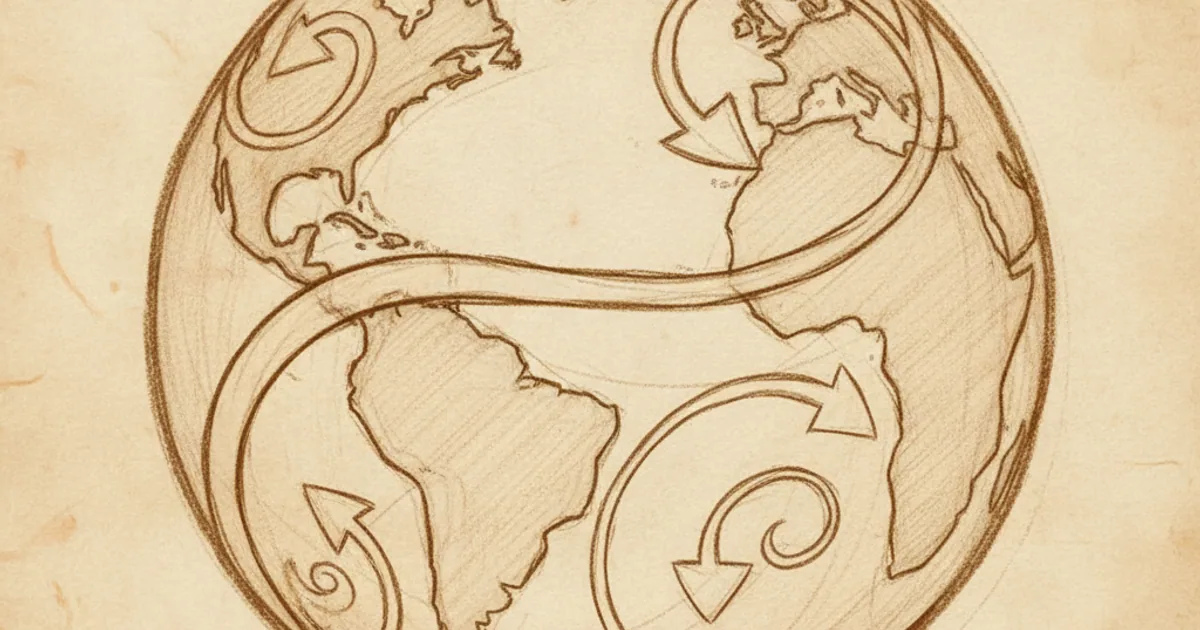
A planetary conveyor belt
The oceans are not still. Water is constantly flowing in patterns that span entire ocean basins, redistributing heat and dissolved gases on timescales from days to millennia. These ocean currents shape climate, sustain fisheries, and play a huge role in how Earth handles incoming solar energy.
Four forces drive them:
- Wind at the surface.
- Temperature differences (warm water is less dense).
- Salinity differences (saltier water is denser).
- Earth's rotation (the Coriolis effect).
The system has two main layers: a wind-driven surface circulation in the upper few hundred meters, and a density-driven deep circulation that takes about 1000 years to complete one circuit. Together they're sometimes called the global ocean conveyor.
Surface currents
The top few hundred meters of every ocean are stirred mainly by wind. The trade winds in the tropics push surface water westward; westerly winds in mid-latitudes push it eastward.
But the water can't just keep going straight forever. Continents get in the way, and Earth's rotation deflects everything. The net result is that surface currents in each ocean basin form giant rotating loops called gyres:
- North Atlantic Gyre: clockwise, with the Gulf Stream as the northward branch and the Canary Current as the southward.
- South Atlantic Gyre: counterclockwise, with the Brazil Current and the Benguela Current.
- North Pacific Gyre: clockwise; carries the Kuroshio Current past Japan.
- South Pacific Gyre: counterclockwise; includes the Humboldt Current along South America.
- Indian Ocean Gyre: complicated by monsoon-driven seasonal reversal.
Each gyre is thousands of kilometers across and moves enormous quantities of water. The Gulf Stream alone carries about 30 million cubic meters per second — over 100 times the combined flow of all the world's rivers.
The Coriolis effect
Why do the gyres rotate in opposite directions in north and south hemispheres? The Coriolis effect.
Earth rotates eastward. A piece of water (or air) at the equator is moving east faster than a piece at high latitude (because it has farther to go in one rotation). When water flows from the equator toward the north pole, it carries its higher eastward velocity with it. From a ground-based observer's perspective, it appears to deflect to the east — i.e., to the right.
Similarly, water flowing from the pole toward the equator finds itself in a region moving faster east than it is, and appears to deflect westward, which is also to the right.
In the southern hemisphere, the same physics produces deflection to the left.
This is the Coriolis effect, and it's responsible for:
- Clockwise gyres in the northern hemisphere; counterclockwise in the south.
- Hurricanes spinning counterclockwise in the northern hemisphere; clockwise in the southern.
- Trade winds blowing east-to-west at the equator (the surface return air for the Hadley circulation deflects right in the north, left in the south).
The Coriolis effect is too small to see in your bathtub or sink, but it's the dominant force shaping any motion that crosses substantial latitudes.
Thermohaline circulation
Below the surface, a much slower circulation operates, driven by density differences instead of wind. This is the thermohaline circulation (literally "heat + salt").
Water is denser when it's colder, and denser when it's saltier. The densest seawater is cold and salty. The densest waters in the world form at two places:
- The North Atlantic, near Iceland and Greenland. Warm water arrives via the Gulf Stream, cools and evaporates (concentrating the salt), gets denser, and sinks.
- The Antarctic, particularly around the Weddell Sea. Sea ice forms there in winter, ejecting the salt into the surrounding water. The cold, saltier water sinks.
This sinking is the driving engine. Once down at depth, the cold dense water spreads out across the bottom of every ocean basin, slowly mixing as it goes. After hundreds of years, it gradually rises in different regions (especially the North Pacific and Indian Ocean) and re-enters the surface circulation.
One full circuit — sinking in the North Atlantic, traveling along the bottom, rising elsewhere, returning at the surface — takes about 1000 years. The deep ocean is, in this sense, a vast reservoir of cold, ancient water.
Why this matters for climate
The thermohaline circulation moves heat globally. The North Atlantic in particular receives a massive net import of warm water via the Gulf Stream — heat that's released into the air over Europe.
Without it, Europe at any given latitude would be roughly 5–8°C colder than it is. London at 51°N would have winters more like Calgary at the same latitude. The whole reason Europe is mild for its latitude is that ocean circulation is doing the heavy lifting of moving tropical heat north.
This is why concerns about a weakening Atlantic Meridional Overturning Circulation (AMOC) — the North Atlantic part of the thermohaline conveyor — are serious. If the AMOC weakens substantially, Europe cools while much of the rest of the world keeps warming. Multiple recent studies suggest it has weakened by 10–15% since the mid-20th century, mainly due to freshwater inputs from Greenland melt diluting the North Atlantic.
A full AMOC collapse is a low-probability but high-impact tipping point in current climate scenarios. Whether and when it might happen is one of climate science's hard open questions.
Upwelling and downwelling zones
Not all coastal water is moving horizontally. In some places, the wind and Coriolis combine to drive vertical circulation:
- Upwelling zones. Wind pushes surface water away from the coast; deeper water rises to replace it. This brings cold, nutrient-rich water to the surface. The west coasts of continents at mid-latitudes (California, Peru, Namibia) have major upwelling zones. These support some of the world's most productive fisheries.
- Downwelling zones. The opposite — surface water piles up against coast and sinks. These tend to be biologically less productive.
El Niño and La Niña, the major climate-cycle oscillations of the Pacific, involve dramatic changes in upwelling along the equatorial Pacific. When upwelling weakens (El Niño), the western Pacific is unusually warm and weather patterns shift globally.
Surface meets deep — and life cares
Where deep currents return to the surface, they bring nutrients (phosphate, nitrate, iron) that have accumulated in the deep over centuries. These nutrients fuel primary productivity — the photosynthesis of plankton that supports all marine food chains.
The most productive regions of the ocean are precisely where deep water upwells: along the equator, in major coastal upwelling zones, around Antarctica. The least productive regions are the centers of gyres, where surface water sits and nutrients deplete. From space you can see this directly — productive zones are green and brown (lots of plankton), unproductive zones are blue (almost no chlorophyll).
The fisheries that feed humans depend on these patterns. So do whale migrations, seabird colonies, and most large-scale marine biology.
If you'd like a guided 5-minute course on ocean circulation, NerdSip can generate one with quizzes covering all the major currents.
The takeaway
Ocean currents are driven by wind (at the surface), density differences (in the deep), and Earth's rotation (everywhere). They form predictable patterns: gyres at the surface, slow circulation through the deep, vertical motion at specific upwelling zones. They redistribute heat globally — most notably, the Gulf Stream warming Europe — and they're responsible for most of the ocean's biological productivity. Disruptions to the thermohaline circulation, especially from increased freshwater in the North Atlantic, could affect climate dramatically. The ocean isn't a stationary reservoir; it's the slow part of the planet's climate machinery.

Comments 0
No comments yet. Be the first to share your thoughts.