
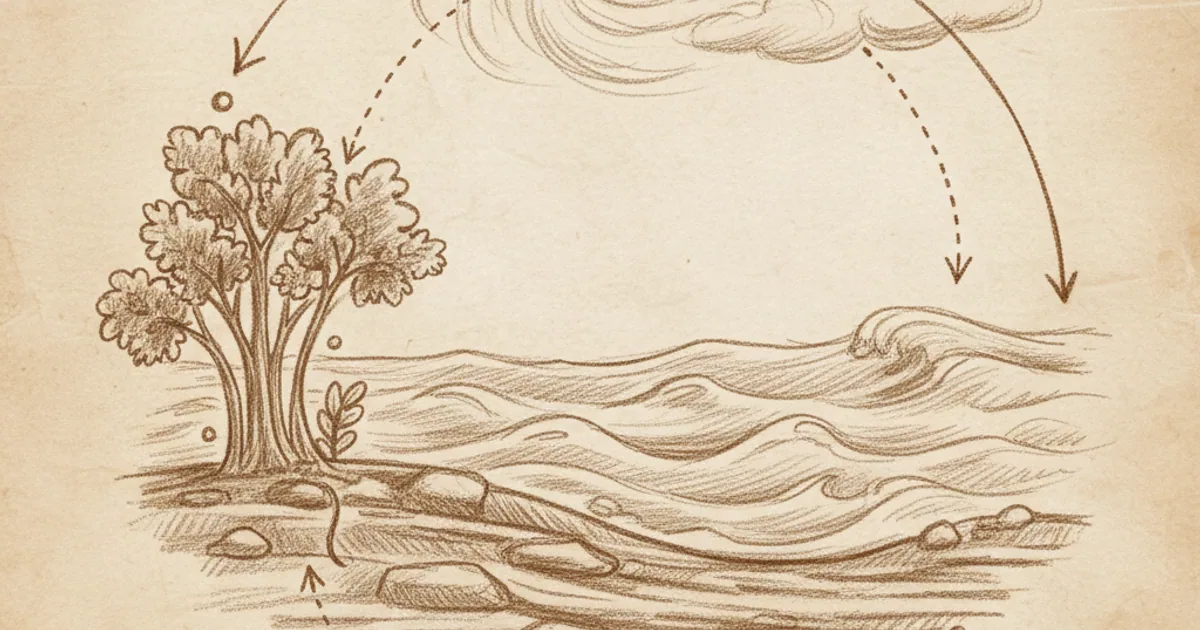
The four reservoirs
Carbon doesn't just live in one place. It's constantly moving between four main reservoirs:
| Reservoir | Approximate carbon content |
|---|---|
| Atmosphere | 880 GtC (gigatons of carbon) |
| Surface ocean | 1,000 GtC |
| Land biosphere (plants, soil) | 3,000 GtC |
| Deep ocean | 37,000 GtC |
| Sedimentary rocks | ~75,000,000 GtC (vast, very slow) |
| Fossil fuels in ground | ~10,000 GtC (decreasing rapidly) |
The atmosphere — the focus of climate concern — is actually the smallest of the major active reservoirs. Most of Earth's carbon is locked in rocks; most of the "available" carbon is in deep ocean and soils. Small fractional changes in those larger reservoirs can swamp the atmosphere.
The fast cycle
The fast carbon cycle moves carbon between atmosphere, surface ocean, and life on timescales of years to centuries.
Photosynthesis. Plants and phytoplankton take in CO₂ and combine it with water (using sunlight as energy) to produce sugars and release O₂. Globally about 120 GtC per year is removed from the atmosphere this way.
Respiration and decay. Plants, animals, and microbes oxidize organic carbon back to CO₂ and water, releasing it back to the atmosphere. Net effect on the carbon cycle: about 120 GtC per year is returned — exactly balancing photosynthesis on a global average, give or take.
Ocean-atmosphere exchange. CO₂ dissolves into surface ocean water and outgasses from it, depending on local concentrations. About 80 GtC per year goes each way. Net: roughly balanced, but currently slightly inward (ocean is absorbing).
If you look at atmospheric CO₂ measurements, you can see the fast cycle in the data. The Keeling Curve from Mauna Loa shows a clear annual cycle: CO₂ drops during the northern hemisphere summer (vegetation photosynthesizes; takes CO₂ out) and rises during winter (decay continues; less photosynthesis). The annual swing is about 7 ppm — the breath of the biosphere.
The slow cycle
On much longer timescales — hundreds of thousands to millions of years — carbon moves between the atmosphere and rocks.
Weathering. CO₂ dissolves in rainwater to form a weak carbonic acid. The acid reacts with silicate rocks (basalt, granite), dissolving them and forming bicarbonate ions. The bicarbonate eventually reaches the ocean. There, marine organisms use it to build calcium carbonate shells (CaCO₃). When they die, the shells sink to the ocean floor and eventually become sedimentary rock — limestone. The net effect: atmospheric CO₂ is removed and locked into rock for tens of millions of years.
Volcanism. Plate tectonics drives subduction (see the plate tectonics article). When carbonate sediments are dragged down at subduction zones, they melt and release CO₂. The CO₂ rises through volcanoes back to the atmosphere. Modern volcanism adds roughly 0.3 GtC per year.
In balance, the slow cycle is a remarkably stable thermostat. If CO₂ rises, weathering speeds up (warmer, wetter weather speeds the reactions), pulling more CO₂ out. If CO₂ falls, weathering slows. Over hundreds of thousands of years, this regulates atmospheric CO₂ within bounds compatible with liquid water.
This is why Earth has had liquid surface water for billions of years despite the sun gradually getting brighter — the slow carbon cycle has been steadily adjusting atmospheric CO₂ to compensate.
The biological pump
In the ocean, there's a specific mechanism called the biological pump that moves carbon downward.
Surface plankton photosynthesize, taking in CO₂. When they die or are eaten, some of the carbon falls toward the deep ocean as particles. About 10-20 GtC per year reaches deeper waters this way. Most is decomposed at intermediate depths, but a small fraction (about 0.5 GtC per year) reaches the bottom sediment and is locked away from the atmosphere for thousands of years to permanently.
The biological pump is why the deep ocean has so much more dissolved carbon than the surface — it's been accumulating for centuries to millennia. Surface ocean carbon is in active exchange with the atmosphere; deep carbon is mostly stuck.
What humans are doing
Human fossil fuel burning currently releases about 10 GtC per year. Deforestation adds another roughly 1 GtC per year. Total: about 11 GtC per year released to the atmosphere.
Of this:
- About half (5-6 GtC) stays in the atmosphere. This is why CO₂ has risen from 280 ppm to 420 ppm since the industrial revolution started.
- About 25% (2-3 GtC) is absorbed by the ocean. This is causing ocean acidification.
- About 25% (2-3 GtC) is absorbed by land plants (the so-called "land sink"). The reasons are partly increased CO₂ promoting photosynthesis, partly recovery of previously cleared forests.
The slow cycle (weathering and volcanism) removes only ~0.3 GtC per year. So humans are adding to the atmosphere about 30 times faster than the slow cycle removes. Even if all emissions stopped tomorrow, CO₂ would only fall slowly — most of the excess will take centuries to millennia to be fully removed.
Why the ocean sink will weaken
The ocean has been a steady sink, absorbing about 25% of CO₂ emissions. But this fraction is likely to decline as CO₂ keeps rising.
Two reasons:
Chemical saturation. As more CO₂ dissolves, the ocean becomes more acidic. The reaction that absorbs CO₂ depends on bicarbonate availability, which gets used up. The ocean becomes less able to absorb additional CO₂ per unit of partial pressure.
Warming. Warmer water holds less dissolved gas. As the ocean warms, its capacity to absorb CO₂ decreases.
Both effects mean that the fraction of human emissions absorbed by the ocean is gradually declining. If continued, this will leave a higher fraction of new emissions in the atmosphere, increasing climate sensitivity.
The carbon cycle vs the carbon budget
Climate policy now often talks about a "carbon budget" — the total amount of CO₂ humans can still emit before passing certain temperature thresholds.
The math comes from the relationship between cumulative emissions and warming. Each ton of CO₂ emitted causes roughly proportional warming, regardless of when it was emitted. To stay under 1.5°C of warming above preindustrial, the remaining budget (as of early 2026) is roughly 200-300 GtC. At current emission rates (~11 GtC per year), that's ~20-30 years.
This linear relationship between cumulative emissions and warming is one of the most useful properties for climate policy — it lets you plan in terms of total emissions, not just instantaneous rates.
Why the carbon cycle isn't "self-correcting" on human timescales
A common misconception: "the Earth has handled CO₂ before; it'll handle this too."
Both halves are technically true, but misleading. Yes, Earth has had higher CO₂ in the past — during the Eocene, for instance — and life adapted. The slow cycle will eventually remove human CO₂ emissions.
The problem is timescale. Past natural CO₂ changes happened over millennia or longer. Human emissions are happening over centuries. Ecosystems and species can't adapt that fast. The slow cycle will eventually catch up — over hundreds of thousands of years. On any human timescale, the disturbance is essentially permanent.
Want to internalize the carbon cycle and its policy implications? NerdSip can generate a 5-minute course on the cycle and its current state.
The takeaway
The carbon cycle moves carbon between atmosphere, oceans, life, and rocks on very different timescales — years for biology, centuries to millennia for ocean mixing, hundreds of thousands of years for rock weathering. Humans are now adding atmospheric CO₂ about 30 times faster than the slow cycle can remove it. The fast cycle and the ocean partly buffer this — about half of emissions stay airborne, the rest is absorbed by land and ocean — but the buffers will weaken as emissions continue. The atmospheric CO₂ rise is essentially permanent on human timescales, and understanding the cycle is essential to understanding what climate change involves and how much can be reversed.

Comments 0
No comments yet. Be the first to share your thoughts.