
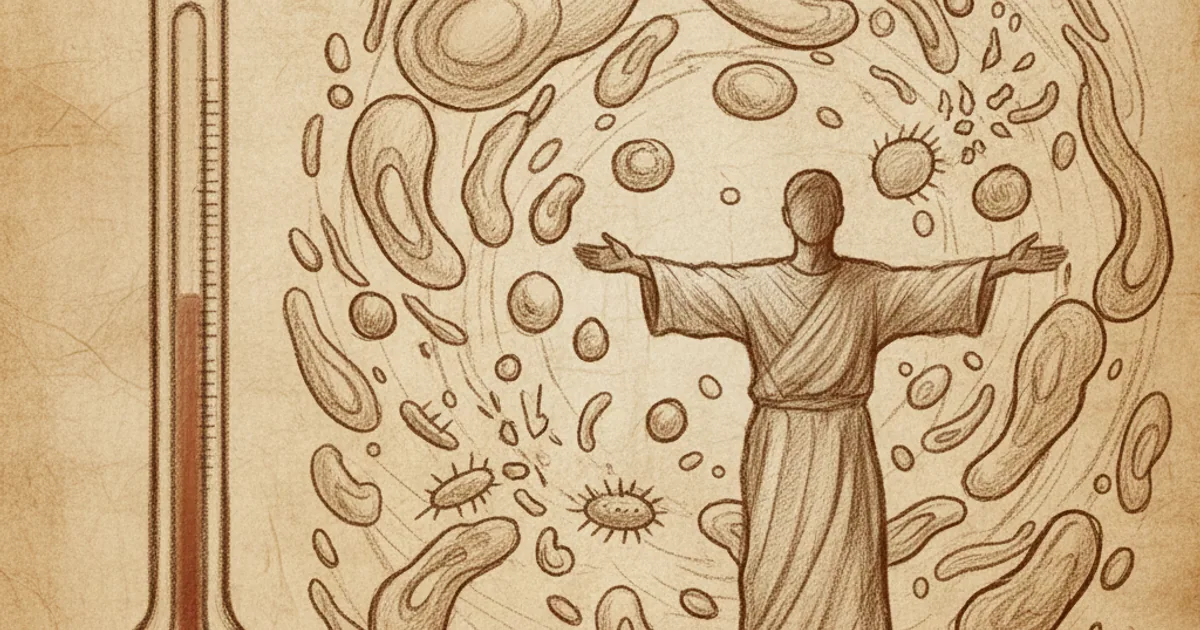
Fever isn't broken thermometers
A common assumption: when you have a fever, your body's temperature regulation has gone wrong. Your job is to bring the temperature back down.
That picture is mostly wrong. A fever is your body deliberately raising its core temperature, by changing the set-point in your hypothalamus — your brain's thermostat. The new higher temperature is intentional. Your body wants to be hotter for a while because it makes fighting the infection easier.
Suppressing every fever therefore can work against your recovery. Modern medical guidance has shifted: treat fevers for comfort and in specific high-risk situations, not just to lower the number on the thermometer.
How fever actually starts
When immune cells (especially macrophages) detect an infection — usually via molecules called pathogen-associated molecular patterns (PAMPs) — they release signalling molecules called cytokines. Some of these cytokines (interleukin-1, interleukin-6, TNF-alpha) act on the hypothalamus.
In the hypothalamus, they trigger the production of prostaglandin E2 (PGE2), which acts on temperature-regulating neurons. PGE2 raises the set-point. Suddenly, the hypothalamus is "telling" the body that 39 °C is the new normal.
What happens next: your body thinks it's cold (because your actual temperature is below the new set-point of 39 °C). You shiver to generate heat. Blood vessels in your skin constrict, reducing heat loss. You feel cold and seek warmth (extra blankets, hot drinks). Your temperature rises until it matches the new set-point.
This is why you feel cold during the early stages of a fever, even though you're hot — your hypothalamus thinks you're below set-point.
Then, when the infection is being beaten and PGE2 production drops, the hypothalamus lowers the set-point back to normal. Now your body thinks it's too hot (because you're actually still at the elevated temperature). You sweat. You feel hot. You shed clothing. Your temperature drops back to normal.
The "feeling cold then feeling hot" cycle of fever isn't random — it's the temperature lagging behind the set-point as it changes.
What the higher temperature actually does
Several mechanisms make fever useful:
Slows pathogens. Many bacteria and viruses grow best at human body temperature (37 °C) or just below. A few degrees higher slows their replication. Some viruses are especially heat-sensitive — rhinoviruses (common cold) replicate poorly above about 35 °C, which is part of why colds typically affect the cooler nasal passages.
Boosts immune cell activity. White blood cells move faster, divide faster, and have stronger inflammatory responses at slightly elevated temperatures. Antibody production by B-cells improves. T-cells respond more strongly to antigens. The immune system itself is partly tuned to operate better in fever conditions.
Increases heat shock proteins. These proteins help cells handle stress and are upregulated at higher temperatures. They also help present pathogen fragments to the immune system.
Triggers iron sequestration. During fever, the body locks more iron away from circulation (in storage proteins like ferritin). This deprives bacteria — which need iron to grow — of an important resource.
Promotes sickness behaviour. Fatigue, loss of appetite, social withdrawal. These conserve energy for the immune response and reduce the chance of spreading the infection. Sickness behaviour and fever are coordinated by the same cytokine signalling and aren't independent.
The combined effect: most infections clear faster with a fever than without one. Studies suppressing fever in patients with influenza and other viral infections show slightly prolonged illness and (in some cases) higher infectivity, not lower.
What guidance actually says
Medical guidance has moved away from "always bring it down", and the reasoning is worth understanding even though the decision itself is not one an article can make for you.
Comfort is a legitimate reason. If you feel awful, treating the fever is reasonable. The trade-off is shorter discomfort against possibly a slightly longer infection.
Febrile seizures in children look far worse than they are. They are usually brief and typically do not cause lasting damage, and they correlate with how fast the temperature rose rather than how high it got. Whether fever reducers prevent them is genuinely debated.
The fever is rarely the threat. The underlying infection is. This is why warning signs matter more than the number: severe headache, a stiff neck, confusion, difficulty breathing, or persistent vomiting all warrant medical attention regardless of what the thermometer says.
Numbers are not a substitute for a clinician. Where the line sits between "ride it out" and "get seen" depends on age, medical history, and what else is going on — and it is very different for a newborn than for a healthy adult. Specific thresholds circulate widely online; this article deliberately does not repeat them, because the right answer for a particular person comes from a doctor, not a table.
How fever reducers work
Aspirin, ibuprofen, and paracetamol (acetaminophen) all work by inhibiting PGE2 production in the hypothalamus. With PGE2 levels reduced, the hypothalamic set-point drops back toward normal. The body recognises it's now "too hot" relative to set-point and sheds heat.
Aspirin and ibuprofen are non-steroidal anti-inflammatory drugs (NSAIDs) that work by inhibiting the enzymes (COX-1, COX-2) that produce prostaglandins, including PGE2. They also reduce pain and inflammation broadly.
Paracetamol works differently — its exact mechanism is still debated, but it likely inhibits PGE2 specifically in the brain and not in peripheral tissues. This makes it good for fever and headache but less effective for inflammation elsewhere.
A note: never give aspirin to children with viral infections — it can trigger Reye syndrome, a rare but severe condition that affects the brain and liver.
Why we have this system
Evolutionarily, fever is expensive. Raising body temperature by 1 °C increases metabolic rate by about 10-13%, which is a significant energy cost. The fact that we have such an elaborate, evolutionarily conserved fever response suggests it must be paying off — otherwise selection would have removed it.
Cold-blooded animals also have a fever response. Lizards infected with bacteria seek warmer microenvironments to raise their body temperature (this is called "behavioural fever"). Fish, too. The response is at least 600 million years old in evolutionary terms.
The widespread conservation across the animal kingdom is one of the strongest indirect arguments that fever has genuine survival value.
If you'd like a guided 5-minute course on fever and how the immune response coordinates, NerdSip can generate one.
The takeaway
A fever is your body deliberately raising its core temperature to fight infection. The hypothalamus shifts its set-point upward in response to immune-cell signalling. The higher temperature slows pathogens, boosts immune cell activity, induces sickness behaviour, and sequesters iron from bacteria. Fever is expensive (about 10-13% more energy per degree) but evolutionarily ancient and well-conserved, suggesting it pays off. Suppress fevers for comfort or specific risks, but recognise that moderate adult fevers usually shorten the infection if left alone. Your body knows what it's doing.

Comments 0
No comments yet. Be the first to share your thoughts.