
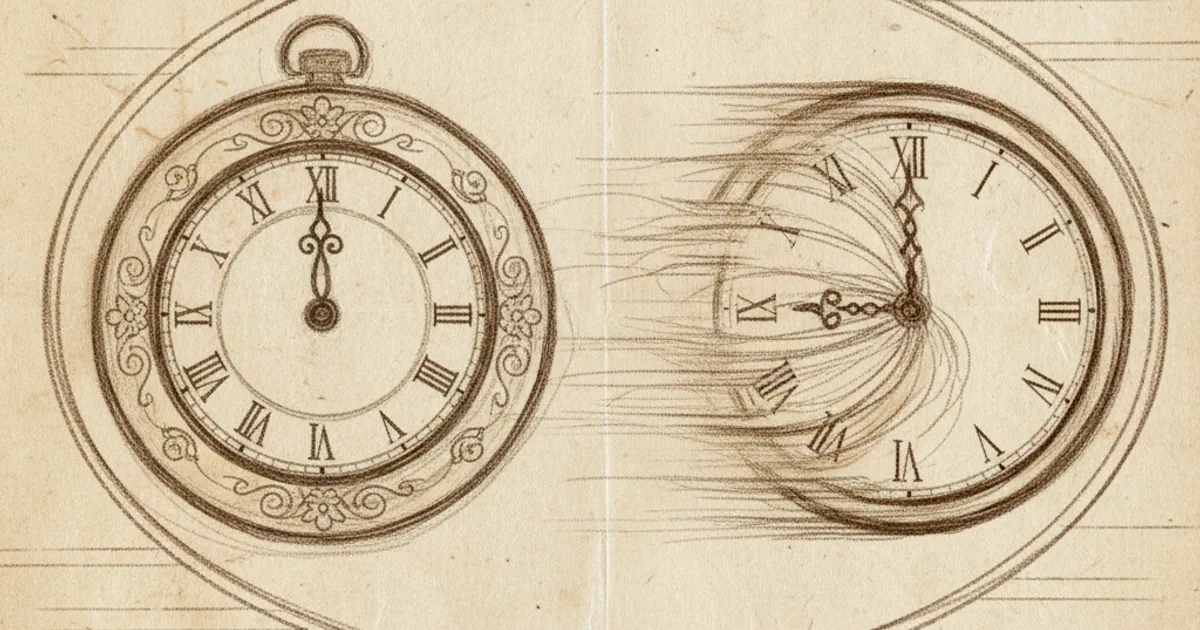
Two ways time can slow down
Special relativity says: moving clocks tick slower. A clock on a fast-moving spaceship accumulates less time than a clock at rest on Earth.
General relativity says: clocks deeper in gravity tick slower. A clock at sea level ticks more slowly than one on a mountaintop.
Both effects are real. Both are tiny at everyday scales. Both have been measured in beautiful experiments. And both are required to make GPS satellites give accurate positions.
The light-clock argument
The cleanest way to see why motion slows time uses a thought experiment Einstein liked.
Picture a "light clock": two parallel mirrors with a single photon bouncing straight up and down between them. Each bounce is a "tick." If the mirrors are spaced so the photon takes 1 nanosecond per round trip, the clock ticks once per nanosecond.
Now put this clock on a train moving past you at high speed. From the train's perspective, the photon bounces straight up and down — 1 ns per tick, as usual.
From your perspective (standing on the platform), the photon doesn't move straight up and down. The mirrors are moving sideways, so the photon's path is a zigzag — diagonal up, diagonal down, repeat. Each leg of the zigzag is longer than the vertical distance between mirrors.
But here's the constraint: light speed is the same for everyone (Einstein's second postulate). The photon can't go faster from your perspective to cover the longer zigzag path. It has to take longer.
So from your platform, each tick of the moving clock takes more than 1 ns. The moving clock ticks slower. Not as an illusion — by the actual measure of elapsed time in your frame.
The Lorentz factor
The slowdown factor is called γ (gamma) and equals:
γ = 1 / √(1 − v²/c²)
where v is the relative velocity and c is the speed of light.
- At v = 0, γ = 1 (no slowdown).
- At v = 0.1c, γ ≈ 1.005 (0.5% slower).
- At v = 0.5c, γ ≈ 1.155 (15% slower).
- At v = 0.9c, γ ≈ 2.29 (2.3× slower).
- At v = 0.99c, γ ≈ 7.09.
- At v = 0.99999c, γ ≈ 224.
The closer you get to c, the more time-dilation explodes. At c, γ would be infinite — which is why you can't actually reach c with mass.
A real experimental verification
Muons are short-lived particles created by cosmic rays smashing into the upper atmosphere about 15 km up. At rest, muons last about 2.2 microseconds — enough time for them to travel a few hundred meters before decaying.
Even moving at near-light-speed, they "shouldn't" reach sea level. But they do. Lots of them. Detectors at sea level see roughly 1 muon per cm² per minute.
The reason: muons created in the atmosphere are moving at ~0.998c. Their internal clock is dilated by γ ≈ 16. Their effective lifetime, in our frame, is 16 × 2.2 = ~35 microseconds — enough to reach the ground.
This was first measured in 1941 (Rossi–Hall), and it's now a standard demonstration. Time dilation isn't subtle — without it, we wouldn't see atmospheric muons at sea level at all.
The gravitational version
General relativity adds a second source of time dilation: gravity.
The relevant formula (approximate, near a planet of mass M):
Δt_far / Δt_close ≈ 1 + GM/(rc²)
So a clock deeper in a gravity well runs slower than one further out. Concretely:
- Atomic clocks at sea level run about 45 microseconds per day slower than clocks at 20,000 km altitude (GPS orbit).
- A clock on top of Mount Everest gains about 30 nanoseconds per day compared to one at sea level.
This effect has been measured precisely. The Pound–Rebka experiment (1959) detected gravitational time dilation between the top and bottom of a Harvard physics building's elevator shaft — a height difference of just 22 meters. They confirmed Einstein's prediction to 10% accuracy at the time; modern repeats are far more precise.
GPS would fail without both corrections
GPS satellites orbit at about 20,200 km altitude, moving at about 14,000 km/h relative to the ground.
- Special relativity: the satellites move fast, so their clocks tick slower than ground clocks — by about 7 µs per day.
- General relativity: the satellites are higher up (weaker gravity), so their clocks tick faster than ground clocks — by about 45 µs per day.
- Net effect: satellite clocks tick about 38 µs/day faster than ground clocks.
If GPS receivers didn't correct for this, positions would drift by about 10 km per day. GPS would be unusable within hours of launch. The system is built with relativistic corrections baked in.
This is one of the cleanest demonstrations that both relativistic effects are real. The system designers had to choose between "build in Einstein's corrections" or "GPS doesn't work." They chose Einstein.
Aging differently
The dramatic version of all this is: astronauts age slower than the rest of us, slightly. The ISS travels at about 7.7 km/s and is in slightly weaker gravity. The net effect is that astronauts return aged about 25 millionths of a second younger per year of orbit than they would have on the ground.
This is small but real. Russian cosmonaut Sergei Krikalev spent 803 days in orbit — he's roughly 20 milliseconds younger than he would have been had he stayed home.
For the more extreme version of this thought, see the twin paradox.
Things that don't actually slow
It's not biological aging in some metaphysical sense. It's the rate at which physical processes — every physical process, including atomic vibrations, nuclear decay, electron transitions, chemical reactions, neuron firing — proceed. Everything slows by the same factor. The astronaut isn't aware of any slowdown; their watch ticks normally, their breathing feels normal, their thoughts proceed normally.
It's only when you compare two clocks that started together and rejoined later that you see the difference. The aged-less astronaut comes back and finds Earth has experienced slightly more time than they have.
The takeaway
Time isn't universal. It runs at different rates for observers moving relative to each other and for observers at different gravitational potentials. Both effects are tiny in daily life and huge in extreme regimes. We use relativistic time-dilation corrections to fly aircraft, navigate cars, observe astrophysical phenomena, and run particle physics experiments. Every experimental test in over a century has confirmed Einstein's predictions to incredible precision. If the light-clock argument finally made relativity click for you, it's the kind of topic that rewards working through it properly with worked examples.

Comments 0
No comments yet. Be the first to share your thoughts.