
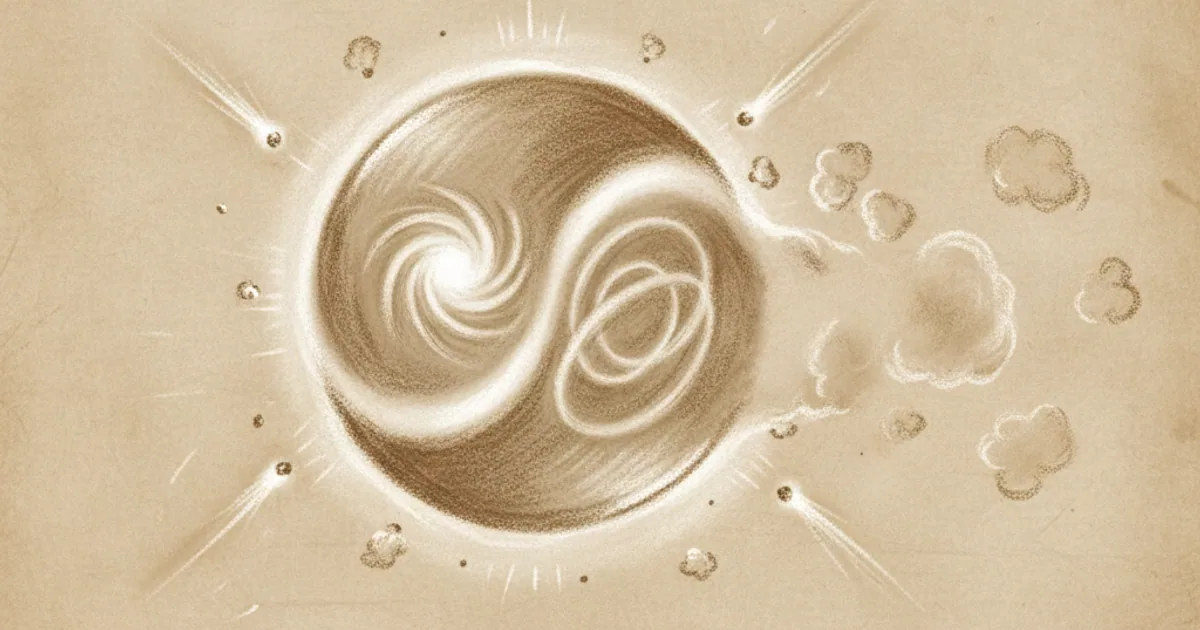
The puzzle decoherence solves
Quantum mechanics applies, in principle, to everything. A photon, an atom, a molecule, a cell, a baseball, a cat, a planet — all are made of quantum particles obeying quantum-mechanical rules.
So why don't we see macroscopic superpositions? Why doesn't a baseball appear in two locations? Why isn't Schrödinger's cat literally both alive and dead?
The standard popular answer is "observation collapses the wavefunction" — but this is misleading. Quantum mechanics doesn't say what counts as observation, and it would be strange if the universe operated differently depending on whether someone happens to be looking.
The actual answer, developed starting in the 1970s and 80s (Heinz-Dieter Zeh, Wojciech Zurek, others), is decoherence. A macroscopic object in a normal environment cannot maintain quantum coherence for any meaningful time, because it constantly interacts with the environment. These interactions effectively destroy the quantum interference between different states, making the system behave (for all practical purposes) like a classical probability mixture.
Decoherence is a real, calculable, observable phenomenon. It's part of quantum mechanics, not an addition to it. And it explains a huge amount of why the world looks classical despite being fundamentally quantum.
What "coherence" means in quantum mechanics
A quantum system in superposition has a wavefunction with specific relationships (specifically, phase relationships) between its parts. For a two-state superposition:
|ψ⟩ = α|0⟩ + β|1⟩
The complex numbers α and β have both magnitudes and phases. The phases matter — they're what allow interference effects to occur. If you measure the system in a basis where interference can show up, the phases produce observable fringes (like the double-slit experiment's interference pattern).
A coherent superposition is one where these phase relationships are well-defined and intact. Interference can occur. Quantum effects are observable.
A decohered state is one where the phase relationships have been scrambled by interactions with environmental degrees of freedom. The system's state, considered on its own (ignoring the environment), looks like a classical probability mixture rather than a coherent superposition. Interference between the components becomes impossible to observe with realistic measurements.
The key mathematical move: when you have an entangled state between system and environment, and you average over the environment (because you can't track all those environmental degrees of freedom), you get an effective state for the system alone that has lost its phase information. This is captured formally by the system's "reduced density matrix."
How fast decoherence happens
The remarkable result: for macroscopic objects in normal conditions, decoherence is absurdly fast.
A small dust particle (radius ~1 micrometer) in a room with normal air and ambient light:
- Air molecules constantly collide with it (~10²¹ collisions per second).
- Photons constantly scatter off it.
- Each collision and scattering event entangles the particle with the colliding particle or photon.
- The entanglement carries information about the particle's position.
If the particle were prepared in a superposition of two locations a micrometer apart, decoherence due to air collisions alone takes on the order of 10⁻³¹ seconds; for larger separations, decoherence is faster still. Add room light, even faster. Add radiation from the room's walls, faster still.
For a cat-sized object exposed to room light, decoherence happens on timescales around 10⁻²³ seconds. This is far faster than any timescale we can observe.
For a baseball at room temperature in normal air: similarly fast. No meaningful timescale of macroscopic superposition is possible without extraordinary isolation.
This is why we don't see cats in superposition. It's not that quantum mechanics is wrong at large scales — it's that decoherence makes macroscopic superpositions effectively unobservable.
How to slow decoherence
To preserve quantum coherence, you have to isolate the system from its environment. Various tricks:
Ultra-low temperatures: reduces thermal phonon and photon emission. Superconducting qubits are operated at ~10 mK.
High vacuum: minimizes molecular collisions. Atom trap experiments operate at ultra-high vacuum, typically 10⁻⁹ to 10⁻¹⁰ Pa (roughly 10⁻¹¹ to 10⁻¹² mbar).
Magnetic shielding: minimizes magnetic field fluctuations from outside.
Material purity: defects in materials provide decoherence pathways. High-purity isotopically-enriched substrates help.
Trapped atoms and ions: individual atoms held in electromagnetic traps in vacuum, manipulated with lasers. Coherence times can reach seconds to minutes.
Photonic qubits: single photons traveling through optical fibers can maintain coherence over significant distances if losses are low.
For quantum computing, "decoherence time" is a key metric. Modern qubit platforms:
- Superconducting qubits: typical coherence ~100 μs to ~1 ms.
- Trapped ions: typical coherence many seconds.
- Photonic qubits: limited by losses; thousands of operations possible.
- Color centers in diamond (NV centers): milliseconds at room temperature.
Each platform balances decoherence rate against gate speed (how fast quantum operations can be performed). The goal is to do many useful operations before decoherence finishes the computation.
Decoherence vs collapse
A common confusion: is decoherence the same as wavefunction collapse?
No. They're related but distinct:
Decoherence is a calculable process that turns quantum interference between branches into something indistinguishable from a classical probability mixture. The full quantum state (including the environment) still contains all branches in superposition; we just can't observe interference between them in practice.
Wavefunction collapse (in interpretations that include it) is a postulated process by which the system actually transitions from a superposition to a single outcome. This is the part decoherence does NOT do.
Decoherence + interpretation = explanation:
- Copenhagen: decoherence sets up the situation, then the wavefunction "really" collapses (some way of saying which outcome we get).
- Many-worlds: decoherence explains why the branches don't interfere — they evolve independently. There's no collapse; all branches exist, decoherence just makes them effectively separate worlds.
- Bohmian: decoherence explains why the empty branches don't influence what the actual particle does.
- Objective collapse: decoherence and objective collapse can both be at work; in some models they're the same thing.
So decoherence is a real, agreed-upon physical phenomenon. What it MEANS — whether it's the whole story of the quantum-to-classical transition or only part of it — depends on interpretation.
What decoherence explains
A few things decoherence handles well:
Why macroscopic objects appear classical. They interact with their environment too much to maintain superposition.
Why quantum interference is hard to observe. Isolation is required, and most systems aren't isolated.
Why the boundary between "quantum" and "classical" isn't sharp. Decoherence gives a smooth quantitative measure of how quantum a system is, depending on how isolated it is.
Why specific "preferred bases" emerge. Environmental interactions select certain bases (like position) as the natural ones to describe the system in. Macroscopic objects have definite positions because their environments preferentially measure position (rather than, say, momentum).
Why quantum technologies are hard. You have to engineer extreme isolation to preserve coherence long enough to use it.
What decoherence doesn't fully explain
A few things it doesn't address:
Why we experience one specific outcome. The quantum state after decoherence still mathematically contains all branches. Why our subjective experience corresponds to just one branch (or many parallel selves in many-worlds, etc.) requires interpretive choice.
The exact transition from "indistinguishable from classical" to "actually classical." Decoherence makes superpositions effectively unobservable, but doesn't necessarily reduce them to single outcomes.
Why probabilities follow the Born rule. Decoherence gives us a mixed state with specific weights; the Born rule says these weights are what we observe as probabilities. Why specifically squared magnitudes (rather than something else)? Various interpretations try to derive this from first principles, with debated success.
These are remaining open questions, not failures of decoherence. The framework as developed is one of the major theoretical achievements in quantum foundations.
Macroscopic quantum effects that DO exist
Despite the general rule that macroscopic objects can't be in superposition, some carefully engineered systems show macroscopic quantum behavior:
Superconductivity: millions of electron pairs (Cooper pairs) occupy a single coherent quantum state across a macroscopic sample. Persistent currents flow without resistance.
Bose-Einstein condensates: thousands to millions of atoms occupy the same quantum state at temperatures near absolute zero. The whole condensate behaves like a single quantum object.
Superfluid helium: liquid helium below 2.17 K (helium-4) flows without viscosity — a macroscopic quantum effect.
Squeezed light states: macroscopic numbers of photons can be prepared in superposition states; used in LIGO for gravitational wave detection.
Large molecule interference: molecules with 2000+ atoms have been shown to produce interference patterns in modified double-slit experiments. The largest objects so far in superposition (as of mid-2026) are still small by everyday standards, but progressively larger systems are being explored.
All of these require extraordinary isolation from the environment. They show that quantum mechanics genuinely applies at macroscopic scales — decoherence just usually prevents us from observing it.
Why this is hopeful for quantum technology
Quantum computers, quantum sensors, and quantum communications all depend on preserving quantum coherence. Decoherence is the enemy.
The good news: we're getting better at fighting it. Coherence times for various qubit technologies have improved by orders of magnitude over the past two decades. Error correction techniques can extend effective coherence further by detecting and fixing errors caused by partial decoherence.
The realistic outlook (as of mid-2026): some quantum technologies (atomic clocks, quantum cryptography, certain quantum sensors) are already commercial. Quantum computers are progressing but still hampered by decoherence — practical fault-tolerant quantum computers are 5-15 years away, requiring substantial reduction in qubit error rates through better materials, better control, and quantum error correction at scale.
If you'd like a guided 5-minute course on quantum decoherence, NerdSip can generate one.
The takeaway
Decoherence is the rapid loss of quantum coherence when a system interacts with its environment. The interactions entangle the system with environmental degrees of freedom; averaging over those degrees of freedom yields an effective state that looks like a classical probability mixture rather than a coherent superposition. For macroscopic objects in normal conditions, decoherence happens absurdly fast — typically nanoseconds or much less, often 10⁻²³ seconds or shorter. This explains why we don't observe macroscopic superpositions. Decoherence doesn't fully solve the measurement problem (it doesn't explain why we observe one specific outcome rather than a mixture), but it does explain why the quantum-to-classical transition appears smooth in practice. It's also the central practical obstacle for quantum technology, where engineering long coherence times is the central challenge.

Comments 0
No comments yet. Be the first to share your thoughts.