
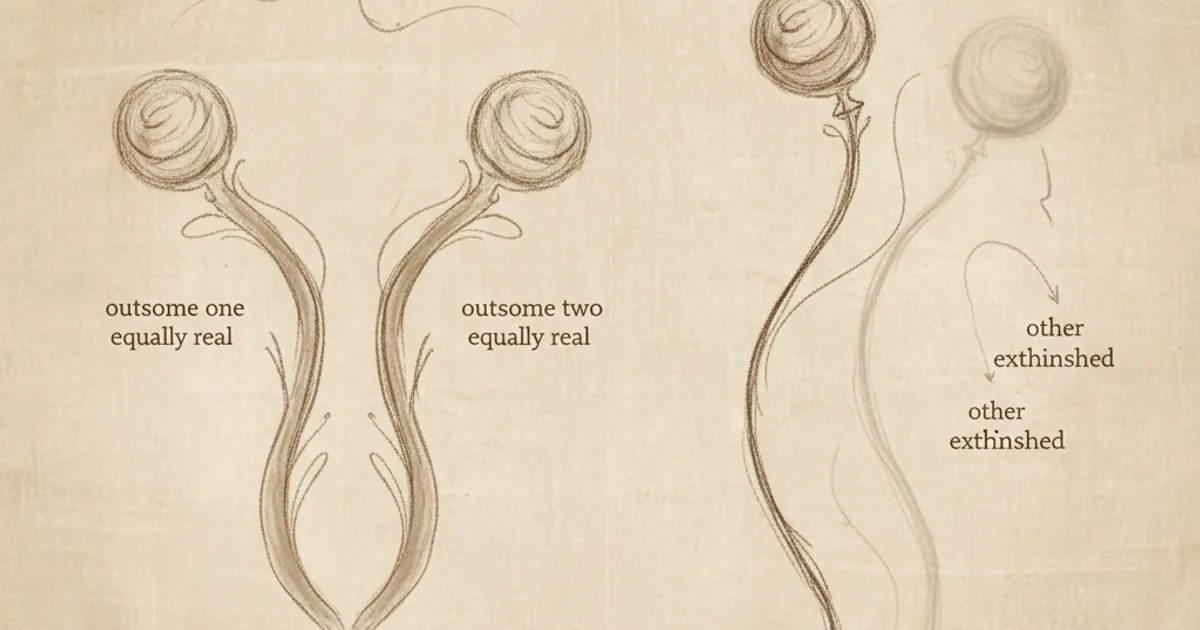
Same predictions, different stories
Both Copenhagen and many-worlds interpretations make the same empirical predictions for ordinary quantum experiments. Run the math, get the answer, compare to experiment — both interpretations work equally well at this level.
What they disagree about is what's really happening underneath the math. Specifically: does the wavefunction collapse when measurement occurs, or does it never collapse and all outcomes exist in parallel branches?
This isn't an empty disagreement. It bears on what reality is like, what observation means, what probability is, and what the role of conscious experience is in the physical world. But it's also not (currently) experimentally testable — both interpretations predict the same observable outcomes.
This article walks through both views, their motivations, their advantages, and their difficulties.
The Copenhagen interpretation (roughly)
The Copenhagen interpretation is associated with Niels Bohr and Werner Heisenberg in the late 1920s and early 1930s, though it was never crystallized into a single unified statement. Different "Copenhagen" physicists believed somewhat different things. The rough framework:
The wavefunction is a tool for predicting measurement outcomes, not necessarily a description of physical reality. Different versions vary in how strongly they emphasize this.
Quantum systems and measurement apparatuses are conceptually distinct. Apparatuses are described classically; quantum systems get wavefunctions.
Measurement collapses the wavefunction. When the quantum system interacts with the (classical) apparatus, the wavefunction discontinuously jumps to the eigenstate corresponding to the observed outcome.
Probabilities are given by the Born rule (square of amplitude). These probabilities are fundamental — they're not reducible to ignorance of hidden variables.
Asking about pre-measurement properties (where the particle "really" was before measurement, what value spin "really" had) is often viewed as meaningless or unscientific.
Why this view appealed to many of the founders:
- It bracketed off thorny philosophical questions and let physicists get on with calculations.
- It accommodated the experimental fact that quantum mechanics gave inherently probabilistic predictions.
- It respected the apparent special role of measurement apparatus in physics experiments.
- It was pragmatically successful — physicists using it produced enormous progress.
Difficulties:
- Where's the quantum-classical cut? Modern physics suggests apparatuses should themselves be described by quantum mechanics. There's no clear principled boundary.
- What "is" the wavefunction? Different Copenhagen practitioners gave different answers.
- Why does measurement collapse? No physical mechanism is provided.
- The "von Neumann chain" issue — the chain of measurements from quantum system to apparatus to observer never resolves itself within the formalism.
- Doesn't take quantum mechanics seriously as a description of reality — treats the apparatus as separate from the quantum world, which seems philosophically and physically inadequate.
Most working physicists today don't strictly subscribe to Copenhagen but adopt some pragmatic descendant of it — "shut up and calculate" being the most concise version. The pure original Copenhagen view is somewhat out of favor; its successors are still widely used.
The many-worlds interpretation (Hugh Everett, 1957)
Hugh Everett's PhD thesis at Princeton (1957) proposed a radical alternative: the wavefunction never collapses.
Everett's proposal:
The wavefunction is real, not just a calculation tool.
The Schrödinger equation applies to everything, including measurement apparatuses and observers. There is no special "collapse" process.
When measurement occurs, the apparatus simply entangles with the quantum system, producing a superposition of "apparatus shows outcome 1 + observer sees 1" and "apparatus shows outcome 2 + observer sees 2." Both terms persist.
These branches don't interfere with each other after decoherence sets in — they evolve effectively independently.
Each branch contains one observer experiencing one outcome. From inside each branch, the world looks like exactly the kind of world we observe.
"Probability" in many-worlds means something like: the weights of the branches in the superposition determine how often each outcome is experienced across the branches.
Why this view appeals:
- Only the Schrödinger equation is needed — no extra postulate of collapse.
- Resolves the measurement problem by denying that anything special happens at measurement.
- Takes the wavefunction seriously as a description of reality.
- Predictively equivalent to Copenhagen for ordinary experiments.
- No mysterious quantum-classical boundary.
- Treats consciousness and observation as ordinary physical processes.
Difficulties:
- What does "probability" mean in a deterministic theory where all outcomes occur? This is a major technical and philosophical challenge; defenders have proposals (decision-theoretic derivations, branch-counting arguments) but none is universally accepted.
- The branching is enormous. Every quantum event involves branching; the total number of branches per second is astronomical. Many find this metaphysically extravagant.
- Personal identity issues. If "you" become many copies after each measurement, what does that mean for memory, continuity, choices?
- Born rule problem. Why do branches with smaller amplitudes happen less often? This is non-trivial to derive within many-worlds; multiple approaches exist, with debated success.
- The preferred basis problem. Quantum mechanics doesn't naturally pick out specific bases (like position) as the "real" ones for branches. Decoherence helps but the philosophical issue remains.
Many-worlds has been gaining ground in physics departments since the 1990s, partly because of decoherence (which makes the branches look more natural) and partly because it avoids the measurement problem. But it remains controversial.
Comparing the two
| Aspect | Copenhagen-ish | Many-worlds |
|---|---|---|
| Wavefunction reality | Tool or instrumental | Real physical state |
| Collapse | Yes, at measurement | No, never |
| Special role of measurement | Yes | No |
| Determinism of fundamental equations | No (collapse is random) | Yes (only Schrödinger evolution) |
| Number of "worlds" | One | Many (branching) |
| Probability source | Fundamental | Emergent (branch weights) |
| Empirical predictions | Same as MWI | Same as Copenhagen |
| Quantum-classical boundary | Implicit | Decoherence-induced |
| Privileged observers | Implicitly | No |
The two share enormous common ground — both accept standard quantum mechanics, both use the Schrödinger equation, both incorporate the Born rule, both reproduce experimental results.
They differ on what's "really" happening behind the formalism.
Other interpretations (briefly)
Not just these two:
Bohmian / pilot-wave mechanics: particles always have definite positions; wavefunction is a guiding "pilot wave." Deterministic, hidden-variable theory. Non-local (per Bell). See Bell's theorem.
Objective collapse (GRW, CSL, Penrose): wavefunction collapse is a real physical process, not an interpretation. Makes slightly different predictions from standard quantum mechanics — potentially testable.
QBism (Quantum Bayesianism): wavefunction represents an agent's personal degrees of belief. Probabilities are subjective Bayesian. Measurement updates the agent's information.
Relational quantum mechanics (Rovelli): measurement outcomes are relations between systems, not absolute facts.
Consistent histories / decoherent histories: focuses on histories of macroscopic outcomes rather than wavefunction collapse.
Transactional interpretation: emitters and absorbers send waves both forward and backward in time, forming "transactions."
Modal interpretations: various proposals where the wavefunction encodes possibilities, with specific rules for which outcome becomes actual.
Each of these has serious physicist defenders. None of the major interpretations has been ruled out experimentally — though specific objective-collapse models (GRW, CSL) have had large regions of their parameter space excluded by interferometry and heating experiments, leaving narrower parameter ranges still viable. Choosing among interpretations is mostly philosophical preference and intuition, constrained by the empirical results we already have.
Where physicists actually stand
Surveys of physicists' interpretive preferences vary in sample size and audience:
- The 2013 Schlosshauer-Kofler-Zeilinger survey (33 participants at a foundations conference) found Copenhagen-derived views most common (~40%), with significant minorities for information-based, many-worlds, and other interpretations.
- A 2025 Nature survey of over 1,100 researchers showed a more spread-out picture: roughly 21% favoring Copenhagen, with the remainder distributed across many-worlds, information-theoretic, Bohmian, objective-collapse, and "other / no opinion" categories.
These numbers depend heavily on which community is sampled (foundations specialists vs experimental physicists vs cosmologists) and shift over time.
Notable: the "shut up and calculate" attitude — not really an interpretation but a refusal to engage — remains popular. Many working physicists treat interpretation questions as philosophical noise distracting from doing physics.
This shifted somewhat in the 2010s-2020s as quantum technology developed (quantum computing, sensing, communication) and made interpretation questions more practically relevant. The Nobel Prize 2022 for Bell-test experiments also gave new prominence to foundational questions.
What might break the deadlock
A few things that could distinguish interpretations:
Testing objective collapse: experiments at the boundary of quantum-classical behavior (large molecules, micromechanical oscillators) constrain GRW-style theories. As capabilities improve, the parameter space is being progressively restricted.
Quantum gravity: a complete theory of quantum gravity would likely have implications for interpretation. Different interpretations make different predictions about quantum gravitational situations (black hole entropy, the early universe, etc.).
Wigner's friend experiments: thought experiments involving observers observing observers have been partly realized experimentally. They probe whether different observers' descriptions of the same event must be consistent. So far results are consistent with all major interpretations, but the experimental frontier is advancing.
Quantum computing: very large quantum computers running specific algorithms might (some have argued) require many-worlds to be intuitive. This is debated.
Cosmological observations: speculative, but the very early universe is a quantum-mechanical situation. Some interpretive choices might lead to slightly different cosmological predictions.
Despite these possibilities, the current honest state is: no experimental result has decisively chosen between the major interpretations. The debate continues at the level of philosophy, intuition, and aesthetic preference.
A personal note
Many people approach interpretations expecting one to be "right" and the others "wrong." The reality is more like the situation in mathematics where different formulations of the same theorem are all valid — except in physics we expect there should be one truth about what's happening.
For most physicists, day-to-day work doesn't require choosing. You compute, predict, measure, compare. The formalism works the same regardless of interpretation.
For physicists working on quantum foundations, technology applications, or quantum-gravity research, the interpretation matters more — different views suggest different research directions.
For anyone interested in the conceptual structure of physics, both Copenhagen and many-worlds are worth understanding deeply. Each illuminates different aspects of what quantum mechanics is and isn't saying.
If you'd like a guided 5-minute course on quantum interpretations, NerdSip can generate one.
The takeaway
The Copenhagen interpretation says the wavefunction is a tool for predicting measurements; when measurement happens, the wavefunction collapses to the observed outcome, with probabilities given by the Born rule. The many-worlds interpretation (Hugh Everett, 1957) says the wavefunction is a real state that never collapses; every measurement entangles the system with the apparatus and observer, producing parallel non-interfering branches — one for each outcome. Both make the same predictions for ordinary experiments. Each has advantages and difficulties. As of mid-2026, no experiment has distinguished them, and the choice is largely a matter of philosophical preference. Other interpretations (Bohmian, objective collapse, QBism, relational) also exist and have their adherents. The interpretation question is genuinely unresolved — not because the math is broken, but because what the math describes isn't settled.

Comments 0
No comments yet. Be the first to share your thoughts.