
The puzzle
Quantum mechanics has two rules for how the state of a system changes over time:
Rule 1: The Schrödinger equation. When a quantum system is left alone, its state evolves smoothly and deterministically according to a specific differential equation. No randomness, no jumps. If you know the state now and the Hamiltonian (which describes the system's energy), you know the state at any future time.
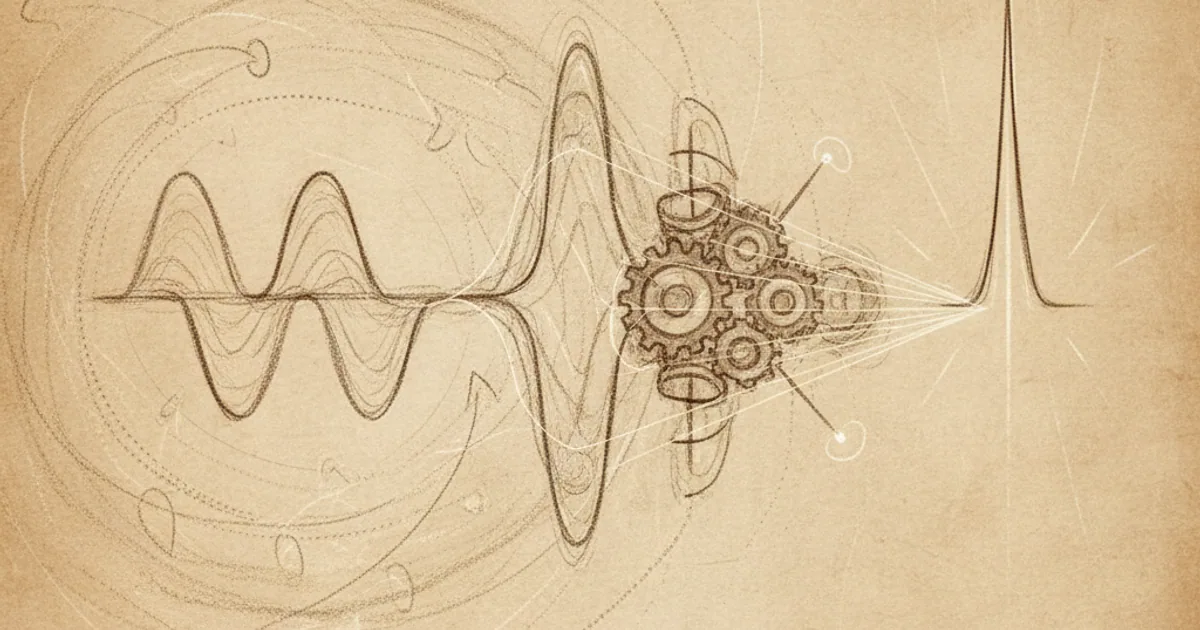
Rule 2: Measurement. When you "measure" a quantum system, the state appears to jump suddenly into one of the possible outcomes with probabilities given by the Born rule (square of the amplitude). This jump is random — quantum mechanics gives you the probabilities but not which specific outcome will occur.
The puzzle: what is a "measurement," and why does it follow different rules from ordinary physical interactions?
Rule 1 is well-defined and uncontroversial. Rule 2 is where all the trouble starts. There's no precise definition of "measurement" in the formalism. There's no equation describing what happens during collapse. There's nothing in the Schrödinger equation that says "stop evolving smoothly here and jump randomly."
This is the measurement problem, and it's been a central issue in quantum foundations since the 1920s. It's not solved.
The von Neumann story
John von Neumann formalized quantum mechanics rigorously in the 1930s. His description of measurement (sometimes called "von Neumann measurement"):
A quantum system in state |ψ⟩ = α|0⟩ + β|1⟩ interacts with a measurement apparatus. The Schrödinger equation says this interaction should entangle them:
α|0⟩|apparatus reads 0⟩ + β|1⟩|apparatus reads 1⟩
Notice: this is itself a superposition. Both terms coexist. The apparatus is in a superposition of "reading 0" and "reading 1."
Now we observe the apparatus. According to von Neumann's analysis, this requires another measurement — entangling the apparatus with our brain/sensory system. Now the brain is in a superposition.
We could continue chaining: measurement on top of measurement, each one entangling more degrees of freedom. The superposition never goes away on its own; it just propagates outward to involve more and more systems.
At some point, something has to convert this superposition into one definite outcome (the one we actually observe). When does that happen? What process produces it? Where in the chain does collapse occur?
This is the von Neumann chain or measurement chain. The measurement problem is essentially: where does the chain end?
The various proposed answers
Different interpretations resolve this differently:
Copenhagen-style: there's a quantum-classical cut
The original Copenhagen interpretation (associated with Bohr, Heisenberg, others, though never a single unified statement) draws a fundamental distinction between quantum systems and classical measurement apparatus. The classical apparatus is, by stipulation, not described by a wavefunction. When a quantum system interacts with classical apparatus, the wavefunction collapses to one outcome.
Problems:
- Where exactly is the cut between quantum and classical? Bohr was deliberately ambiguous.
- What makes classical apparatus special? Modern physics applies quantum mechanics to apparatuses too.
- The position is at best pragmatic; it doesn't really explain why measurement is different.
Despite these issues, "shut up and calculate" approaches loosely descended from Copenhagen remain the dominant working attitude in physics.
Many-worlds (Hugh Everett, 1957): no collapse, all outcomes occur
Everett's proposal: there is no measurement-induced collapse. The Schrödinger equation applies to everything, including measurement apparatus and observers. When measurement happens, the resulting superposition simply persists — the universe "branches" into parallel non-interacting components, each containing one outcome.
In one branch, the apparatus reads 0 and you observe 0. In another branch, the apparatus reads 1 and you observe 1. Both versions of you exist, in different branches, both believing they got "the" outcome.
Decoherence explains why the branches don't observably interfere with each other in normal conditions.
Advantages:
- Only the Schrödinger equation is needed — no extra collapse postulate.
- Resolves the measurement problem by denying that anything special happens at measurement.
- Has a natural account of why probabilities work as they do (though this requires care).
Difficulties:
- The Born rule (where do the |α|², |β|² probabilities come from?) is harder to derive cleanly than it seems.
- The branching structure raises questions about personal identity, probability, and meaning.
- Some find the multiverse picture extravagant.
Detail in many-worlds vs Copenhagen.
Bohmian mechanics: particles always have definite positions
Louis de Broglie (1927) and David Bohm (1952) developed a fully deterministic theory: particles always have definite positions, guided by a "pilot wave" (the wavefunction). The apparent randomness in quantum experiments is just ignorance of the initial particle positions.
The wavefunction evolves smoothly via the Schrödinger equation (no collapse) and guides the particle motion. Measurement just reveals where the particle already was.
Advantages:
- Fully deterministic and realist — particles have definite positions at all times.
- Solves the measurement problem trivially: there's no superposition of particle positions, just one position plus a wavefunction.
- Reproduces all standard quantum predictions.
Difficulties:
- Explicitly non-local (necessary, by Bell's theorem). The pilot wave can change instantly across arbitrary distances based on measurements.
- Doesn't generalize cleanly to relativistic quantum field theory.
- Tends to feel "ad hoc" to some physicists — adds extra ontology (the particle positions) on top of the wavefunction.
Bohmian mechanics has a small but committed following. It's often dismissed too quickly; the theory is mathematically rigorous and empirically equivalent to standard quantum mechanics for non-relativistic systems.
Objective collapse (GRW, Penrose, others)
Theories that propose real physical collapse processes, not just an effective phenomenon.
The Ghirardi-Rimini-Weber (GRW) theory adds a random spontaneous localization to the Schrödinger equation. Particles undergo random collapses to specific positions at a low rate. For single particles, the rate is negligible (no effect on standard quantum experiments). For macroscopic objects (many particles), the collective rate is high enough that the object effectively has a definite position at all times.
Penrose proposed gravitationally-induced collapse: superpositions of significantly different mass distributions are inherently unstable due to gravity's interaction with spacetime.
Both make slightly different predictions from standard quantum mechanics in extreme regimes (very large superpositions, very precise measurements over long times). Experiments are pushing the limits but haven't yet definitively ruled them in or out.
Advantages:
- Solve the measurement problem with a clear physical mechanism.
- Make experimentally testable predictions different from standard quantum mechanics.
Difficulties:
- The parameters of GRW have to be carefully tuned to escape detection so far.
- Penrose's proposal requires speculation about quantum gravity.
- Both add structure to the theory that may seem unnecessary if interpretations like many-worlds work.
QBism (Quantum Bayesianism)
A relatively recent interpretation (Chris Fuchs, Rüdiger Schack, others, formalized in the 2000s-10s): the wavefunction represents an agent's personal degrees of belief about future measurement outcomes, not an objective physical state. Measurement updates the agent's information.
Each observer has their own wavefunction reflecting their own information. Probabilities are subjective Bayesian probabilities. Quantum mechanics is fundamentally about decisions and experiences of agents.
Advantages:
- Sidesteps many measurement-problem issues by reinterpreting what the wavefunction is.
- Connects naturally to subjective probability theory.
Difficulties:
- Many physicists find the radical observer-dependence unsatisfying.
- Doesn't obviously explain the success of objective-looking experimental predictions made by different observers.
Relational quantum mechanics (Carlo Rovelli)
A variant where measurement outcomes are relations between systems, not absolute facts. A given event has a definite outcome relative to one observer but may have a different outcome relative to a different observer. Reality is fundamentally relational.
Why this all matters
You might think: who cares about interpretations, as long as the math works?
A few reasons it matters:
1. The interpretations might not all make the same predictions. Objective collapse theories make slightly different predictions; experimental tests are ongoing.
2. They affect physical intuition. Working physicists develop intuitions that guide research. Different interpretations suggest different research directions, especially at the boundary between quantum mechanics and gravity.
3. They have implications for quantum technology. Quantum computing, quantum cryptography, quantum sensing — all use quantum mechanics in subtle ways. Different interpretations sometimes suggest different optimal strategies.
4. They affect philosophy. Free will, the nature of reality, the role of observers, the meaning of probability — quantum interpretations bear on all these.
5. They might point toward a deeper theory. Quantum mechanics doesn't naturally accommodate gravity. Understanding what quantum mechanics is "really" doing might be necessary for the eventual quantum theory of gravity.
But many working physicists adopt a pragmatic stance: "shut up and calculate" — use the math, don't worry too much about interpretation unless you're doing foundations specifically.
Some experiments that have probed measurement
A few experimental directions:
Delayed-choice experiments: Wheeler's thought experiment, now experimentally realized: a photon's path through a double-slit can be determined after the photon has already "passed through" the slits. The outcome depends on the later measurement choice, suggesting something genuinely strange about timing of measurement-related effects.
Quantum eraser experiments: which-path information about a photon can be erased after the fact, restoring interference patterns. Suggests the relevant question is what information is available, not what physically happened.
Weak measurements: a technique that extracts limited information about a quantum system without fully collapsing it. Has been used to probe wavefunctions experimentally and look at average behavior of quantum states.
Tests of macroscopic superposition: as of the mid-2020s, quantum interference has been observed for molecules exceeding 25,000 atomic mass units, with proposals to push toward levitated nanoparticles approaching 10⁹ amu and beyond. So far no deviation from quantum mechanics; objective collapse models are being progressively constrained as the experiments reach larger scales.
Tests of Bell-type inequalities with progressively closed loopholes: keep confirming quantum mechanics over local hidden variables. The 2022 Nobel Prize honored this work.
None of these experiments has definitively ruled an interpretation in or out. But they keep probing the edges and constraining what's possible.
What "observation" actually means
A common confusion: "the observer collapses the wavefunction" makes it sound like consciousness or human attention is special.
In contemporary physics, this is largely seen as a confused way of putting things. What matters is the physical interaction with a sufficiently classical apparatus. A photographic plate measures a photon's position even if no one looks at the plate. A Geiger counter detects a particle even with no human present. The "observer" is just a stand-in for "any system that interacts sufficiently with the quantum system to entangle with it."
Decoherence makes this precise: once enough environmental degrees of freedom are entangled, the original superposition becomes practically indistinguishable from a classical probability distribution. Consciousness isn't required.
The misconception persists in popular culture because it sounds profound — "you create reality by looking at it!" — but it doesn't correspond to what physicists mean by measurement.
If you'd like a guided 5-minute course on quantum measurement, NerdSip can generate one.
The takeaway
The measurement problem is the question of why quantum mechanics seems to have two different rules: smooth Schrödinger evolution most of the time, and apparently sudden probabilistic collapse during measurement. No precise definition of "measurement" exists in the formalism, and no equation describes the collapse process. Multiple interpretations have been proposed — Copenhagen (collapse is fundamental, perhaps with a quantum-classical cut), many-worlds (no collapse; all outcomes occur in parallel branches), Bohmian mechanics (definite particle positions all along, deterministic), objective collapse (real spontaneous collapse processes), QBism (wavefunction is subjective information), and others. All make the same predictions for ordinary experiments, so distinguishing them experimentally is hard but not impossible — and increasingly being attempted. Until then, the measurement problem remains one of the deepest unresolved questions in physics.

Comments 0
No comments yet. Be the first to share your thoughts.