
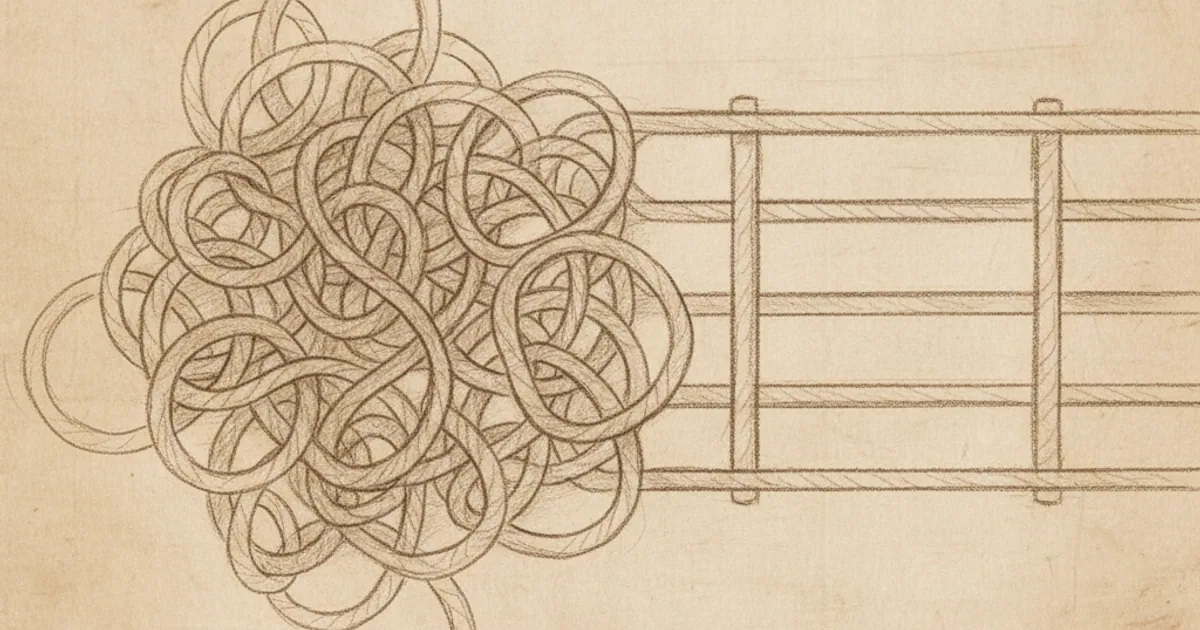
A bowl of microscopic spaghetti
Stretch a rubber band and it pulls back. Let go and it snaps to its old shape. That seems ordinary until you ask what is actually pulling it back — and the answer turns out to be one of the strangest and most beautiful ideas in materials science. Rubber doesn't snap back because its bonds are stiff, like a metal spring. It snaps back because of disorder.
To see why, picture what rubber is made of. Rubber is a polymer: a material built from enormously long, flexible chain molecules, each one thousands of links long. Imagine a tangled bowl of spaghetti, except each strand is far longer and floppier, wriggling constantly from the heat of its own thermal motion. In a relaxed rubber band, these chains are coiled, crumpled, and randomly knotted together in every imaginable shape.
That randomness is the whole key.
Why it stretches: uncoiling, not bond-stretching
When you pull on the rubber band, you're not really stretching the chemical bonds along each chain. You're uncoiling the chains — pulling the crumpled, wiggly strands out straighter and lining them up in the direction you're pulling.
This is why rubber can stretch so dramatically. A metal can only be pulled a tiny fraction longer before its atomic bonds give and it deforms for good, because stretching a metal really does mean prying its bonds apart. Rubber's chains, by contrast, start out balled up, so there's enormous slack to take up. You can pull a rubber band to several times its length just by straightening tangles that were there all along — no bonds need to break or even strain much.
Why it snaps back: entropy
Now the deep part. When the chains are coiled and tangled, there are a staggering number of different random shapes they could be in — countless ways for floppy strands to crumple. When you stretch them straight and parallel, there are far fewer arrangements: an aligned chain is much more orderly, and order is rare.
In physics, the count of how many arrangements a system can be in is entropy — high entropy means lots of disordered possibilities, low entropy means few orderly ones. And nature has a relentless statistical preference: systems drift toward higher entropy, simply because there are vastly more disordered states to fall into than orderly ones.
So a stretched rubber band is sitting in a low-entropy, highly-ordered state that it is statistically desperate to leave. The constant thermal jiggling of the chains keeps nudging them to re-crumple, to scramble back into the disordered tangle where there are billions of times more places to be. That drive back toward disorder is the elastic force. The band pulls on your fingers not because bent bonds are pushing back, but because its molecules "want" to return to chaos.
This is called entropy elasticity, and it makes rubber genuinely different from almost every other elastic material. A spring stores energy in strained bonds; rubber stores it in lost disorder.
The tell-tale sign: rubber warms when stretched
If this entropy story is right, it makes a weird prediction you can test on your own lip. When you force the chains into their orderly, low-entropy aligned state, that drop in entropy has to release heat (the thermodynamics demands it). So stretching a rubber band quickly should warm it up.
Try it: stretch a thick rubber band fast and press it to your upper lip. It feels warm. Now let it snap back and hold it to your lip again — as the chains scramble back into disorder, entropy rises, and the band absorbs heat and feels cool.
Most solids do nothing so dramatic. This little warm-then-cool trick is direct, hands-on evidence that rubber's springiness comes from entropy, not from stiff bonds. There's an even stranger consequence: heat a stretched rubber band and it pulls back harder, because more thermal jiggling means a stronger statistical push toward disorder. A heated metal goes soft; a heated rubber band gets stronger. That backwards behavior is the signature of an entropy spring.
Why it doesn't just turn to goo: cross-links
There's one problem left. If rubber is just a tangle of separate chains, why doesn't pulling on it simply make the chains slide permanently past each other, so it stretches out and stays stretched — like pulling taffy?
That's exactly what raw, untreated rubber does. Natural latex is sticky and tends to flow; stretch it hard and the chains slip past one another for good, and it never fully recovers. Useless for a tire.
The fix is vulcanization, discovered by Charles Goodyear. You heat the rubber with sulfur, and the sulfur forms cross-links — short chemical bridges that stitch neighboring chains together at scattered points along their lengths. Now the chains are tied into a single connected network. They can still uncoil and stretch when you pull, but they can't slide away from each other, because they're anchored. So instead of flowing apart, the whole network springs back every time. Vulcanization is what turned gooey latex into the durable, bouncy rubber of tires, hoses, and elastic bands. The number of cross-links even tunes the feel: few cross-links give soft, stretchy rubber; many give a hard, stiff rubber like a hockey puck.
The takeaway
Rubber stretches because it's a dense tangle of long, floppy polymer chains with enormous coiled-up slack to give. It snaps back because straightening those chains forces them into a rare, orderly, low-entropy state — and nature, always favoring disorder, drives them back into their tangle, producing the restoring pull. That entropy origin is why a stretched band warms up and why heating it makes it pull harder, both backwards from ordinary solids. And vulcanization's sulfur cross-links tie the chains into a network so they spring back rather than oozing apart. A rubber band, in other words, is a machine that turns the universe's love of disorder into a force you can feel in your fingers. A pocketful of small, demonstrable surprises like the warm-rubber-band trick is exactly what makes someone more interesting to talk to.

Comments 0
No comments yet. Be the first to share your thoughts.