Subject
Why stuff behaves the way it does. The states of matter, why metals carry heat and current, what makes a diamond the hardest thing you'll touch, and why rubber snaps back — the physics hiding inside everyday materials.
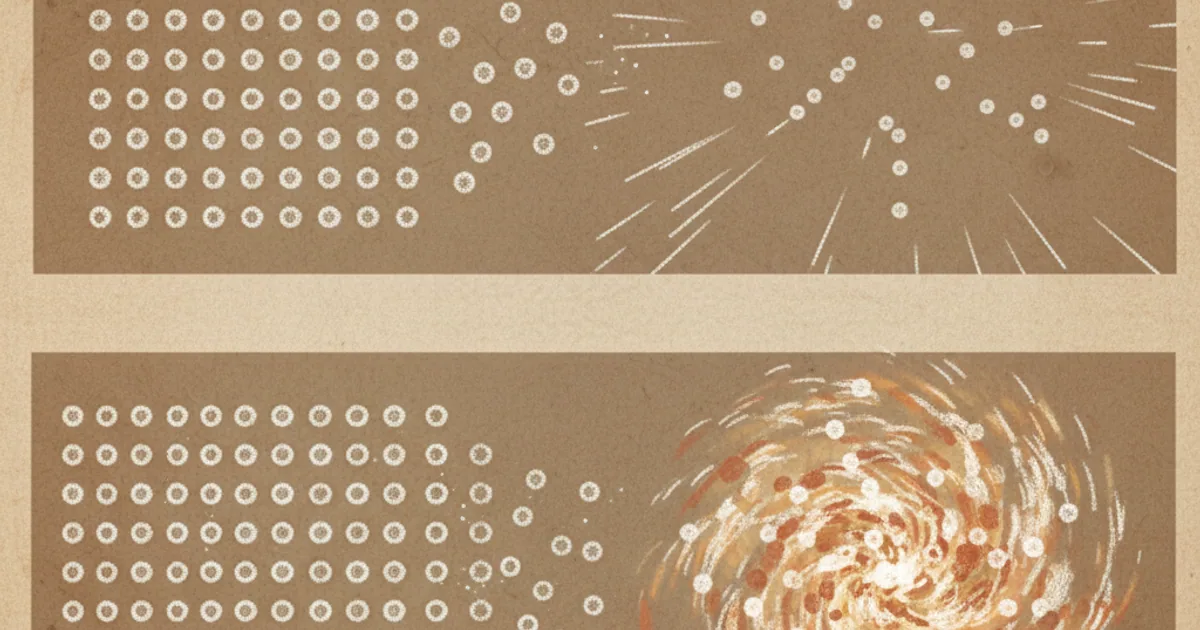
Pick any chunk of stuff — water, iron, air, a star — and ask whether it's solid, liquid, gas, or plasma. The answer always comes down to the same tug-of-war between two things:
That's the whole story. State of matter is the outcome of a fight between motion energy trying to scatter the particles and attraction trying to clump them. When attraction wins decisively, you get a solid. When it's a stalemate, a liquid. When motion wins, a gas. When motion is so violent it shatters the atoms themselves, plasma.
In a solid, the particles don't have enough energy to escape each other's pull. They lock into fixed positions — often a repeating, orderly grid called a crystal lattice — and stay there. They still jiggle in place, but they can't trade neighbors or wander off.
This is why a solid holds its shape and resists being squished: every particle is pinned by its bonds. Push on one corner of a steel beam and the whole lattice pushes back. The particles aren't motionless — they're vibrating constantly — but they're trapped, like people packed shoulder to shoulder in a crowd who can sway but can't walk.
Add heat — pump energy into the particles — and they vibrate harder. At some point they have just enough energy to break free of their fixed spots but not enough to escape each other entirely. Now the particles slide and tumble over one another while staying packed close together. That's a liquid.
This explains liquids' odd in-between behavior. A liquid takes the shape of its container (the particles can flow past each other) but keeps a fixed volume and doesn't easily compress (they're still touching, still pulled together). Water poured into a glass becomes glass-shaped, but a cup of water is always a cup of water — you can't squeeze it into a thimble.
Add more energy still, and the particles finally have enough to break completely free of each other's attraction. They fly off in straight lines, bouncing off the walls and occasionally each other, with vast empty space in between. That's a gas.
Because the particles are no longer holding hands, a gas has no fixed shape and no fixed volume — it expands to fill whatever it's in. And because there's so much empty space between particles, a gas is easy to compress: squeeze it and you just push the flyers closer together. This is also why gases are thousands of times less dense than the liquids they came from. The same water that filled a teaspoon becomes a cloud of steam big enough to fill a bucket.
Here's a subtlety worth pausing on. Why does ice melt at a sharp temperature instead of slowly going mushy?
Because breaking a structure is all-or-nothing. As you heat ice, the molecules vibrate harder, but the crystal lattice holds — right up until the vibration is strong enough to break the bonds wholesale. At that point the structure collapses, and something surprising happens: extra heat you add stops raising the temperature and instead goes entirely into breaking bonds. This hidden energy cost is called latent heat. It's why a glass of ice water sits at 0 degrees Celsius until the last ice cube is gone, and why steam burns are so much worse than hot-water burns — condensing steam dumps all that latent heat back into your skin.
Temperature isn't the only thing that flips the state. Pressure does too, by forcing particles closer together so their attractions can grab hold.
Squeeze a gas hard enough and you can shove its particles close enough to condense it into a liquid — no cooling required. This is how a butane lighter works: the fuel is a gas at room temperature and normal pressure, but the pressure inside the little tank is high enough to keep it liquid. Open the valve, the pressure drops, and it flashes back to gas to feed the flame.
Pressure and temperature together draw a map called a phase diagram for each substance: a chart showing which state you get at any combination of the two. It even has weird corners. At low enough pressure, the liquid stage can vanish entirely — push a solid past its line and it goes straight to gas, skipping liquid. That's sublimation, and it's why dry ice (frozen carbon dioxide) makes fog and never leaves a puddle.
Keep heating a gas — to thousands of degrees — and the collisions get so violent that they start ripping electrons clean off the atoms. Now you don't have neutral atoms anymore; you have a soup of free electrons and positively charged ions. That's plasma, the fourth state of matter.
The charged particles change everything. Because plasma is full of free-moving charges, it conducts electricity, bends to magnetic fields, and glows. A neon sign, a lightning bolt, a candle flame's hottest part, and the entire Sun are all plasma. In fact, if you tally up all the ordinary matter in the universe, most of it — every star — is plasma. The solids and liquids we live among are the cosmic exception, not the rule.
Solid, liquid, gas, plasma — these aren't four unrelated things. They're four answers to one question: in the contest between particle motion and particle attraction, who's winning? Cold locks particles into a solid; warming lets them slide as a liquid, then fly apart as a gas; extreme energy strips their electrons into plasma. Turn the temperature knob or the pressure knob and you shift the balance, and the substance obediently changes its state. Once you see it as that single tug-of-war, every melting, boiling, freezing, and lightning bolt is the same story told over again. Finding the one idea that unifies a dozen separate phenomena is the quiet thrill that keeps curious minds coming back.
A short editorial reading list. Pick whichever fits how you like to learn.


Comments 0
No comments yet. Be the first to share your thoughts.