
A diamond is basically one giant molecule
Most objects are made of countless small molecules stacked loosely together, held by weak forces. A diamond isn't like that. A diamond is essentially one single molecule — a single, seamless network of carbon atoms all bonded directly to each other, running unbroken from one face of the stone to the other.
That's the secret to its hardness. To scratch or dent a diamond, you can't just nudge molecules past each other, the way you'd scuff wax or dent lead. You'd have to break actual chemical bonds, and not just a few — bonds running in every direction through a continuous rigid cage. Nature has very few tools strong enough to do that.
Four bonds, every atom, every direction
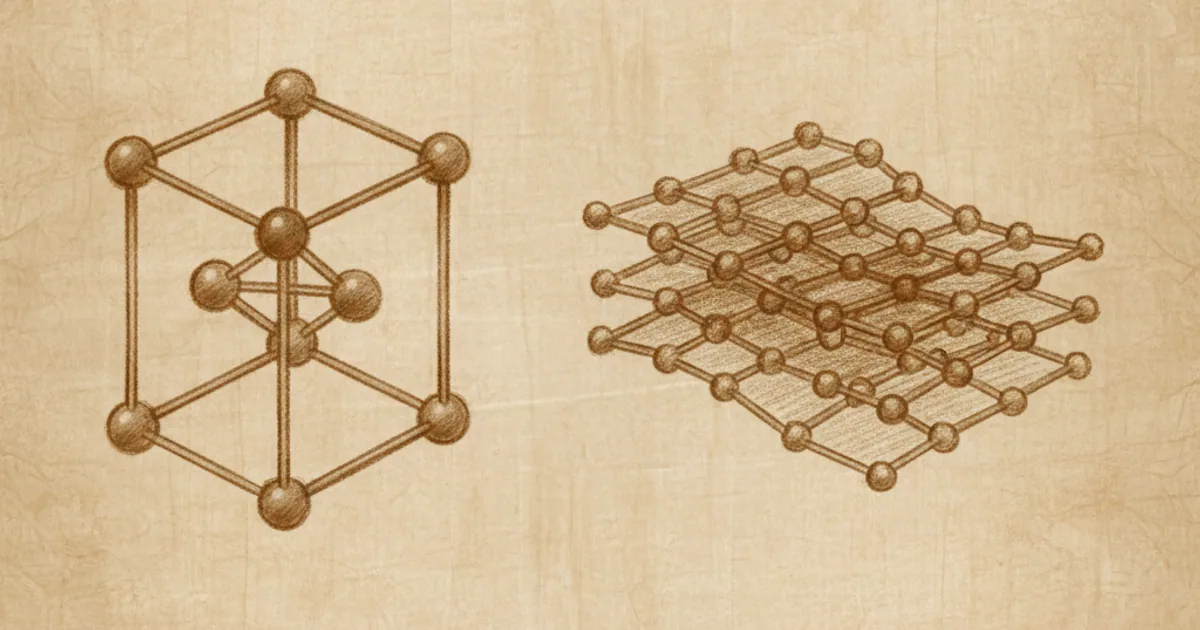
Carbon has four electrons available for bonding, and in diamond it uses all four. Each carbon atom forms a strong covalent bond — a shared pair of electrons — with four neighboring carbon atoms. Those four neighbors sit at the corners of a tetrahedron, spread out as far from each other as possible, pointing into three dimensions.
Now repeat that for every atom. Each of those four neighbors is itself bonded to four more, and so on, endlessly. The result is a rigid three-dimensional lattice with no soft spots, no loose layers, no place to slip. Every atom is pinned by four strong bonds aimed in different directions, so there's no way to shift one part of the crystal relative to another without snapping bonds across the whole structure at once.
Covalent bonds are among the strongest bonds in chemistry, and diamond is wall-to-wall covalent bonds arranged for maximum rigidity. That combination — strong bonds and a fully three-dimensional network — is what puts diamond at the very top of the hardness scale.
The twist: graphite is the same atoms
Here's the part that should stop you. The "lead" in your pencil is graphite, and graphite is made of the exact same carbon atoms as diamond. Pure carbon, nothing added. Yet graphite is so soft it rubs off onto paper when you write.
How can identical atoms be the hardest material and one of the slipperiest? Because hardness comes from the bonding architecture, not just the element.
In graphite, each carbon bonds to only three neighbors instead of four. Three bonds in a plane build a flat sheet of carbon atoms — a chicken-wire pattern of hexagons. Within each sheet the bonds are strong, just like diamond's. But the sheets themselves only stack on top of one another, held together by weak forces between layers, not real covalent bonds.
So while a single graphite sheet is tough, the stack is like a deck of cards or a ream of paper: the layers slide over each other with almost no resistance. Drag a pencil across paper and you're shearing off layer after layer of carbon sheets, which is why it leaves a gray streak. Graphite even works as a dry lubricant for exactly this reason.
Same atoms, different wiring: four-way bonds in 3D give you the hardest thing in nature; three-way bonds in slippery sheets give you pencil lead. Different structures of the same element are called allotropes, and carbon's allotropes are the textbook example. (For the basics of how atoms bond at all, see atoms and molecules explained.)
Hard is not the same as tough
There's one more misunderstanding worth clearing up, because it surprises almost everyone: a diamond can shatter from a hammer blow, even though it's the hardest material known. How?
Because hardness and toughness are different properties:
- Hardness is resistance to being scratched or dented. It's about whether something else can deform your surface. Diamond is the champion here.
- Toughness is resistance to cracking or shattering — whether the material can absorb a sudden shock without breaking apart. Diamond is actually rather poor at this. It's brittle.
The very rigidity that makes diamond so hard also makes it brittle. A tough material — like a metal — can flex and bend a little to absorb a sharp impact, spreading the energy out. Diamond can't flex; its bond network is too stiff. And along certain flat planes in the crystal, the atoms line up so that a crack, once started, can race straight through. A sharp, well-placed blow can therefore cleave a diamond cleanly in two.
Jewelers actually use this on purpose: a skilled diamond cutter can split a rough stone with a single tap along the right plane. Hard, yes — unbreakable, no.
Why it matters beyond jewelry
This is also why diamond is an industrial workhorse, not just a gemstone. Because it can scratch everything and nothing can easily scratch it, diamond goes onto cutting blades, drill bits, and grinding wheels for machining hard materials. And because diamonds cut diamonds, the only practical way to polish one into a sparkling gem is with diamond dust. The same property that makes the ring expensive makes the saw blade effective.
The takeaway
A diamond is hard because it's one continuous molecule in which every carbon atom is locked to four others by strong covalent bonds arranged in a rigid three-dimensional cage — to mar it, you'd have to break bonds in every direction at once. Graphite, built from the very same carbon atoms but with each bonded to only three neighbors in weakly-stacked sheets, slides apart and is soft. And because hardness isn't toughness, the hardest material in nature is brittle enough to be split with a tap. The lesson hiding in a diamond: what a material does depends less on what it's made of than on how its atoms are joined together — one of those quietly useful things to know that reframes how you look at ordinary objects.

Comments 0
No comments yet. Be the first to share your thoughts.