
The puzzle worth taking seriously
Drop a solid steel bolt into a bucket and it goes straight to the bottom. Steel is heavy; everyone knows steel sinks. And yet a cargo ship is made of tens of thousands of tons of steel, and it sits calmly on top of the ocean. Same metal. Opposite result.
If you can explain that clearly, you understand buoyancy completely. So let's.
Floating is about what you push out of the way
Here is the one idea, due to Archimedes over two thousand years ago: when you put something in water, it has to shove some water aside to make room for itself. The water doesn't vanish — it gets displaced. And the displaced water pushes back. Specifically:
An object is pushed upward by a force equal to the weight of the water it displaces.
That's Archimedes' principle, and it's the whole game. The upward push is called buoyancy.
So now there's a simple contest for any object you lower into water:
- The object has its own weight, pulling it down.
- The water it displaces has a weight too, and that's the upward buoyant force.
If the water it shoves aside weighs more than the object, the upward push wins and the object floats up until it's only partly submerged. If the object weighs more than the water it displaces, down it goes.
Why the steel bar loses
Take the solid steel bolt. It's small and dense. When it's underwater it displaces a volume of water exactly equal to its own volume — a bolt-sized gulp of water. But steel is about eight times denser than water, so a bolt-sized piece of steel weighs about eight times more than a bolt-sized piece of water.
The contest isn't close. The bolt weighs far more than the water it pushes aside. Buoyancy can't lift it. It sinks.
Notice what mattered: not that it was "made of steel" in some magical heavy way, but that the steel was packed into a small volume. Density — weight divided by volume — is the thing.
Why the ship wins
Now do the trick that makes ships possible: take that same steel and don't leave it solid. Roll it thin and bend it into a big hollow bowl — a hull. The hull encloses an enormous volume of air.
Ask the only question that matters: what is the average density of the whole hull — all that steel plus all that enclosed empty space — measured against its total outside volume?
- The steel is heavy, yes.
- But it's now smeared around a vast volume of nearly weightless air.
- Weigh the whole ship, divide by the whole outside volume it occupies, and the answer comes out less than the density of water.
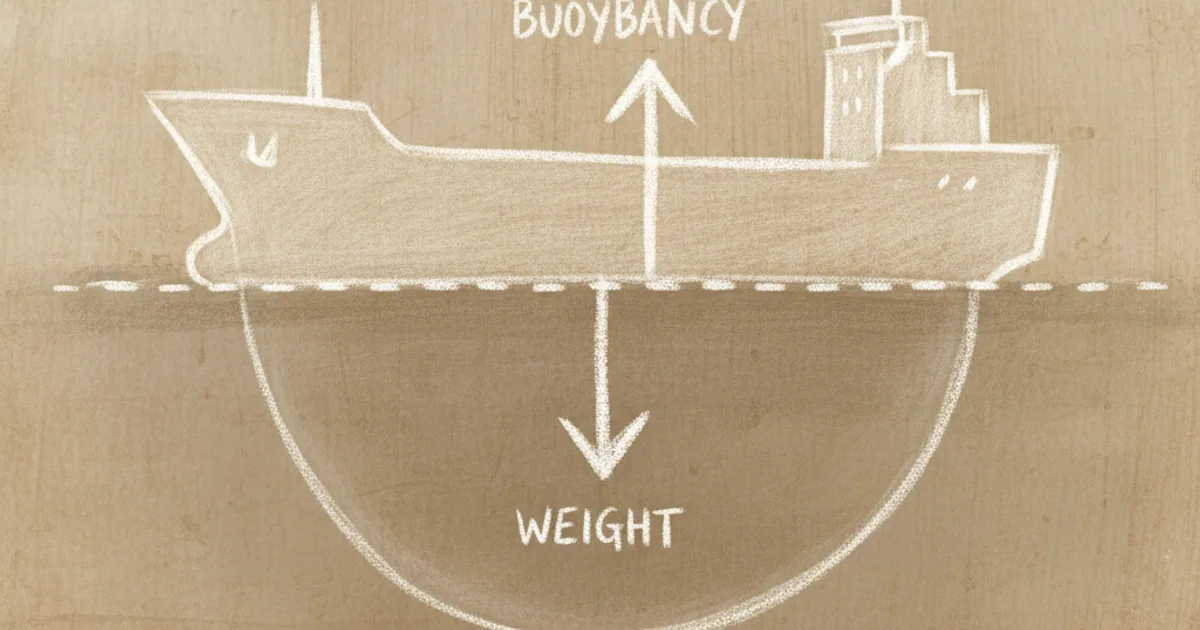
That's the magic, and there's nothing magic about it. The ship as a whole is lighter, per unit of volume, than water. So as the hull settles into the sea it displaces a huge slug of water — and that displaced water weighs a great deal. Long before the hull is fully underwater, the weight of the water it has shoved aside grows to match the ship's full weight. At that point the upward buoyant force equals the downward weight, the forces balance, and the ship floats.
Same steel as the bolt. Completely different average density. Opposite outcome. It was never about the material; it was always about the average density.
The waterline tells the whole story
Watch where the water meets the hull — the waterline — and you're reading the force balance directly.
The ship floats at exactly the depth where the weight of displaced water equals the total weight of ship plus cargo. Push the hull a little deeper than that and it displaces extra water, the buoyant force exceeds the weight, and it gets pushed back up. Let it ride a little higher and it displaces too little, weight wins, and it settles back down. The waterline is a self-correcting equilibrium.
This also explains loading:
- Load cargo and the ship gets heavier. To restore balance it must sink lower, displacing more water until the displaced weight again matches the new total. The waterline climbs up the hull.
- Unload and the ship rises, displacing less.
Because flooding the hull with too much weight can sink the waterline past a safe point, ships carry painted load lines (the "Plimsoll line") marking the deepest they're allowed to ride.
A wrinkle: the water matters too
Buoyancy compares the object to the water it's in — and not all water has the same density. Saltwater is denser than freshwater, so the same hull pushes aside a heavier slug of seawater for the same depth. A ship therefore floats a little higher in the ocean than in a freshwater lake or river.
This is a genuine hazard, not a curiosity: a ship loaded right up to its safe line in salty seawater will settle noticeably lower when it sails into a freshwater river, because freshwater offers less buoyancy. That's exactly why load lines come in separate marks for saltwater and freshwater.
The same logic, by the way, is why ice floats on water and why a helium balloon rises in air — buoyancy doesn't care whether the surrounding fluid is water or air, only whether you weigh more or less than the fluid you displace.
The takeaway
A steel ship floats for the same reason anything floats: it displaces a weight of water greater than its own weight. A solid steel bar can't — it's eight times denser than water, so it sinks. Shape that steel into a hollow hull around a huge volume of air and the average density of the whole object drops below water's, so it displaces a heavy slug of water and floats. The waterline marks the exact depth where displaced-water-weight equals the ship's weight — and it climbs or falls as you load or unload. Floating was never about the material. It was always about average density versus the fluid around you. If you enjoy that click of a confusing thing turning simple, it's worth learning a few of these properly rather than half-remembering them.

Comments 0
No comments yet. Be the first to share your thoughts.