Subject
How things move through air and water. Why a heavy plane stays up, why a steel ship floats, how a rocket pushes on nothing, and why a helium balloon rises — buoyancy, lift, and thrust explained without the equations.
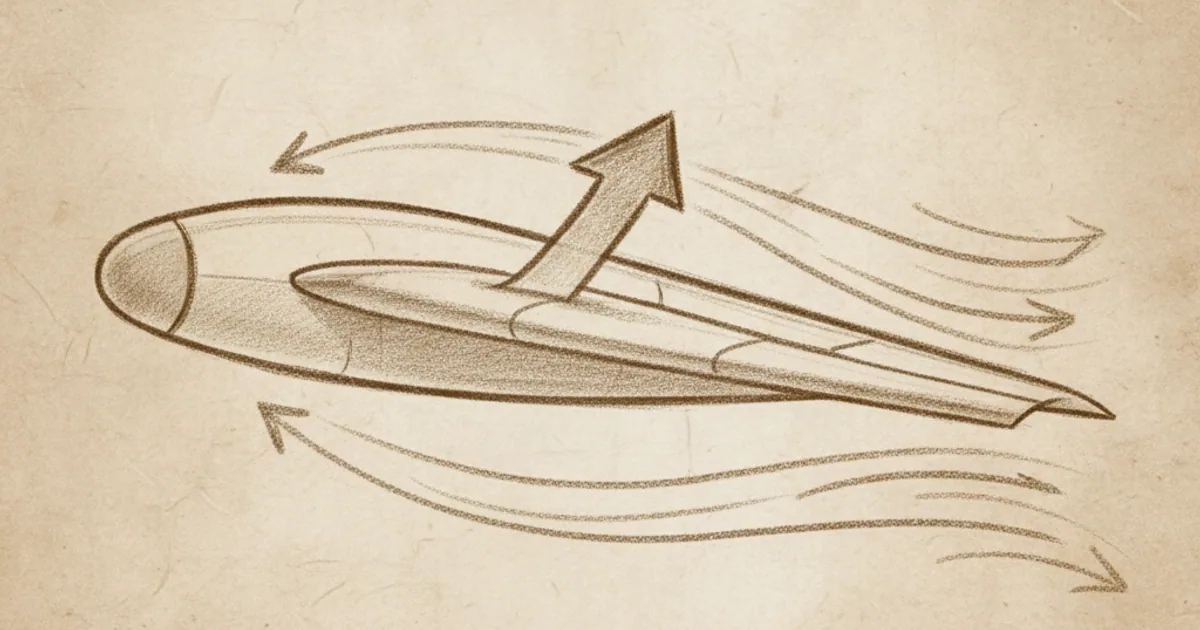
A plane flies because its wings throw air downward, and the air throws the wing back upward. That's it. That upward push is lift, and it is nothing more mysterious than Newton's third law: push on something, and it pushes back on you just as hard, in the opposite direction. Push a few tons of air down every second, and a few tons of force lift you up.
Everything else — the curved wing shape, Bernoulli's principle, angle of attack — is detail about how the wing manages to fling air down so effectively. But if you remember only one thing, remember the air going down.
Most of us were taught a different story, and it's worth killing it cleanly because it's false, not just incomplete.
The story goes: a wing is curved on top and flatter on the bottom. Air splitting at the front edge has to travel a longer path over the curved top than under the flat bottom. And — here's the bad part — the two streams "must meet up again" at the back edge at the same moment. So the top air has to go faster to cover more distance in the same time. Faster air means lower pressure (Bernoulli), and the higher pressure underneath pushes the wing up.
This is the equal transit time explanation, and almost every clause of it is suspect:
So let's throw it out and build the real picture.
Stand behind a wing as it moves through the air and watch what happens to the air it passes. The wing leaves a downward-moving wake — a whole river of air pushed down and slightly back. This is called downwash, and it is real, measurable, and the whole point.
By Newton's third law, every bit of air the wing shoves downward shoves the wing upward by an equal force. Add up all the air, all the downward momentum the wing hands to it every second, and you have exactly the lift. No assumptions, no rejoining streams — just bookkeeping on momentum.
How does the wing push air down? Two ways, working together:
Both halves throw air down. Both halves lift the wing.
Now, Bernoulli's principle is also real, and the people who quote it aren't wrong about the physics — they're just usually wrong about why the air speeds up. Bernoulli says: in a smooth flow, where the air moves faster, its pressure is lower.
Over the top of a flying wing the air genuinely moves faster, so the pressure up there genuinely drops. Underneath, the air is slowed and the pressure is a touch higher. Lower pressure above, higher below — the wing gets sucked up from the top and pushed up from the bottom. That pressure difference, integrated over the whole wing, is lift.
Here's the key insight that resolves the endless "Newton vs. Bernoulli" arguments: they are the same event seen from two sides.
A wing that bends air downward (Newton) must have lower pressure on top and higher pressure below (Bernoulli) — that's what does the bending. Tally up all the pressures, and you get the same total force as tallying up all the downward-flung air. They have to agree, because there's only one wing and one real force. Anyone who tells you it's "really" one and not the other has missed that they're describing one thing in two languages.
The mistake in the schoolbook version was never invoking Bernoulli — it was the fake reason for the speed-up (the rejoining-streams rule). The air speeds up because of how the wing turns and accelerates the flow, not because it has a longer commute to finish on schedule.
Here's the proof that wing curvature isn't the secret: take a perfectly flat wing — a sheet of plywood, a paper airplane — and tilt its front edge up into the wind. It flies. Tilt it more, it lifts harder.
That tilt is the angle of attack: the angle between the wing and the oncoming air. Increase it and the wing deflects more air downward, so lift goes up. This is the knob pilots actually use. To generate more lift for takeoff or a climb, you raise the nose, increasing the angle of attack.
But there's a limit. Tilt too far and the air can no longer hug the top surface — it tears away into a churning, turbulent mess. The smooth downwash collapses, lift drops off a cliff, and the wing stalls. A stall isn't the engine quitting; it's the wing exceeding its angle of attack and losing its grip on the air. Recovering means lowering the nose to let the flow reattach.
Zoom out from the wing to the whole airplane, and at any moment four forces act on it:
In steady, level, constant-speed flight these balance in two pairs: lift equals weight, and thrust equals drag. Want to climb? You need lift (or a tilt of thrust) to exceed weight. Want to accelerate? Thrust must beat drag. Every takeoff, turn, climb, and descent is just the pilot rebalancing these four arrows.
Planes fly by pushing air down; the air pushes back up; that's lift, courtesy of Newton's third law. Wing shape and angle of attack are clever ways to deflect more air more smoothly. Bernoulli's pressure picture is the same event described in the language of pressure rather than momentum — both correct, both giving the same force. The "equal transit time" story you were taught is not a simplification; it's simply wrong — and it's far from the only schoolbook "fact" worth relearning from scratch. And the whole flight is governed by four forces — lift, weight, thrust, drag — balanced or rebalanced moment to moment.
A short editorial reading list. Pick whichever fits how you like to learn.


Comments 0
No comments yet. Be the first to share your thoughts.