
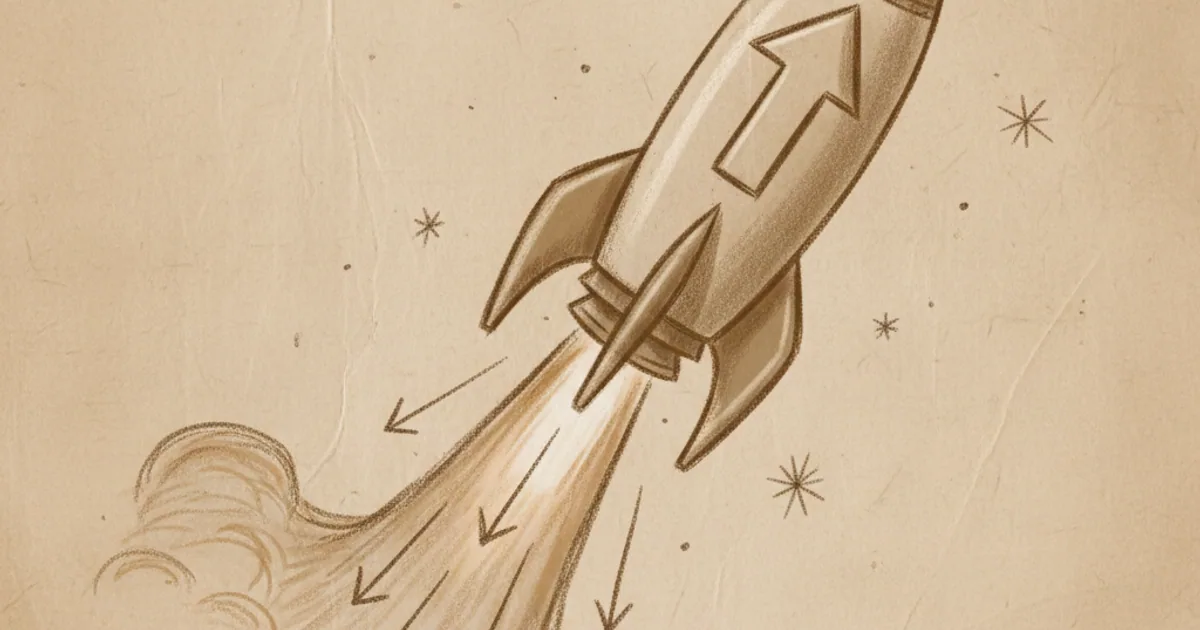
The thing people get backward
There's a stubborn belief that a rocket flies by pushing against the air — that the exhaust blasts down onto the ground or shoves against the atmosphere and that's what lifts it. It sounds reasonable. It's also wrong, and the proof is sitting in orbit right now: rockets work perfectly well in the vacuum of space, where there's no air to push against and no ground for thousands of miles.
So what is a rocket pushing against? The answer is beautiful and simple: a rocket pushes against its own exhaust. It throws mass backward and gets shoved forward in return. That's the whole machine.
Throw something, get pushed back
Sit on a skateboard holding a heavy backpack. Throw the backpack forward as hard as you can. You roll backward. You didn't push against anything outside you — no wall, no floor shove. You pushed against the backpack, and the backpack pushed back on you. Throw mass one way, you go the other way.
That's a rocket. The rocket carries propellant (fuel plus oxidizer), burns it, and hurls the resulting hot gas out the back at tremendous speed. Throwing that gas backward takes a force — and by Newton's third law, the gas pushes back on the rocket with an equal force, forward. The continuous stream of ejected exhaust gives a continuous forward push, called thrust.
The rocket pushes on the propellant; the propellant pushes on the rocket. The air, the ground, the launch tower — none of it is part of the deal.
Same truth, told as momentum
Physicists usually tell this story in terms of momentum, which is just mass times velocity, and the rule that the total momentum of an isolated system never changes — conservation of momentum.
Before ignition, the rocket sits still. Total momentum: zero. Now light the engine. A stream of exhaust shoots backward — that's a chunk of mass moving fast in the backward direction, carrying backward momentum. But the total has to stay zero. The only way to balance the backward momentum of the exhaust is for the rocket to carry an equal amount of forward momentum. So the rocket accelerates forward.
This is exactly the same fact as Newton's third law, dressed in different clothes. Newton's law talks about the forces (push and equal push-back); momentum conservation talks about the bookkeeping (the totals must balance). Pick whichever picture you like — they always agree, because they describe one physical event.
Why a vacuum is no problem — and even helps
Now the surprise that trips people up: a rocket doesn't just tolerate the vacuum of space, it actually performs better there.
Why? Because the thrust comes entirely from ejecting the rocket's own mass. The surrounding air was never doing any pushing for you. Take the air away and two good things happen:
- No air resistance. In the atmosphere, the rocket has to plow through air, and drag fights its motion. In vacuum, there's nothing to plow through.
- No back-pressure on the exhaust. Down in the atmosphere, the outside air presses inward against the engine's exhaust as it leaves the nozzle, slightly working against it. In vacuum there's no outside pressure pushing back, so the exhaust leaves more freely and the engine produces a bit more thrust.
That's why rocket engines made for the upper atmosphere and space — upper-stage engines — are shaped differently from sea-level engines, and squeeze out more thrust once they're up high. Far from needing air, a rocket is happiest with none.
A jet engine is the opposite, and the contrast makes the point: a jet scoops in outside air, heats it, and throws it back, so a jet genuinely does need air and dies in a vacuum. A rocket brings everything it throws — propellant and the oxygen to burn it — so it owes the outside world nothing.
Why rockets are mostly fuel tank
Here's the catch that makes spaceflight hard, and it follows straight from "the rocket throws its own mass."
To go faster, you have to throw more mass backward, which means carrying more propellant. But propellant has weight, and that extra propellant itself has to be accelerated — which means you need still more propellant just to move the propellant you added. Each bit of speed you want costs disproportionately more fuel than the last. The fuel requirement doesn't grow in step with your target speed; it climbs steeply.
This compounding relationship is captured by the Tsiolkovsky rocket equation, and you don't need the math to grasp the consequence: reaching orbit takes so much propellant that an orbital rocket is, by weight, mostly fuel tank. The shiny payload at the top is a tiny fraction of what sits on the launch pad. Two levers help — throwing the exhaust faster (better engines) and dropping empty fuel tanks along the way (staging) — which is exactly why big rockets shed stages as they climb.
The takeaway
A rocket works by throwing mass backward and getting pushed forward in return — Newton's third law, or equivalently conservation of momentum. It pushes against its own ejected exhaust, never against the air or the ground, which is why it works in space and even gains a little thrust there with no air to resist it. The price of this self-contained trick is that the rocket must haul and burn its own propellant, so going faster costs fuel that compounds on itself — the reason rockets are mostly tank and shed stages on the way up. "A rocket pushes on nothing but its own exhaust" is exactly the kind of counterintuitive fact that's more fun once you can explain why it's true.

Comments 0
No comments yet. Be the first to share your thoughts.