
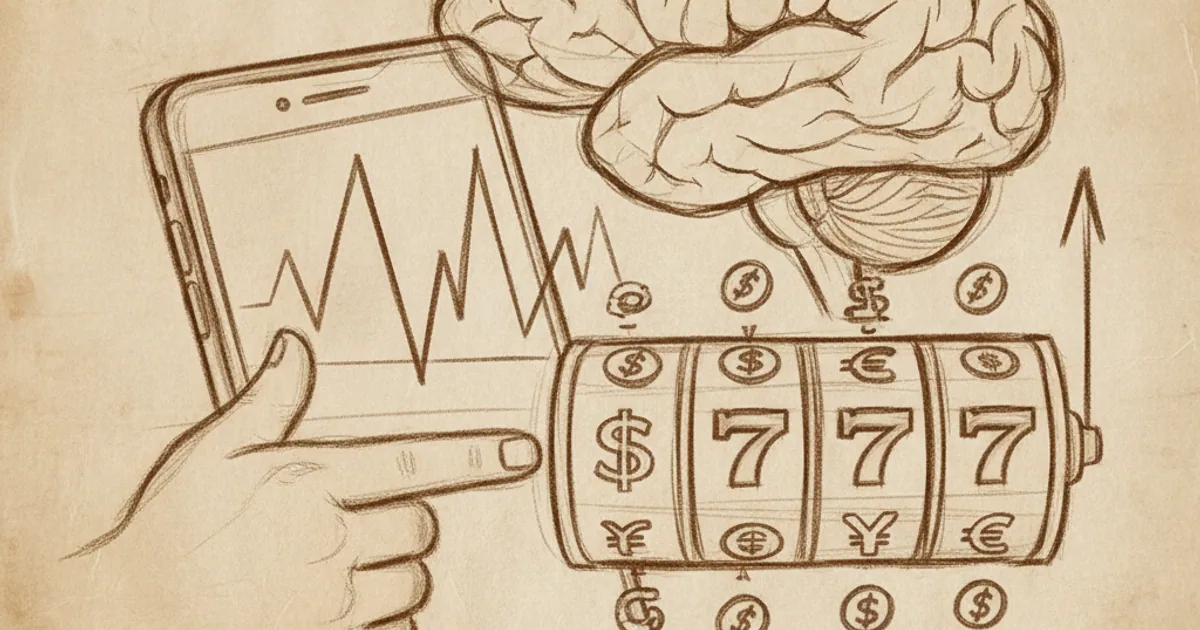
Not a moral failing — an engineering choice
A common framing of heavy social media use: "I just need more willpower." "I should just put my phone down." "It's a discipline problem."
This framing puts the burden on the user and misses something important: social media platforms are engineered to be compulsive. Their design exploits well-understood psychological mechanisms that work even on people with strong self-control. Reading about how the design works isn't enough to undo the effect, but it changes the framing from "I'm weak" to "I'm being deliberately targeted by a sophisticated system."
This article explains the design choices. The other articles in this cluster cover why doomscrolling leaves you worse off, why slow learning satisfies differently, and how to rebuild attention.
The single most important mechanism: variable-ratio reinforcement
If you remember one thing about why social media is compulsive, remember this: variable-ratio reinforcement is the most powerful behavioral conditioning pattern known.
The history: B. F. Skinner spent decades in the 1930s-50s studying how different reward patterns affect behavior in pigeons and rats. He compared:
- Continuous reinforcement: every action gets a reward. Result: animals learn fast but stop quickly when rewards stop.
- Fixed-ratio reinforcement: every N actions gets a reward. Result: animals work in bursts and pause after rewards.
- Variable-ratio reinforcement: rewards come after a variable number of actions, averaging some target. Result: animals work persistently, with very high response rates, highly resistant to extinction.
The classic result: pigeons on variable-ratio schedules would peck a button thousands of times, even when rewards became extremely rare. The behavior was nearly impossible to extinguish.
The neuroscience now explains why. Variable rewards maximize reward prediction errors (see how the dopamine system actually works). Each unpredicted reward is "better than expected" — producing a dopamine spike. The behavior is strongly reinforced. The unpredictability is the point.
This is exactly how social media feeds work.
You open the app. You scroll. Most posts are mediocre — uninteresting, advertisements, things you'd ignore. But every so often, something genuinely interesting appears. A funny meme, a friend's update, a beautiful photo, a useful article, a notification about someone interacting with your content. You don't know when. So you keep scrolling.
The math is unforgiving: a few unpredictable rewards mixed into many uninteresting items produces stronger and more persistent compulsion than predictable rewards would. Social media platforms optimize this ratio — too few interesting posts and you'd give up; too many and you'd be satiated. The ratio is tuned to keep you scrolling.
This is the same mechanism that makes slot machines compulsive. The interfaces are slightly different; the underlying psychology is identical.
Other design choices that amplify the effect
Variable rewards are the engine. Several other design choices amplify it:
Infinite scroll
In old web designs, content came in pages. You'd see 10 items, then click "next page" to see more. The "next page" click was a natural stopping point — a moment of deliberation where you could decide whether to continue.
Around 2006, Aza Raskin (working at Humanized) is widely credited with creating infinite scroll. As you scroll, more content automatically loads. There's no end, no stopping point, no moment of decision.
Infinite scroll became standard in social media (Facebook, Twitter/X, Instagram, TikTok). Raskin has since publicly regretted the invention; he estimates infinite scroll has cost humanity many years of collective attention.
The mechanism: by eliminating natural stopping points, infinite scroll makes you scroll past the point you would have stopped if asked. Combined with variable rewards, this produces extended scrolling sessions far longer than people intend.
Pull-to-refresh
The gesture of pulling down a feed to refresh it was invented by Loren Brichter for a Twitter client. The slot machine comparison is an analogy — the kinesthetic similarity is real, but documented origin is the metaphor of pulling down content into view, not a deliberate copy of slot mechanics. Either way, the result is a small physical action that triggers the next round of unpredictable rewards.
Red notification badges
Red numerical badges (the "5" in red next to an app icon) exploit several psychological mechanisms at once:
- Red is attention-grabbing (an evolved response to blood, fire, warning signs).
- Numbers create curiosity ("what are those 5 things?").
- Loss aversion ("if I don't check, I might miss something important").
- Variable rewards (some of those 5 things might be interesting; some not).
Settings to hide badges (or app-specific settings to delay or batch notifications) typically reduce check-rates by 50%+ when used.
Algorithmic ranking
Older feeds showed posts in chronological order. Modern feeds use machine learning to predict what you'll engage with, prioritizing those items.
The optimization target is usually "engagement" (time spent, clicks, likes, comments). High-engagement content tends to be: emotionally charged (anger, outrage, fear); novel; close to your existing interests; or socially provocative. Algorithmic feeds optimize for these properties, which means they often surface content that's compelling but not beneficial.
This is why algorithmic feeds often show: outrage-bait politics, sensational news, body-image-focused content, conspiracy material, addictive video formats. The platform isn't trying to make you angry or anxious; it's trying to maximize engagement, and engagement happens to correlate with anger and anxiety.
Push notifications
Pushed alerts to your phone screen ensure you check the app even when not actively using it. Each notification is a small variable-reward event. The variable-ratio mechanism applies to notifications themselves — most are mundane, but occasionally one is genuinely interesting or important.
Android 1.0 (2008) shipped with a notification system; iPhone added push notifications with iPhone OS 3.0 in 2009. Average daily notification counts vary widely by study, country, OS, and installed apps, but estimates often place them in the tens to over a hundred per day. Each one is a potential variable reward triggering app open.
Social validation loops
Likes, comments, reactions, shares, follower counts — all create variable-reward signals tied to the user's own content. You post something, then check whether it's getting engagement. The engagement (or lack of it) is unpredictable, producing variable rewards.
Researchers (especially Sherry Turkle, danah boyd, others) have documented how this affects identity formation, especially in adolescents. The internalization of "metrics as self-worth" is widespread.
Friction-free access
Smartphones make all these mechanisms accessible at any moment. No login needed, no waiting, no transition cost. Boredom for 3 seconds? Reach for the phone. Awkward moment in conversation? Pull out the phone. Standing in line? Phone.
Average phone check rates vary widely by study and population — frequently reported in the range of dozens to well over a hundred times per day, with heavy users substantially higher. Each check is a brief variable-reward exposure. Cumulatively, this represents many hours of dopamine-spike-driven attention each day.
Why this is different from older media
Television, radio, and print media all had attention-capturing mechanisms, but several things make social media qualitatively different:
1. Variable rewards on demand. TV had schedules; you watched when something good was on. Social media gives variable rewards any time you open the app.
2. Algorithmic personalization. TV showed everyone the same content. Social media optimizes for YOU specifically, based on your past behavior — far more precisely tuned to maximize your engagement.
3. Active participation. TV is passive. Social media demands action (post, comment, like, share), which engages additional brain systems and creates feedback loops involving your own content.
4. Continuous availability. TV stopped when you left the room. Phones are always within reach.
5. Optimized at scale by machine learning. Modern recommendation systems test thousands of variations and select what works. The systems are evolutionarily adapted to your attention in ways no human designer could intentionally match.
The combined effect is something genuinely new in human history — variable-reward optimization tools tuned to individual psychology, available continuously, scaled to billions of users.
What this does over time
Heavy social media use is associated with several documented effects, though causation and effect sizes are sometimes debated:
Attention fragmentation: harder to sustain focus on long-form content, deep work, in-person conversation.
Diminished returns from slower rewards: activities that previously felt enjoyable (reading, walks, conversation) feel boring compared to the rapid spikes from scrolling.
Sleep disruption: blue light and engagement effects delay sleep, reduce sleep quality.
Mood effects: especially in adolescents, heavy use correlates with depression, anxiety, body image issues. (Causation is debated but the correlations are robust.)
Time displacement: hours spent scrolling come from somewhere — reduced sleep, exercise, social interaction, learning, reflection.
Comparison effects: chronic exposure to curated others' lives (often highlighting only successes and aesthetic moments) produces unfavorable self-comparison.
Echo chamber and polarization: algorithmic curation tends to expose people to more extreme versions of their existing views, contributing to political polarization.
Not all of these are deterministic; many heavy users don't experience the negative effects acutely. The US Surgeon General issued a formal 2023 advisory on social media and youth mental health; the EU has focused on regulation and child-safety enforcement (DSA, age-verification rules); the UK's Online Safety Act and related guidance address similar concerns through legislation rather than advisory alone.
What's harder than it looks
A few things that sound easy but aren't:
"Just use less." Willpower fights well-optimized variable-reward systems, and willpower loses. Heavy users who try to "just cut back" usually fail without environmental changes.
"Block the apps for an hour." Apps with strong variable-reward structure produce craving when blocked. Many users find ways around blocks.
"Use them mindfully." Some users can — but the platforms are designed to override mindfulness. Each session intends to be brief; ends up long.
"Set time limits in app settings." Helpful but easily bypassed. The platforms have business reasons to keep limits weak.
"Switch to less-addictive social media." Most major platforms use similar mechanisms; switching often just changes which platform you spend time on.
What actually helps (covered in how to rebuild your attention):
- Environmental changes: phone in another room, social media uninstalled from phone, browser blocks at the network level.
- Replacing the variable-reward pattern with sustainable alternatives (books, walks, learning, in-person interaction). For the app slot specifically, the best apps to replace social media compares what to install in place of a feed.
- Time-budgeting at the calendar level, not the in-app level.
- Reducing notification interruptions as a baseline practice.
- Periods of deliberate disconnection (digital sabbath, vacation without devices).
A note on NerdSip's design
A specific contrast worth pointing out: micro-learning apps like NerdSip use SHORT-form content but the design is fundamentally different from social media.
- Fixed structure (one short lesson per topic, not infinite scroll).
- Intentional engagement (you choose the topic, no algorithm pushing you).
- No social comparison metrics.
- Clear "complete" signals (you finish a lesson; you stop).
- Knowledge that compounds (each lesson builds on prior ones; learning is a slow-reward activity that produces sustained satisfaction — see the next article in this cluster).
A 5-minute focused learning session is fundamentally different from a 5-minute scroll session — even though they feel superficially similar. The 5 minutes of learning leaves you with knowledge and an increased sense of agency. The 5 minutes of scrolling leaves you with fragmentary impressions and (often) a faint sense of unease.
If you'd like a guided 5-minute lesson — short-form learning that's the opposite of doomscrolling — NerdSip is built for exactly this.
The takeaway
Social media platforms aren't accidentally compulsive — they're engineered around behavioral psychology principles that have been understood since Skinner's experiments. The central mechanism is variable-ratio reinforcement: unpredictable rewards interspersed with low-value content, producing strong and persistent compulsion. Design choices reinforce the pattern: infinite scroll removes stopping cues, pull-to-refresh mimics slot machine action, red notification badges trigger checking, algorithmic ranking optimizes for engagement (which correlates with outrage and anxiety), and friction-free access keeps the apps perpetually available. The mechanism exploits how the dopamine system actually works — not pleasure, but anticipation and prediction error. Understanding the design helps reframe heavy social media use: not a willpower failure, but exposure to a deliberately compulsive system. Practical responses (next article) work better than guilt or self-blame.

Comments 0
No comments yet. Be the first to share your thoughts.