Subject
Why social media hijacks your brain, why doomscrolling leaves you worse off, and why slower kinds of satisfaction — learning, mastery, flow — feel different from spike-and-crash. The neuroscience under the modern attention problem.
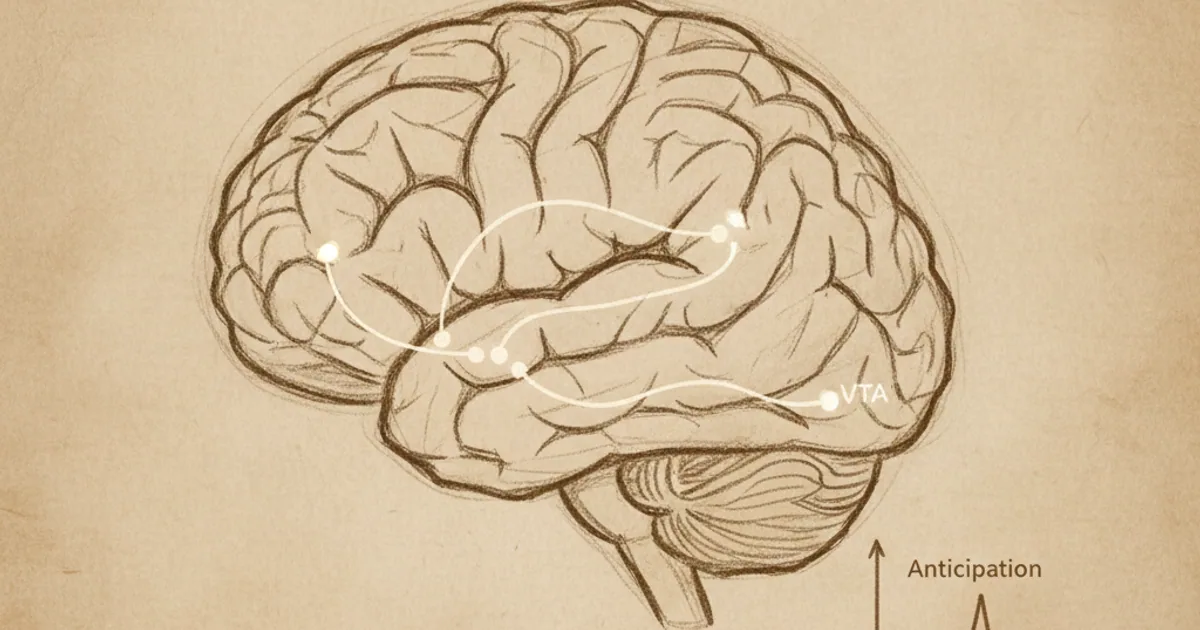
The popular story of dopamine goes like this: it's "the pleasure chemical." Doing something enjoyable releases dopamine, which feels good, which makes you want to do it again. Drugs, food, social media, sex — all release dopamine, which is why they feel good. Higher dopamine = more pleasure.
This story is wrong in important ways.
Decades of neuroscience research, especially work by Wolfram Schultz, Kent Berridge, and others starting in the 1980s-90s, has produced a more accurate picture:
Dopamine is not a pleasure chemical. It's a learning and motivation signal — specifically, a signal of expected reward, even more specifically a signal of "reward prediction error."
This distinction matters a lot for understanding cravings, motivation, addiction, social media compulsion, and why sustained satisfaction is so different from a quick high.
This article unpacks what dopamine actually does. The cluster covers what this means in practice: why social media hijacks the system, why doomscrolling leaves you worse off, why learning builds satisfaction differently, and how to rebuild attention.
There's also an earlier article on the specific dopamine-isn't-pleasure point in the brain-basics cluster: dopamine isn't pleasure. This article is the broader systems view.
Dopamine is a neurotransmitter — a chemical signal that neurons use to communicate. In the brain, several specific populations of neurons make and release dopamine in specific pathways.
The most relevant pathway for understanding motivation: the mesolimbic dopamine pathway, which originates in the ventral tegmental area (VTA) of the midbrain and projects to the nucleus accumbens, prefrontal cortex, and other regions.
What this pathway does:
Predicts rewards. When you encounter a cue that predicts something good is coming (the smell of food, a notification on your phone, your hand reaching for a glass of water when thirsty), dopamine neurons fire briefly. This is a "phasic" dopamine spike — quick and short.
Compares prediction to outcome. When the actual reward arrives:
Teaches the brain what to repeat. The brain associates the cue (and the action you took) with the prediction error. Cues that reliably predict better-than-expected outcomes get learned as "things to pursue." Actions that lead to better-than-expected outcomes get reinforced. Over time, you find yourself doing the things that worked.
Drives motivation, not pleasure. The dopamine signal tells you what to WANT, not what to LIKE. You can want things you don't enjoy; you can enjoy things you don't pursue. The neural systems for wanting (dopamine) and liking (opioid and endocannabinoid systems) are different.
This is the reward prediction error model, formalized in the 1990s and confirmed in many experiments. It's the consensus model in neuroscience today.
There are two timescales of dopamine activity:
Phasic ("burst") dopamine: brief, high spikes (lasting milliseconds to a second) triggered by specific cues and outcomes. This is the signal that drives moment-to-moment motivation, cravings, and learning. It's also what addictive substances and behaviors trigger.
Tonic (baseline) dopamine: the slowly-changing background level. Reflects overall motivation, mood, energy. Disrupted in conditions like Parkinson's disease (low tonic dopamine) and certain forms of psychosis (high tonic dopamine in some regions).
When people talk about "dopamine hits" from social media or junk food, they usually mean phasic spikes. These don't necessarily change the tonic baseline much in the short term. But over weeks and months, chronic phasic stimulation can affect tonic levels and receptor sensitivity in complex ways.
A few clarifications worth making explicitly:
It's not "the pleasure chemical." Pleasure (the felt quality of enjoying something — the "liking" component) is mediated by different systems. Researchers can dissociate them experimentally: rats with dopamine systems blocked still show "liking" reactions to sweet tastes, but stop pursuing food (no motivation, but pleasure preserved when food is given).
It's not "released only by good things." Dopamine plays many roles besides reward — motor control (Parkinson's involves dopamine in the substantia nigra), attention, working memory, even some types of stress response. Reducing dopamine to "pleasure or reward only" misses most of what it does.
It's not "what you should chase." The dopamine system rewards prediction; it doesn't reliably predict long-term well-being. Maximizing dopamine spikes in the short term often produces compulsive behavior with low long-term satisfaction. Slower, more meaningful activities (deep learning, relationships, mastery) involve different reward processes that better correlate with sustained well-being.
It's not addiction in itself. Many things release dopamine. The factors that produce addiction-like patterns involve specific properties: unusually large or rapid dopamine release, unpredictability (variable-ratio reinforcement), bypass of normal regulatory mechanisms. Not all dopamine release leads to addiction; addictive behaviors share specific dopamine-system patterns.
The "dopamine = pleasure" framing has practical consequences when it leaks into popular psychology and self-help culture. Some patterns:
"Just chase what gives you dopamine." Bad advice. Dopamine signals tell you what to want, not what's good for you. The system can be hijacked by artificial rewards (social media, junk food, drugs, gambling) that produce strong dopamine signals without corresponding well-being.
"Dopamine detox" framed as eliminating dopamine. You can't, and severe dopamine depletion produces profound motor and motivational impairment (as in untreated Parkinson's disease), not a state anyone would want. What people calling it "detox" actually do is reduce exposure to strong artificial cues, allowing the system to recalibrate so that slower rewards feel meaningful again.
Wellness products promising "dopamine boosts." Most of these are pseudoscience. Direct dopamine modulation in the pharmacological sense is done with carefully-targeted medications (in conditions like Parkinson's, ADHD, depression) under medical supervision. Some supplements and digital tools may have indirect effects on dopamine-adjacent pathways, but the marketing usually outruns the evidence.
Treating motivation as a willpower failure. The framing of "I just need to want it more" misunderstands how motivation works. The dopamine system responds to learned cues and prediction errors, not pure will. Changing motivation usually requires changing the cue environment — not just trying harder.
The model has been confirmed in many experiments:
Classic experiment: a monkey learns that a light precedes a juice reward. At first, dopamine spikes when the juice arrives (the unexpected reward). After learning, dopamine spikes when the LIGHT appears (the predictor of reward), and there's no extra spike at juice delivery — the brain has learned the prediction.
If the juice fails to arrive after the light: dopamine DIPS below baseline at the time the juice was expected. The brain registers a negative prediction error.
This is the bedrock of "reinforcement learning" in machine learning too — the same mathematical framework that trains AI agents like AlphaGo or game-playing systems is closely modeled on the dopamine system's reward prediction error.
Decades of behavioral research, starting with B. F. Skinner's pigeon experiments in the 1930s-50s, established that variable-ratio reinforcement is the most powerful pattern for producing persistent behavior.
The reward prediction error model explains why: variable ratios maximize the magnitude and frequency of positive prediction errors. Each unpredictable reward is "better than expected" by some margin, producing a dopamine spike. The behavior gets strongly reinforced.
Slot machines work this way. So do social media feeds: every time you refresh, sometimes there's something interesting, sometimes not. The unpredictability is the point. Detail in why social media hijacks your brain.
A few practical takeaways from the actual neuroscience:
Don't chase dopamine spikes; reduce exposure to artificial spike-generators. The brain's reward system was built for environments where rewards came slowly, intermittently, with effort. Modern environments deliver dense, unpredictable spikes via social media, junk food, hyper-palatable products, and on-demand entertainment. Reducing exposure (especially for highly variable-ratio sources) helps the system recalibrate.
Tonic baseline matters more than phasic spikes for long-term well-being. Sustained activities — sleep, exercise, social connection, mastery, creative work — affect baseline mood and motivation more durably than spike-generating activities.
Anticipation is the strongest part of the system. Looking forward to something often produces more reward signal than the thing itself. Use this deliberately — plan things, allow anticipation, savor it.
"Liking" and "wanting" can come apart. Many people find themselves compulsively pursuing things they don't actually enjoy (scrolling social media, checking email, eating when not hungry). The wanting is the dopamine signal; the liking is whether the experience was actually good. Notice the gap.
Mastery and meaning produce different reward profiles than instant gratification. Learning a skill, building relationships, creating something — these involve different neural processes that correlate better with sustained satisfaction. They feel "slow" because they don't produce big phasic spikes; over time they produce a higher baseline.
If you'd like a guided 5-minute course on dopamine and modern attention, NerdSip can generate one — and NerdSip's whole format (one short focused lesson a day, no infinite scroll, no algorithmic feed) is built to give you the satisfaction of learning without exploiting the variable-ratio mechanisms that hook you on social media.
Dopamine is not a pleasure chemical. It's a learning and motivation signal — the brain's prediction of expected reward and its response to reward prediction error (better or worse than expected). It drives "wanting" more than "liking." This system was built for environments with slow, occasional rewards; modern environments (social media, hyper-palatable food, gambling, addictive substances) exploit it with intense, unpredictable spikes that produce compulsive behavior without sustained well-being. The path forward isn't chasing more dopamine or trying to eliminate it; it's reducing exposure to artificial spike-generators and investing in slower processes (learning, mastery, relationships) that build a higher tonic baseline of motivation and meaning. The rest of the cluster goes deep on the practical implications.
A short editorial reading list. Pick whichever fits how you like to learn.


Comments 0
No comments yet. Be the first to share your thoughts.