
The pattern
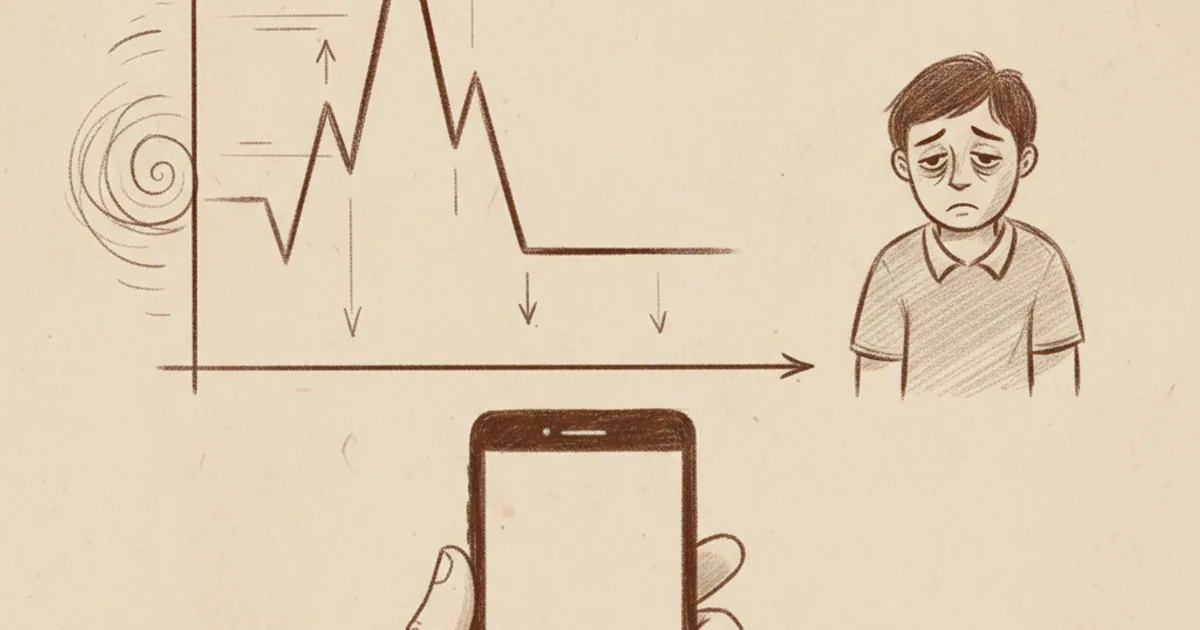
You sit down to "just check social media for 5 minutes." Forty-five minutes later, you put the phone down. You feel restless. Your eyes are tired. You can't quite remember most of what you saw. You feel a vague sense of unease, maybe guilt about the time spent, maybe a low-level anxiety from whatever upsetting content you absorbed.
The next day's recall: hazy. A few specific posts, maybe. Mostly a blur. The 45 minutes feel like they happened to someone else.
This is the doomscrolling aftermath, and it's a real phenomenon with identifiable causes. Several effects converge:
- Dopamine spike-crash cycle: after the variable-reward burst, baseline dips temporarily.
- Cortisol from emotionally activating content: outrage, fear, and comparison release stress hormones that linger.
- Attention residue: cognitive performance is impaired for some time after rapid context-switching.
- Sleep displacement: especially when scrolling happens late.
- Time-versus-outcome gap: significant time spent, minimal meaningful outcome.
Each effect is small alone. Together, they explain why scrolling sessions consistently produce more regret than satisfaction.
This article goes through each in turn.
1. The dopamine spike-crash cycle
When you engage with variable-reward content (most social media), your dopamine system fires in spikes during the scrolling. Each unpredictable hit of interesting content produces a brief surge.
When the session ends, dopamine returns toward baseline. But it doesn't return smoothly — there's typically a brief dip BELOW baseline. This is the body's way of regulating: after a period of elevated signaling, the system temporarily downregulates.
Physically:
- Receptor desensitization: post-synaptic dopamine receptors temporarily reduce their sensitivity after high signaling.
- Reuptake/clearance: dopamine gets cleared from the synapse, and synthesis takes time to recharge.
- Negative prediction error: the prediction error signal flips negative when the variable rewards stop.
The result: for some minutes to hours after a long scrolling session, your baseline experience is slightly worse than it would have been if you hadn't scrolled at all. The exact magnitude varies by person, content type, and session length, but the direction is consistent.
This is why activities that previously felt enjoyable (reading, conversation, going for a walk) sometimes feel flat right after social media use. Your baseline has temporarily dropped.
2. Cortisol and stress hormones
Much of what's served by algorithmic feeds is emotionally activating: outrage, fear, conflict, body comparison, political polarization, breaking news.
Emotionally activating content triggers the stress response:
- Cortisol (the primary stress hormone) rises in response to threatening or upsetting content.
- Adrenaline/noradrenaline spike with sudden surprising content.
- Heart rate elevates.
- Vigilance increases.
This is the body's threat-response system. It evolved to help us respond to immediate dangers — predators, conflicts, environmental threats. It works on the scale of minutes to hours.
The problem: doomscrolling exposes you to dozens or hundreds of such triggers in a single session. Your body's threat system gets activated repeatedly, with no actual threat to respond to. The cortisol levels stay elevated. The body remains in low-level alert state.
After a session, cortisol decays slowly (half-life of about 60-90 minutes). The lingering stress hormone produces:
- Irritability.
- Difficulty concentrating.
- Restless body sensations.
- Mild anxiety.
These persist for hours after the scrolling ended, contributing to the feeling that "something is off" even after you've put the phone down.
Chronic, regular doomscrolling can keep cortisol elevated as a baseline — implicated in long-term effects on mood, immune function, sleep, and cardiovascular health.
3. Attention residue
Research by Sophie Leroy at University of Washington Bothell, starting around 2009, has shown that task switching leaves traces in cognitive performance. After switching from task A to task B, your brain continues to process aspects of task A for some time, reducing your capacity for task B.
This is attention residue. It's measurable in experiments and consistent with subjective reports.
Doomscrolling involves continuous rapid task switching — each post is a new "task" requiring fresh interpretation. After 30 minutes of scrolling, your attention is fragmented across hundreds of brief tasks. Each one has left a small residue.
When you put the phone down and try to do something requiring sustained focus (work, reading, conversation), your brain is still partially processing the residue. Performance is degraded; focus is hard.
The residue dissipates over time (minutes to hours), but during that time:
- Working memory is partially occupied by residual processing.
- Attentional control is reduced.
- Cognitive flexibility is impaired.
- Sustained focus is harder than it would be from a fresh start.
This is why scrolling-as-break often doesn't restore productivity but instead reduces it for some time afterward. The "break" is itself a cognitively demanding activity.
4. Sleep displacement
Scrolling tends to happen at times that displace or interfere with sleep:
Before bed: many people scroll for 30-60 minutes in bed before sleep. This delays sleep onset by:
- Blue light suppressing melatonin: light in the blue spectrum (~480 nm) inhibits melatonin secretion, which signals sleep readiness.
- Emotional activation: upsetting content elevates cortisol just when you should be winding down.
- Cognitive engagement: variable rewards keep the brain in active engagement mode.
- Anxiety triggers: content about politics, work, conflicts, news creates ruminative thinking patterns.
The result: shorter sleep duration, lower sleep quality, more time to fall asleep, more night wakings.
Middle of the night: phone checks during night awakenings (a common pattern) extend wake periods, expose the brain to alerting content, and make returning to sleep harder.
First thing in the morning: immediate phone-checking on waking pre-loads the day with reactive, attention-grabbing content. This affects cortisol patterns (which should peak naturally on waking, then decline), and frames the day in a more anxious mode.
Sleep deprivation amplifies many of the other effects in this article — including emotional reactivity, attention impairment, mood instability, and stress reactivity. The doomscrolling-sleep cycle is self-reinforcing.
5. The time-outcome gap
Beyond the neurochemistry, there's a subjective evaluation component. After a 30-minute scrolling session, you've spent 30 minutes. What did you get from it?
For most people:
- A few specific posts they enjoyed.
- Mostly forgettable content.
- Some level of awareness of "what's happening" that wasn't there before — but rarely actionable or important.
- No skills built, no relationships deepened, no problems solved.
Compare to 30 minutes spent on most other activities: reading a book chapter, going for a walk, learning something, talking to a friend, working on a project. Each of these tends to produce a more durable outcome — knowledge, fitness, connection, progress.
The time-outcome gap is felt subjectively as a sense of "I should have done something else." The gap isn't a moral judgment; it's an accurate perception that the time produced limited value compared to plausible alternatives.
This is amplified by the fact that during scrolling, the variable-reward mechanism keeps you engaged. You're not consciously deciding "this is worth my time" — you're being kept by a system optimized to keep you. Afterward, your conscious self evaluates what happened and often disagrees with what the variable-reward system chose.
What the aftermath specifically feels like
Many people report a consistent set of post-scrolling experiences:
- Restlessness: physical inability to settle, mild agitation.
- Mild irritability: lower threshold for frustration with people, tasks, environment.
- Difficulty concentrating: hard to read, do focused work, hold attention.
- Sense of waste/regret: "I just lost an hour."
- Vague anxiety: low-grade alertness without clear cause.
- Mood dip: feeling worse than before scrolling, sometimes briefly, sometimes for hours.
- Foggy recall: difficulty remembering specifics of what was seen.
- Reduced interest in other activities: things that previously felt enjoyable feel flat.
Not everyone experiences all of these every time. But the general pattern is well-documented in surveys and self-reports.
The consistency of the pattern is informative: it's not just "you" experiencing this; it's a predictable outcome of the underlying mechanisms.
Why this isn't a willpower problem
A common reaction: "I should be able to scroll without it affecting me afterward."
But the mechanisms above operate at neurochemical and physiological levels that don't respond to willpower. You can't will away receptor downregulation. You can't will away cortisol clearance time. You can't will away attention residue.
What you can do:
- Reduce or restructure your exposure to spike-generating content.
- Choose different post-session activities that don't require freshness.
- Plan around the predictable aftermath.
- Replace scrolling time with activities that build sustained satisfaction. If the phone itself needs a replacement, the best apps to replace social media covers calmer options for the same slot.
These work because they target the underlying mechanism. "Just have more willpower" doesn't.
For a personal account of putting this into practice, Bob Paulson, part of the team behind Feynmanpedia, wrote How I Stopped Doomscrolling Without Giving Up My Phone on Medium.
A note on what slow learning feels like instead
For comparison, sustained learning activity (deep reading, focused study, mastery-oriented practice) produces a very different post-session experience:
- Calmer: not restless.
- More focused: residue is forward-oriented (continuing the topic), not fragmentary.
- Sense of accomplishment: time produced something durable.
- Curiosity: often want to continue or come back later.
- Better mood: gradual, sustained baseline lift rather than spike-crash.
Detail in how learning builds long-term satisfaction.
If you'd like a guided 5-minute lesson instead of another scrolling session, NerdSip is designed to give you the satisfaction of learning in the same time you'd spend on a short scroll — but with the opposite aftermath.
The takeaway
Doomscrolling feels good during the session because variable-reward dopamine spikes produce momentary engagement. It feels bad afterward because of converging mechanisms: a brief dopamine baseline dip, lingering cortisol from emotionally activating content, attention residue impairing post-session focus, sleep displacement when scrolling happens late, and the gap between time spent and meaningful outcome. Each effect is small but they compound, especially with regular long sessions. The aftermath isn't a moral failing or a willpower issue — it's the predictable physiological response to the way the platforms are designed. Understanding the pattern lets you predict and counter it; the most effective interventions target the underlying mechanism rather than relying on self-control.

Comments 0
No comments yet. Be the first to share your thoughts.