
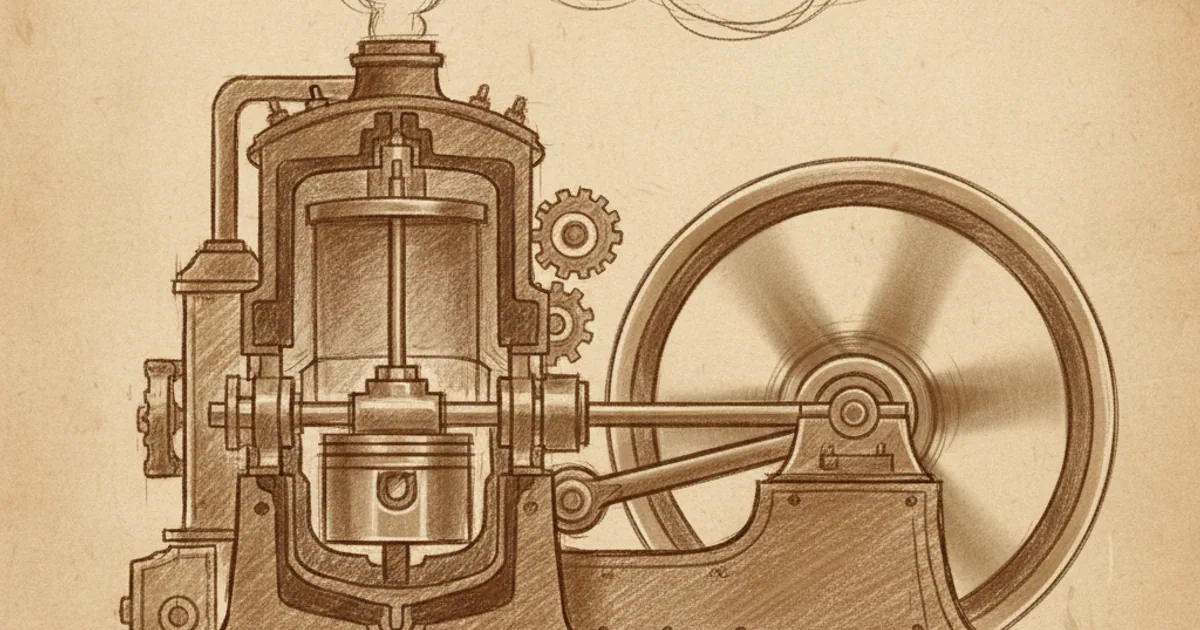
What a heat engine actually is
Anywhere there's a temperature difference, you can extract useful work. That's all a heat engine is: a device that lets heat flow from hot to cold and skims off some of the energy as motion, electricity, or whatever you need.
A steam engine, a petrol car, a nuclear power plant, a jet turbine, the wind itself — these are all heat engines, distinguished only by what fluid they use and how they cycle it. The physics is the same.
The general recipe
Every heat engine does three things in a loop:
- Absorb heat from a hot reservoir (burning fuel, hot steam, fissioning uranium, the sun).
- Convert some of that heat into work (pushing a piston, spinning a turbine).
- Dump leftover heat to a cold reservoir (the atmosphere, a river, a radiator).
The work you get out is whatever wasn't dumped. The catch — and this is the second law of thermodynamics doing the talking — is that you must dump some heat. You cannot turn 100% of the input into work.
Why "must"
Imagine you tried to run an engine that absorbed heat from a hot reservoir and produced work, with nothing dumped to cold. That's the same as taking heat out of one place and turning it entirely into mechanical motion.
The second law forbids this because it would decrease entropy with no compensating increase. Heat is high-entropy energy (spread out across many molecules); work is low-entropy energy (concentrated in coordinated motion). Converting fully from one to the other is moving the universe to a more ordered state — which the second law won't allow.
You can do it partially, as long as you also dump enough heat to a cold reservoir to compensate. The cold reservoir absorbs the disorder. That's why heat engines have an exhaust pipe, a radiator, or a cooling tower.
The Carnot ceiling
The theoretical maximum efficiency of any heat engine working between two temperatures was figured out by Sadi Carnot in 1824:
efficiency ≤ 1 − T_cold / T_hot
Both temperatures in kelvin. The formula is universal — it doesn't depend on what the working fluid is, what the cycle looks like, or how cleverly engineered the engine is.
Examples:
- Car engine: roughly 1500 K in the combustion chamber, exhausting to about 400 K. Carnot says max ≈ 1 − 400/1500 ≈ 73%. Real petrol engines hit 25–35%.
- Coal power plant: steam at ~800 K, condenser at ~310 K. Carnot ≈ 1 − 310/800 ≈ 61%. Real plants hit 35–45%.
- Geothermal: hot reservoir maybe 400 K, cold 290 K. Carnot ≈ 27%. Real plants get 10–15%.
The closer your two temperatures are, the worse you do. This is why low-temperature waste heat is so hard to capture usefully: there isn't enough Carnot headroom.
Why real engines fall short
Carnot is a theoretical maximum. Real engines lose to:
- Friction at every moving part.
- Heat conduction that bleeds energy across the engine without doing work.
- Incomplete combustion that turns fuel into soot and CO instead of CO₂.
- Pumping losses when air or fluid has to be moved.
- Finite cycle times — a perfectly slow Carnot cycle is reversible and lossless, but produces zero power. Practical engines run fast and lose efficiency in return for power output.
A real petrol engine therefore lives in the 25–35% range. Diesel is a bit better (35–45%). Combined-cycle gas turbines, which run a gas turbine and a steam turbine on the same heat, get into the high 50s and even low 60s — by capturing heat that would otherwise become waste.
Refrigerators are heat engines in reverse
Run the same machine backwards and instead of converting a temperature difference into work, you create a temperature difference using work. That's a refrigerator, an air conditioner, or a heat pump.
It moves heat from cold to hot, which by itself would violate the second law — but it pays for the move with the electricity going in. The total entropy of the universe still increases (the electricity-generating plant, somewhere, dumped more heat than your fridge absorbed). The fridge just locally reverses the flow.
This is why a heat pump can be over 100% "efficient" by the naive accounting. A good heat pump delivers 3–5 kWh of heating for every 1 kWh of electricity, because it's moving heat, not creating it.
The free-energy claim trap
You will occasionally see news of someone claiming a heat engine that exceeds the Carnot limit, or runs without any cold reservoir, or otherwise breaks the second law. None of these are real. Either the claim involves a hidden energy input, or it's a measurement error.
The second law is one of the most rigorously tested statements in physics. Every claimed violation has, on inspection, turned out to be a misunderstanding. Anyone selling you a free-energy device is selling you fiction.
The takeaway
A heat engine converts temperature differences into useful work, but only partially — there's a hard ceiling, set by the two temperatures it works between, and no engineering trick gets you above it. Real engines, with their friction and finite speeds, sit well below the ceiling. The second law isn't a regulation; it's the structure of the universe. Engineers spend careers squeezing efficiency closer to Carnot without ever crossing it. If the Carnot ceiling is the kind of result you'd like to actually derive rather than just nod at, it rewards working through it with examples.

Comments 0
No comments yet. Be the first to share your thoughts.