
The statement
Heisenberg's uncertainty principle, in its most famous form:
Δx · Δp ≥ ℏ/2
where Δx is the uncertainty in a particle's position and Δp the uncertainty in its momentum. ℏ (h-bar) is Planck's constant divided by 2π, roughly 1.05 × 10⁻³⁴ J·s.
In words: the product of position and momentum uncertainties has a minimum value. You can know position very precisely, or momentum very precisely, but not both arbitrarily precisely at the same time.
This isn't an engineering limit. It's a structural feature of how quantum systems work.
Where it comes from
The cleanest way to see why is through waves.
A quantum particle is described by a wavefunction — a wave in space. The position of the particle is determined by where the wavefunction is localized. The momentum is determined by the wavefunction's spatial frequency (how many wave peaks fit per unit distance).
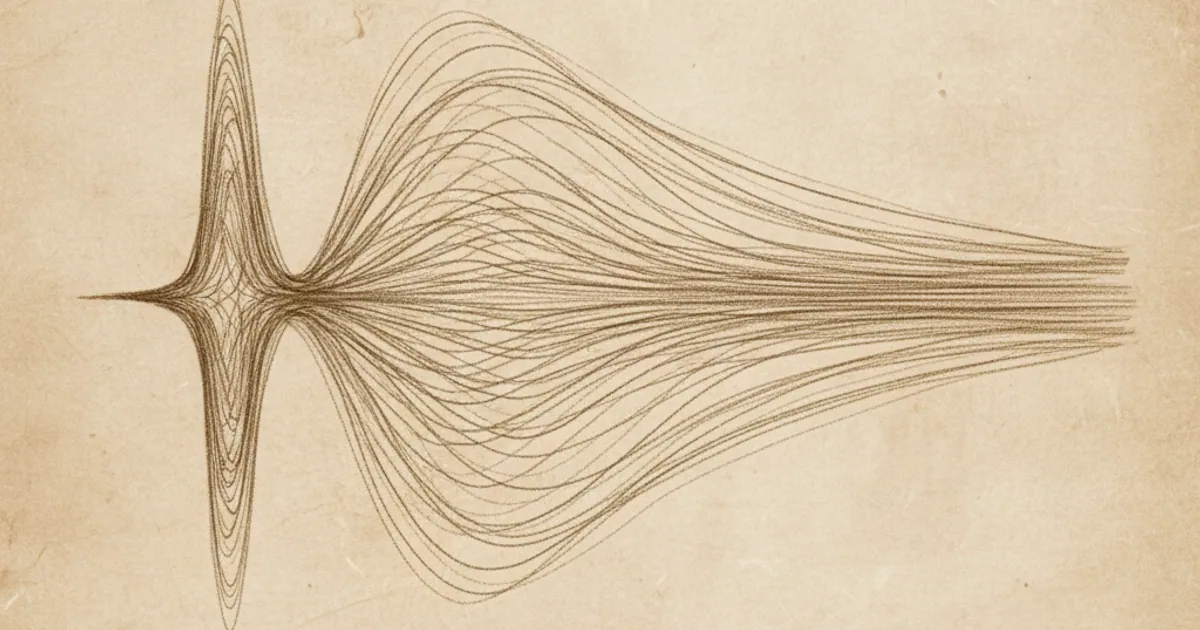
Here's the catch from basic Fourier analysis: a wave that's localized in space (a sharp pulse) is made of many different wavelengths added together. A wave with a single well-defined wavelength (a pure sine wave) is spread out over all space.
- Sharp position = many wavelengths = uncertain momentum.
- Sharp momentum = single wavelength = spread-out position.
You can't have both at once. The wave packet that minimises the product is a Gaussian, and for it Δx·Δp equals exactly ℏ/2. Every other waveform does worse.
Not "measurement disturbance"
There's a folk-explanation of the uncertainty principle that goes like this: "to see an electron, you have to bounce a photon off it. The photon's kick changes the electron's momentum, so the more accurately you measure its position, the more you disturb its momentum."
This is what Heisenberg originally argued in 1927 (the "microscope thought experiment"), and it gives the right order-of-magnitude. But it's not the deep reason.
The deeper statement: the particle doesn't have a simultaneously definite position and momentum to be disturbed. The uncertainty isn't a measurement artifact — it's a statement about what's there.
A version of this distinction was sharpened in the 2010s by Ozawa's revised uncertainty relations and subsequent experiments: the measurement disturbance and the intrinsic indeterminacy are separate quantities, and the intrinsic part is what Heisenberg's inequality bounds. You can sometimes measure with less disturbance than the original argument suggested, but you cannot get past the structural Δx·Δp limit.
Other conjugate pairs
Position and momentum are the most famous, but they're one example of a broader pattern. Any two "conjugate" quantities — quantities whose measurement operators don't commute — obey an uncertainty relation.
Energy and time: ΔE · Δt ≥ ℏ/2.
A quantum state that exists only briefly has an uncertain energy. This is why excited atomic energy levels with short lifetimes have broader spectral lines (more energy spread) — the brief existence forces a finite energy range. Lasers exploit this in reverse: stabilising a long-lived energy level gives a sharp, monochromatic output.
Angular momentum components: you can know how much spin a particle has, but you can't simultaneously know its spin's component along all three axes. Measure spin along z and you destroy your information about spin along x and y.
Electric and magnetic fields at a point: the vacuum has irreducible field fluctuations because E and B at a single point can't both be exactly zero.
Why it doesn't affect everyday life
Planck's constant is small. To get a sense:
A baseball weighs 0.145 kg. Suppose you locate it within 1 nanometre (10⁻⁹ m). The uncertainty principle implies its momentum is uncertain by at least about 5 × 10⁻²⁶ kg·m/s — meaning its velocity is uncertain by 4 × 10⁻²⁵ m/s. That's well below any physically achievable measurement precision. The uncertainty exists, but it's irrelevant.
For an electron (mass 9 × 10⁻³¹ kg) localised to within an atom (~10⁻¹⁰ m), the momentum uncertainty corresponds to velocities around 10⁶ m/s. That's a sizable fraction of the speed of light. For electrons, the uncertainty principle is the headline.
Consequences you can see
Atom stability. An electron sitting still at the nucleus would have zero kinetic energy (low). But pinning it to that tiny position would require infinite momentum uncertainty (high kinetic energy). The trade-off produces a stable orbital with a specific characteristic radius — the Bohr radius. This is why atoms have the size they do, and why electrons don't simply fall into the nucleus.
Zero-point energy. A quantum harmonic oscillator can't sit at the bottom of its potential well — that would mean exactly known position and exactly zero momentum. It must have a residual "zero-point" energy. This shows up in why helium won't freeze, in molecular vibrations at 0 K, and in the cosmological constant problem.
Quantum tunneling. A particle can briefly violate energy conservation by ΔE, as long as it does so within Δt ≤ ℏ/2ΔE. This lets particles tunnel through energy barriers they classically shouldn't penetrate — the basis of nuclear fusion in stars, alpha decay, and how a flash drive stores data (Fowler–Nordheim tunneling through a thin oxide layer).
Stellar pressure. Inside a white dwarf star, gravity tries to compress electrons into a tiny volume. The uncertainty principle resists: localizing electrons to a small space forces high momentum, which provides outward pressure (electron degeneracy pressure). This is what keeps white dwarfs from collapsing.
The takeaway
The Heisenberg uncertainty principle is a structural feature of quantum mechanics. Conjugate pairs of properties — position/momentum, energy/time, perpendicular angular momentum components — cannot both be simultaneously sharply defined. The product of their uncertainties has an irreducible floor set by Planck's constant. It's the reason atoms have stable sizes, why nuclear fusion is possible, and why stars can exist in their middle-aged stable form. Not a limit on observation, but a property of the world. Getting past the "you disturb it by looking" folk version to the real idea is exactly the kind of upgrade that genuinely makes you sharper.

Comments 0
No comments yet. Be the first to share your thoughts.