
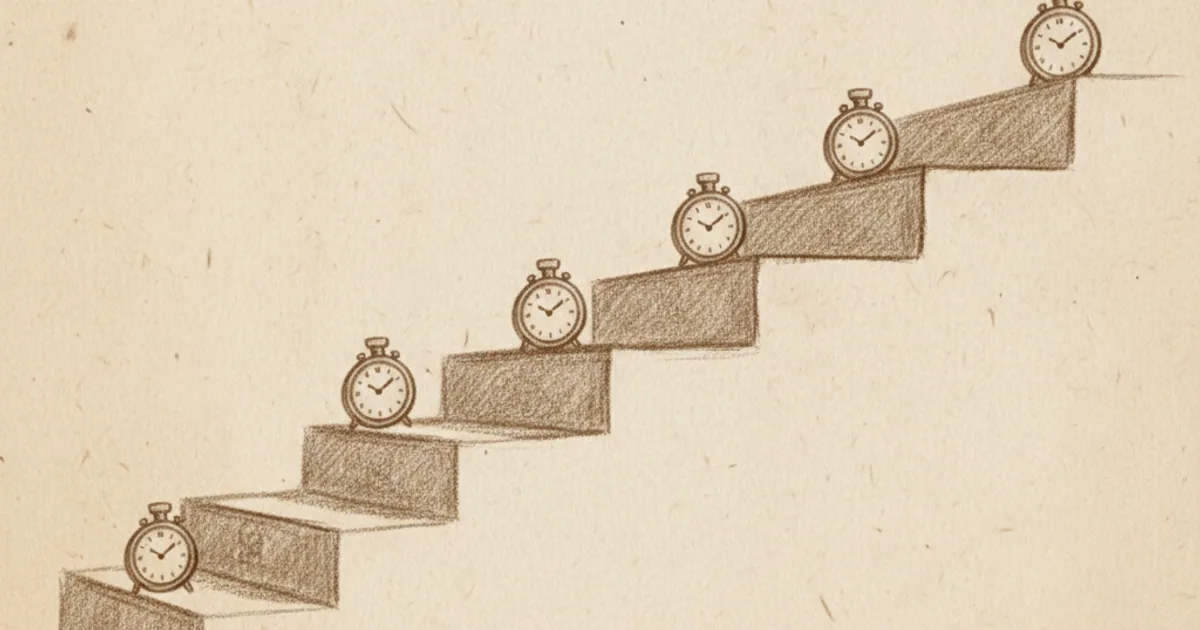
The technique in one sentence
Review material at expanding intervals, timed to land just before you'd otherwise forget.
That's the whole idea. The implementation is more interesting than the principle, but the principle is that simple.
Where it comes from
In 1885, the German psychologist Hermann Ebbinghaus wanted to measure forgetting. He memorised lists of nonsense syllables (chosen to be content-free, so prior knowledge couldn't help), then tested himself at various intervals to see how much he could recall.
The results, plotted as percent recalled versus elapsed time, formed a curve: rapid loss at first (most of what you learn is gone within a day if you don't review), then a slower decline as the small remainder consolidated.
The Ebbinghaus forgetting curve — exponential decay with a long tail — has been replicated thousands of times. It's one of the most reliable findings in cognitive psychology.
The key Ebbinghaus discovery wasn't the forgetting itself. It was that repeated review resets the curve. Each time you retrieve and reinforce the memory, the forgetting that follows is slower. Five reviews at well-chosen intervals produce vastly more durable memory than the same number of reviews crammed together.
Why timing matters
If you review too early — when you still remember the material clearly — the review is wasted effort. The memory is already at full strength; rehearsing it adds nothing.
If you review too late — after you've forgotten — you're not reviewing, you're re-learning. The benefit is much smaller than if you'd caught it just in time.
The sweet spot is just before you'd otherwise forget. At that moment, the retrieval is hard (which strengthens the memory) but still possible (which makes it productive). The act of digging the memory out — not finding it on a freshly-rehearsed surface — is what produces durable consolidation.
Different facts forget at different rates. Words you encounter daily stay fresh; obscure vocabulary fades fast; well-understood concepts (where you've built lots of cross-connections) stay accessible longer than isolated facts.
Spaced repetition software figures out the right interval for each individual fact, adaptively, based on your performance.
How the algorithm works
The simplest version, SM-2 (Piotr Wozniak, 1987):
- When you successfully recall a card, its next review interval grows by a factor based on how easy it felt.
- When you fail to recall, the interval drops back to roughly a day.
- Each card has an "ease factor" that adjusts based on how it performs over time.
Modern algorithms (FSRS, the current state of the art) use more sophisticated probabilistic models of memory decay, estimating each card's individual forgetting curve and scheduling the next review at the precise point where recall probability dips to, say, 90%.
You don't need to understand the algorithm to use it. Pick an app (Anki, RemNote, NerdSip, etc.), drop your material in, and follow the schedule it produces.
What this looks like in practice
Say you're learning the Spanish word "bibliotecario" (librarian). The system shows you this card today. You correctly translate it; the system schedules the next review for tomorrow.
Tomorrow you see it again. Still correct. Next review: 3 days from now.
Three days later. Still correct. Next: 7 days.
Seven days later. Still correct. Next: 16 days.
The intervals balloon. By month 3, you're seeing this card roughly once a month. By year 1, once or twice a year. The card is maintained for life with a few minutes of review per year — provided you keep using the system.
If at any review you fail, the interval crashes back to 1 day and starts over. The system protects you from "leaks" by aggressively re-spacing anything you're forgetting.
Flashcards are not the only way to apply this. Bob Paulson, part of the team behind Feynmanpedia, describes a ten-minute daily version aimed at broad knowledge instead of vocabulary in How to Improve Your General Knowledge in 10 Minutes a Day on Medium.
The math on cramming versus spacing
Imagine you have 10 hours to learn 100 vocabulary words.
Cramming option: 10 hours the night before the test. You learn all 100 words. Tomorrow, you remember about 95. Two weeks later, about 20. Two months later, maybe 5.
Spaced option: 30 minutes per day for 20 days, with spaced repetition. By day 20 you've encountered each word multiple times at the optimal intervals. Tomorrow you remember about 90. Two weeks later, about 80. Two months later, about 70.
Same 10 hours total. Different outcomes by an order of magnitude at the relevant time horizon.
This isn't a theoretical claim. It's been replicated in dozens of studies across many learning domains. The cramming win is short-lived; the spacing win compounds.
Why we don't all do this
Three reasons:
Cramming feels effective in the moment. The night-before push produces strong recall by morning. You haven't yet hit the curve where the difference matters.
Spacing requires planning. You have to be willing to commit to 20 days of small reviews rather than one big push. Most students aren't.
Spacing requires software. Manually tracking what to review when is exhausting. Modern apps make it trivial — but you have to set them up.
Once you've internalised the loss-curve math, the choice usually flips. Anyone who's seriously learning long-term — medical students, language learners, programmers learning new systems — eventually adopts some form of spaced repetition.
The mechanism
Why does timing work? The leading theory is the encoding-retrieval cycle.
When you learn something, it goes into the hippocampus in a state that decays unless something maintains it. Each successful retrieval re-encodes the memory in the neocortex — the long-term storage — but only completes when the retrieval is hard enough to engage the neocortical machinery.
Too-easy retrieval (within minutes of the original learning) doesn't engage that machinery; the memory stays in hippocampal limbo. Just-hard-enough retrieval (right before forgetting) maximally engages the consolidation system. The interval that produces "just hard enough" retrieval is the optimal one — and the spacing algorithms find it experimentally.
What it doesn't replace
Spaced repetition is excellent for retention of well-defined units of information — facts, words, definitions, formulas, principles. It's not a complete learning system on its own:
- You still need initial understanding before spacing helps. Repetition of confusion produces confusion.
- You still need active retrieval during each review — looking at the answer and saying "yes that's right" doesn't help; you have to attempt the answer first. (See active recall for more.)
- You still need application and problem-solving to develop the procedural skill of using what you know.
- You still need sleep for consolidation. Reviewing at the right times doesn't help if you don't sleep on the material.
Think of spaced repetition as a maintenance layer: it keeps in memory what you've already understood. The understanding itself comes from elsewhere.
The takeaway
Spaced repetition turns the Ebbinghaus forgetting curve from your enemy into your scheduling tool. Reviewing material at expanding intervals — driven by an adaptive algorithm that times each review to just before you'd otherwise forget — produces durable long-term retention that cramming cannot match. The principle is 140 years old. The software that makes it practical is recent. Anyone serious about learning material that has to stick eventually adopts it; it's one of the few cognitive techniques that's been replicated enough times that the question is no longer "does it work" but "why aren't you using it yet."

Comments 0
No comments yet. Be the first to share your thoughts.