
The image everyone thinks they know
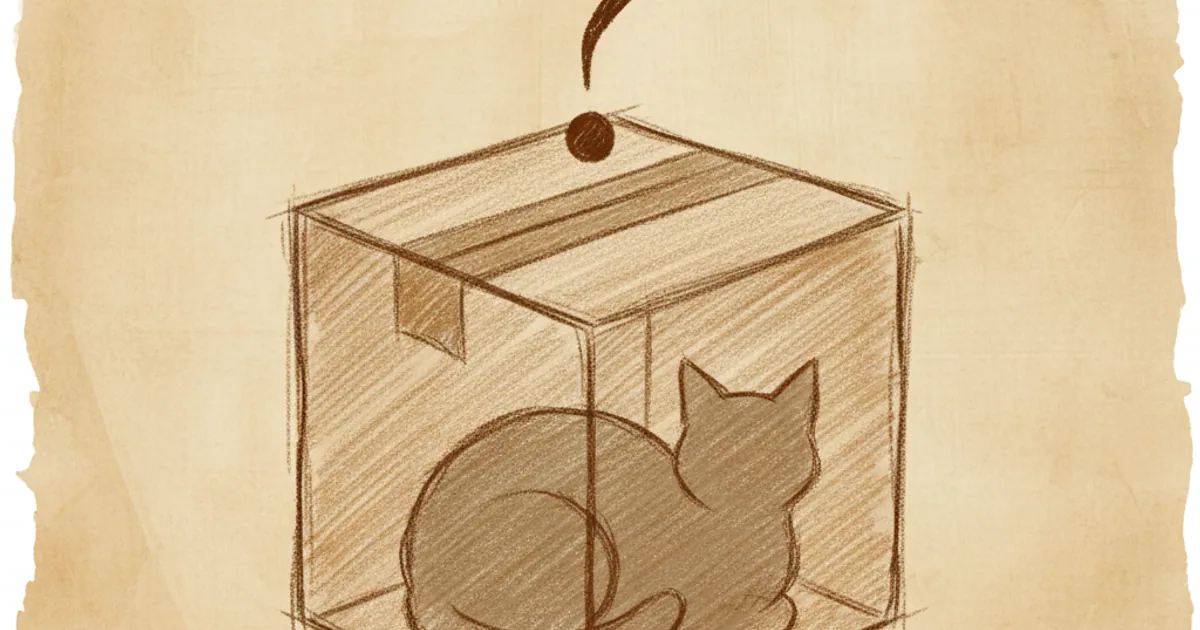
A cat in a sealed box. Inside the box: a radioactive atom that might or might not decay in the next hour. If it decays, a Geiger counter triggers a hammer, which breaks a vial of poison, and the cat dies. If the atom doesn't decay, the cat lives.
Until you open the box and look, quantum mechanics says the atom is in a superposition of "decayed" and "not decayed." By extension, the cat must be in a superposition of "dead" and "alive."
That's the setup. The common takeaway: "wow, quantum mechanics is so weird, the cat is both dead and alive at the same time."
That takeaway misses what Schrödinger was actually doing.
Schrödinger thought this was ridiculous
Erwin Schrödinger wrote about the cat in 1935, in a long paper trying to articulate his discomfort with the (then-new) Copenhagen interpretation of quantum mechanics being pushed by Bohr, Heisenberg, and others.
His view was: yes, the maths says microscopic systems can be in superposition. But if you couple a microscopic system (the atom) to a macroscopic one (the cat), the standard interpretation would force you to say the cat is in a superposition too. And that's absurd. Nobody has ever seen a half-dead cat. There must be something incomplete about the theory as stated.
The cat was a reductio ad absurdum — an attempt to show that quantum mechanics, taken too literally, leads to nonsense at the macroscopic level. Schrödinger was pointing at a problem, not celebrating a feature.
The problem he was pointing at
It's known today as the measurement problem. Quantum mechanics has two rules:
- Schrödinger evolution — wavefunctions evolve smoothly and deterministically according to a wave equation.
- Measurement collapse — when a measurement happens, the wavefunction abruptly collapses to one of its components, with probabilities given by the Born rule.
Rule 1 says superpositions persist indefinitely. Rule 2 says measurements collapse them. Standard quantum mechanics doesn't specify when rule 2 kicks in — what counts as a "measurement"? What's the boundary between a quantum system (evolves by rule 1) and a measuring apparatus (triggers rule 2)?
If the cat-plus-atom system is purely rule-1, the cat must be in superposition. If something inside the box triggers rule 2 — the Geiger counter? the hammer? the cat itself? — then the superposition collapses well before any human looks. Standard quantum mechanics, as written, doesn't say.
This was Schrödinger's complaint. And it's a real one.
The modern answer: decoherence
Most physicists today think the measurement problem has, if not a perfect resolution, at least a satisfactory practical answer: decoherence.
A macroscopic object like a cat is constantly interacting with its environment — photons hitting it, air molecules bouncing off, infrared radiation from its own body. Every one of these interactions effectively measures some property of the cat. The cat's wavefunction quickly becomes entangled with trillions of environment particles.
Once that happens, you can no longer treat the cat as a clean superposition. The superposition has "leaked" into the environment, where the two branches — dead-cat-and-corresponding-environment vs. alive-cat-and-corresponding-environment — no longer interfere with each other. For all observational purposes, the cat is in one definite state. Just as if it had collapsed.
The time scale matters. For a cat-sized object at room temperature, decoherence happens in roughly 10⁻²³ seconds. By the time the radioactive atom decays, the macroscopic superposition is already lost. There is no moment when the cat is observably both alive and dead.
This doesn't fully resolve the philosophical question (why did decoherence pick THIS branch rather than that one?), but it explains why the practical absurdity Schrödinger worried about doesn't actually happen.
What's still up for debate
The branches that decoherence creates don't simply vanish. According to many-worlds, both branches really exist — there's a universe where the cat is dead and one where it's alive, and you (the observer) end up in one of them. According to Copenhagen, only one branch is real and the others are mathematical fiction. According to Bohmian mechanics, there were always definite trajectories; the wavefunction is real but only one branch contains actual particles.
These interpretations are empirically equivalent — no experiment can distinguish them so far. The physics is the same. The metaphysics is open.
Real macroscopic superpositions
Modern experiments have produced genuine superpositions of macroscopic objects, just very small and very cold macroscopic objects. The current state of the art includes:
- Superpositions of currents in superconducting loops (a few microamps flowing simultaneously clockwise and counterclockwise around a millimetre-scale ring).
- Mechanical oscillators consisting of hundreds of millions of atoms put into vibrational superpositions.
- Molecules with thousands of atoms (oligo-porphyrins, in 2019).
In every case, extreme isolation — vacuum, near-absolute-zero temperatures, magnetic shielding — is required to keep decoherence at bay. A room-temperature cat is hopelessly far from those conditions.
What "dead and alive at the same time" actually means
Here's the careful statement, when someone insists on the colourful phrase:
The combined wavefunction of (radioactive atom + Geiger counter + hammer + vial + cat) has both branches — dead-cat-after-decay and alive-cat-without-decay — present mathematically. But this combined wavefunction also entangles with the environment so fast that the two branches lose all ability to interfere with each other. From any practical standpoint, the cat is just dead or just alive by the time anything observable can happen. The superposition isn't real in the sense of "you'd ever experience it."
Saying "the cat is both dead and alive" is at best a loose poetic statement about the wavefunction before decoherence resolves it. At worst, it's marketing copy.
The takeaway
Schrödinger's cat is a thought experiment about the measurement problem, not a model of how cats actually behave. Schrödinger himself thought the superposition conclusion was absurd. Decoherence answers his complaint in practice: macroscopic objects can't maintain quantum coherence with their environments, so observable cat-superpositions never form. The deeper question — what counts as a measurement, and why one branch — is still philosophically open, and serves as a useful test for any proposed interpretation of quantum mechanics. The cat is a great example of a "fact everyone knows" that turns out to mean the opposite of the popular version — and there's a whole pile of topics like that worth unlearning.

Comments 0
No comments yet. Be the first to share your thoughts.