
The setup
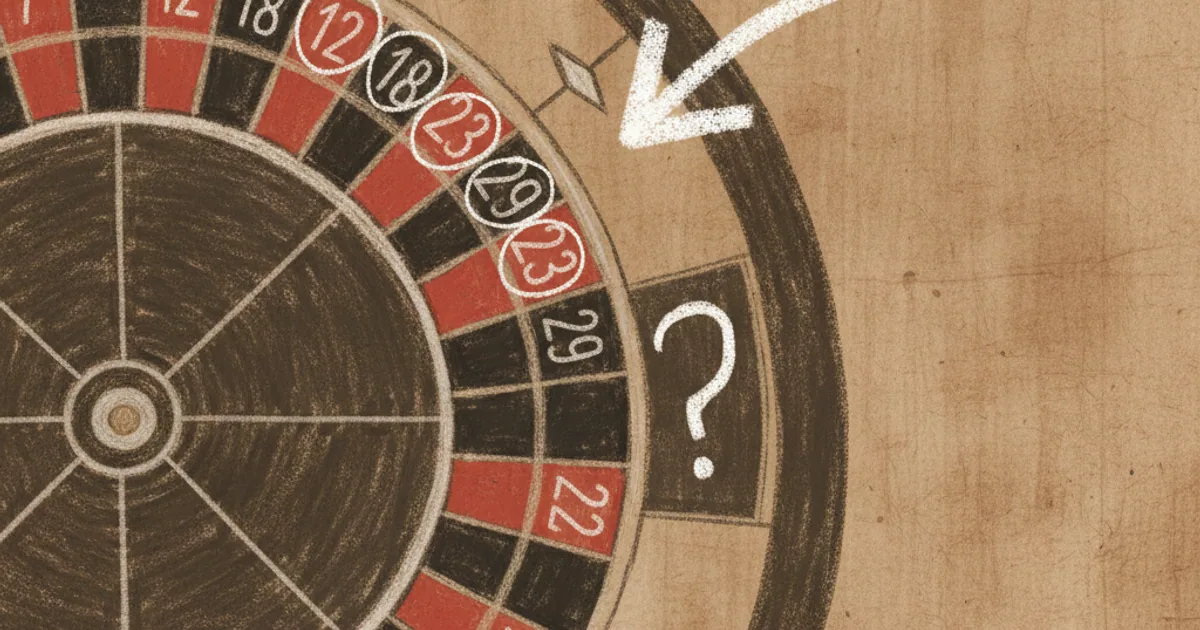
A roulette wheel lands on red ten times in a row. You walk up. The board shows the recent history. You feel — and most people would feel — that black is "due."
It isn't. The wheel doesn't remember. Each spin is an independent event with a fixed probability (slightly under 50% for either color, because of the 0 and 00). The next spin is the same odds as any other spin.
This is the gambler's fallacy: believing that past outcomes affect future independent events, in a direction that "balances things out." It's one of the most stubborn and expensive cognitive errors in the history of intuition.
Monte Carlo, 1913
The textbook case happened at the Casino de Monte-Carlo on August 18, 1913. At one roulette table, the ball landed on black 26 times in a row.
By the seventh or eighth spin, players had started piling money on red, convinced it was "due." With each new black, more poured in. By the time the streak ended (with a red, finally), the casino had cleaned out millions of francs from players who had bet against the streak.
The wheel was working perfectly. Each spin had been around 50/50. Twenty-six in a row is improbable — about 1 in 67 million — but on any given evening, somewhere in the world, some sequence near that improbable is unfolding. The Monte Carlo wheel wasn't broken; it was just having one of those evenings.
The lesson nobody at the table took: a fair process can produce long streaks, and a long streak doesn't change the next outcome.
Why the feeling is so strong
The intuition that "things even out" comes from a real piece of math, applied in the wrong place. The law of large numbers says that over enough trials, the observed frequency of an event approaches its true probability. Over 10,000 coin flips, you'll get close to 5,000 heads.
So far so good. The error is applying this expectation to short sequences. After 10 heads in a row, the next 9,990 flips will indeed average close to 50/50 — but they'll do this by adding more or less an equal mix to the existing imbalance, not by overcorrecting toward tails. The 10-head streak doesn't get "paid back." It just becomes a smaller fraction of the total as you keep flipping.
Mathematically: the count of heads and tails diverges over time (with probability 1, the gap between them grows arbitrarily large), but the ratio approaches 50/50. The fallacy is confusing these two things.
The casino business model
Casinos depend on this fallacy. Roulette wheels typically have an electronic board displaying recent results — usually 20 or so. There is no operational reason for this. The board exists because it triggers the gambler's fallacy in players, who then bet against the recent streak.
If players actually internalized that each spin was independent, this display would be useless to them. They don't, so it isn't.
Slot machines exploit a related dynamic. After a long losing streak, players feel a payout is "due" — and they keep playing. Modern slot machines are random-number-generator-driven; each pull is independent. There's no "due" payout. The streak feeling produces more pulls, which produces more revenue.
Independence vs. regression
A common confusion: isn't the gambler's fallacy just the opposite of regression to the mean? Don't both involve thinking about streaks?
They look similar but apply to different situations.
Regression to the mean applies when you're measuring an underlying value that has noise. Pick the highest-scoring student on a test, retest them, and their score will probably be lower — because their first score included luck, and luck reverts. There's a stable underlying skill that next measurements pull toward.
Gambler's fallacy applies to events with fixed independent probabilities. There's no "underlying value" that the next coin flip is reverting toward. Each flip is independently 50/50; previous flips have no influence whatsoever.
Same patterns of streaks, different mathematical setup. Regression is real and you should expect it. Gambler's fallacy is wrong and you shouldn't.
The diagnostic: are the events measurements of something underlying (regression applies) or independent draws from a fixed probability (gambler's fallacy applies)? Stock returns? Mostly regression — there's value behind the price. Coin flips? Pure independence — gambler's fallacy zone. Sports performance? Mix of both — and that's why analysis there is hard.
The hot hand
The opposite fallacy: believing that a player who's been winning recently is more likely to keep winning.
In pure-chance games (roulette, slot machines), this is just as wrong as the gambler's fallacy. The wheel doesn't develop a "hot hand."
In sports, the question is more interesting. A 1985 paper by Gilovich, Vallone, and Tversky famously argued that the basketball "hot hand" was an illusion — players who hit a shot were no more likely than baseline to hit the next one.
But in 2018, Miller and Sanjurjo showed the original analysis had a subtle statistical bias that artificially suppressed any hot-hand signal. When corrected, basketball does show some real hot-hand effect — players who just made a shot are slightly more likely to make the next, probably due to momentum, confidence, or favorable defensive setup.
So: hot hands aren't a fallacy in skill sports, but they're often weaker than fans believe. And in pure-chance contexts, the hot-hand intuition is just as wrong as the gambler's intuition.
How to retrain the gut
A few practices that help internalize independence:
Simulate. Flip a coin 100 times. Write down the results. You'll see long streaks. Around 50-50 overall, but with clusters that feel like patterns. Doing this once teaches the lesson better than a thousand explanations.
Compute, don't intuit. When tempted to think a streak means something, ask: what's the actual probability of this streak occurring by chance alone? Usually higher than your gut expected.
Notice the framing. "Red is due" sounds like a forecast. It's actually a prediction the future will compensate for the past. Once stated explicitly, the absurdity is easier to spot.
Take the casino's perspective. Why would a roulette wheel know what it has done? It doesn't have a memory. It has no internal state related to past spins. Why would the next spin care?
Want to drill independence and probability intuitions further? NerdSip can generate a 5-minute course on this exact topic.
When the fallacy is partly right
A small wrinkle: sometimes the events are NOT actually independent. A poker dealer dealing from a shuffled deck without replacement: as cards come out, the remaining probabilities shift. If three aces have already been dealt, the next card is less likely to be an ace.
But this is conditional probability, not the gambler's fallacy. The mechanism — a finite deck whose composition changes as cards are removed — is real and computable. The fallacy is applying this kind of reasoning to processes that ARE genuinely memoryless (roulette, coin flips, slot machines).
The takeaway
The gambler's fallacy is the wrong belief that independent events compensate for past outcomes. They don't; a fair coin has no memory. Casinos exploit this by displaying recent results, knowing the displays trigger the fallacy in most players. The closely-related law of large numbers does describe genuine long-run convergence, but it works through accumulating new outcomes, not through balancing past ones. Knowing the difference saves you from one of the most stubborn — and expensive — cognitive errors there is.

Comments 0
No comments yet. Be the first to share your thoughts.