
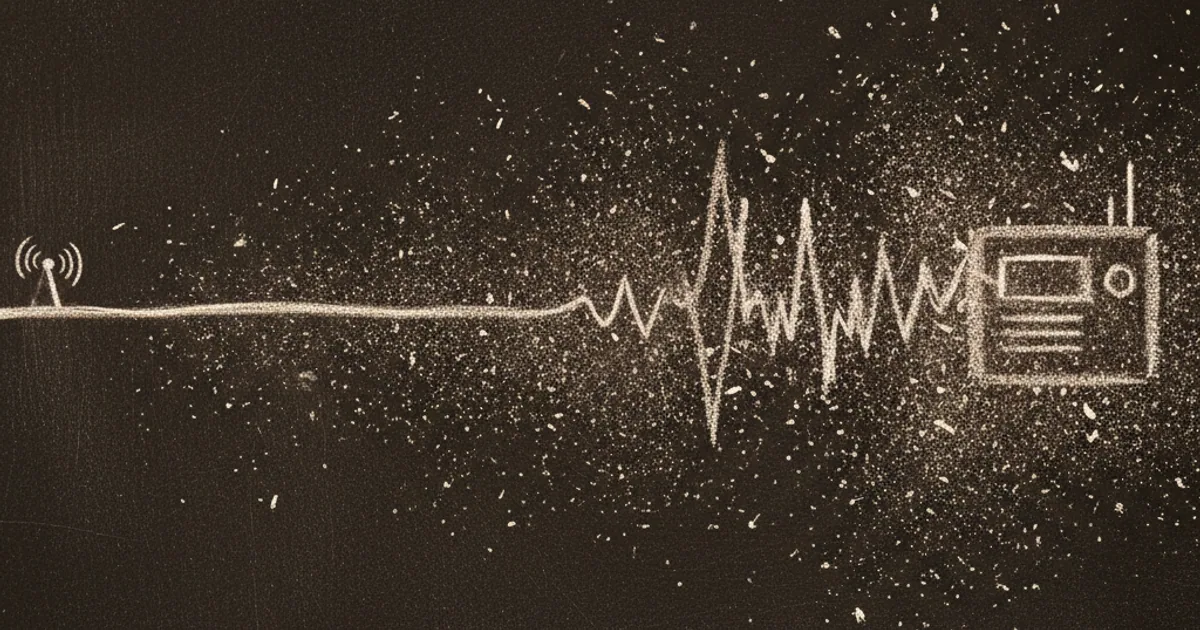
Walk away from your WiFi router with a laptop and watch the speed test numbers fall — full speed in the same room, half through one wall, a crawl from the garden. Nothing is broken. You are watching a law of nature in action: every communication channel has a maximum data rate set by physics, and there is a single, short formula that tells you what it is. It may be the most consequential equation you've never been shown.
This article is part of a cluster on information and bits. The foundations — what a bit is and why information is measurable at all — are in the pillar, what information really is. This piece is about the wall at the end of the road.
The formula
Claude Shannon (building on earlier work by Ralph Hartley) proved that a channel with bandwidth B and signal-to-noise ratio S/N can carry error-free data at any rate up to
C = B log₂(1 + S/N)
and at no rate beyond it. Let's take the symbols one at a time, slowly, because each one is a real physical thing.
C is the capacity, in bits per second: the ceiling on how fast information can cross this channel with as few errors as you like. Not "how fast before it gets flaky" — how fast, period, with essentially perfect reliability, if your engineering is good enough.
B is the bandwidth, in hertz: the width of the slice of frequencies you're allowed to use. A channel spanning 2,400 to 2,480 MHz has 80 MHz of bandwidth. Think of frequencies as lanes on a highway: bandwidth is how many lanes you own. It is emphatically not the same thing as "speed," even though internet marketing has blurred the words — bandwidth is one ingredient of speed.
S is the signal power arriving at the receiver, and N is the noise power — the random electrical hiss that contaminates every real receiver. Some noise comes from interference, but there's a floor you can never remove: the thermal jiggling of electrons in the receiver's own circuits generates noise, and only cooling to absolute zero would silence it. The ratio S/N says how loudly you're talking compared to the room's murmur.
log₂(1 + S/N) then tells you how many bits each use of the channel can carry. And the logarithm is the punchline of the whole formula, so it deserves its own section.
Why the logarithm is the whole story
How does a signal carry many bits at once? By using many distinguishable levels. If the receiver can tell apart 16 different signal amplitudes, each received symbol identifies one choice among 16 — that's log₂ 16 = 4 bits per symbol, the yes/no-question counting familiar from Shannon entropy.
Noise is what limits how many levels you can distinguish. Each level arrives smeared by roughly the noise amplitude, so levels must be spaced farther apart than the smear, or the receiver confuses neighbors. The available "space" for levels is set by signal power; the required spacing is set by noise. Their ratio fixes the number of distinguishable levels — roughly √(1 + S/N) of them — and the bits per symbol is the log of that.
Here's the practical sting: the logarithm makes signal power a miser's game. Doubling S/N doesn't double capacity — it adds just one bit per symbol's worth. Going from S/N = 15 to S/N = 255 (sixteen times the power!) only doubles the per-symbol payload from 4 bits to 8. Meanwhile bandwidth B sits outside the log: double your lanes, double your capacity, done. This one asymmetry explains a huge amount of modern radio engineering — nobody wins by shouting; everybody wins by finding more spectrum.
The formula in your daily life
WiFi across the house. Radio power thins out geometrically as it spreads and gets eaten by walls; your router's signal might arrive a million times weaker in the garden than in the same room, while the receiver's noise floor stays put. S/N collapses, so C collapses. Your laptop doesn't fight the formula — it obeys it, stepping down through slower, more noise-tolerant encodings (fewer amplitude-phase levels per symbol) so that what it sends still gets through. The speed test isn't measuring your patience; it's measuring log₂(1 + S/N) in real time.
5G's climb up the spectrum. Since power is a losing game, carriers chase B. Down at the traditional cellular frequencies (say 600-2,600 MHz), spectrum is a crowded, auctioned scarcity, doled out in slivers of tens of megahertz for eye-watering sums. Up at millimeter-wave frequencies (24 GHz and beyond), there's room for channels of hundreds of megahertz — vastly more B, and capacity scales right along with it. That's the entire logic of 5G's high bands. The catch is physics rent: waves up there behave like light, blocked by walls and weakened by rain and even oxygen, so millimeter-wave 5G works as short-range hotspots with many small cells, while lower bands still do the wide-area work.
Deep space, the opposite corner. A probe beyond Neptune delivers S/N far below 1 — the signal is genuinely buried in the hiss. The formula still pays out: capacity never hits zero as long as some signal arrives. You just live with few bits per second and lean on ferocious error-correcting codes to spend those bits wisely. Slow, not silent.
Once you have the formula, half the mysterious behavior of your gadgets snaps into focus — why the microwave oven murders the WiFi (it sprays noise into the same 2.4 GHz band, cratering S/N), why fiber is fast (optical frequencies offer stupendous B with almost no N), why your phone's bars and its speed are related but not identical. It's the kind of everyday-physics payoff that a five-minute NerdSip read is built around: one equation, and suddenly the router in your hallway is legible.
A wall, not a hurdle
Here is the part that makes Shannon-Hartley special among engineering formulas: it is not a description of current technology. It's a theorem. Shannon proved both directions — below C, there exist coding schemes achieving any desired reliability; above C, no scheme, no cleverness, no future invention can deliver reliable communication. Exceeding the Shannon limit isn't hard; it's impossible, in the same sense that a perpetual-motion machine is impossible.
For decades this was an almost taunting result, because Shannon's proof showed the great codes exist without saying how to build them, and practical systems languished far below capacity. The gap finally closed in the 1990s: turbo codes and rediscovered LDPC codes now operate within a fraction of a decibel of the Shannon limit, which is why they're baked into 5G, WiFi, and satellite links. The wall didn't move — we just finally walked all the way up to it and put our hands on it.
And when capacity is scarce, the other half of this cluster becomes the strategy: if the pipe's width is fixed by physics, send fewer bits. That's compression — squeeze the redundancy out of the message so that every precious bit of capacity carries actual information. Compression and channel coding are the two blades of the same scissors, and Shannon forged both in the same 1948 paper.
The takeaway
C = B log₂(1 + S/N): a channel's capacity grows in lockstep with bandwidth but only logarithmically with signal power, which is why engineers hunt spectrum instead of shouting louder, why your WiFi fades gracefully with distance, and why 5G colonized the high frequencies. The limit is provably unbeatable — noise sets a hard ceiling on every conversation the universe permits — and the story of modern communications is the story of approaching that ceiling: from Morse operators to LDPC decoders pressed almost flat against Shannon's wall.

Comments 0
No comments yet. Be the first to share your thoughts.